Table of Contents
- Meet Thyme Essential Oil
- What makes Thyme distinctive?
- What the research genuinely adds
- Everyday ways to enjoy Thyme
- A carefully diluted topical recipe
- Quality changes the experience
- Thoughtful safety supports confident use
- The inviting takeaway
- A practical way to begin
- Continue learning about Thyme Essential Oil
- Bring the warm herbal character of Thyme home
- Frequently Asked Questions
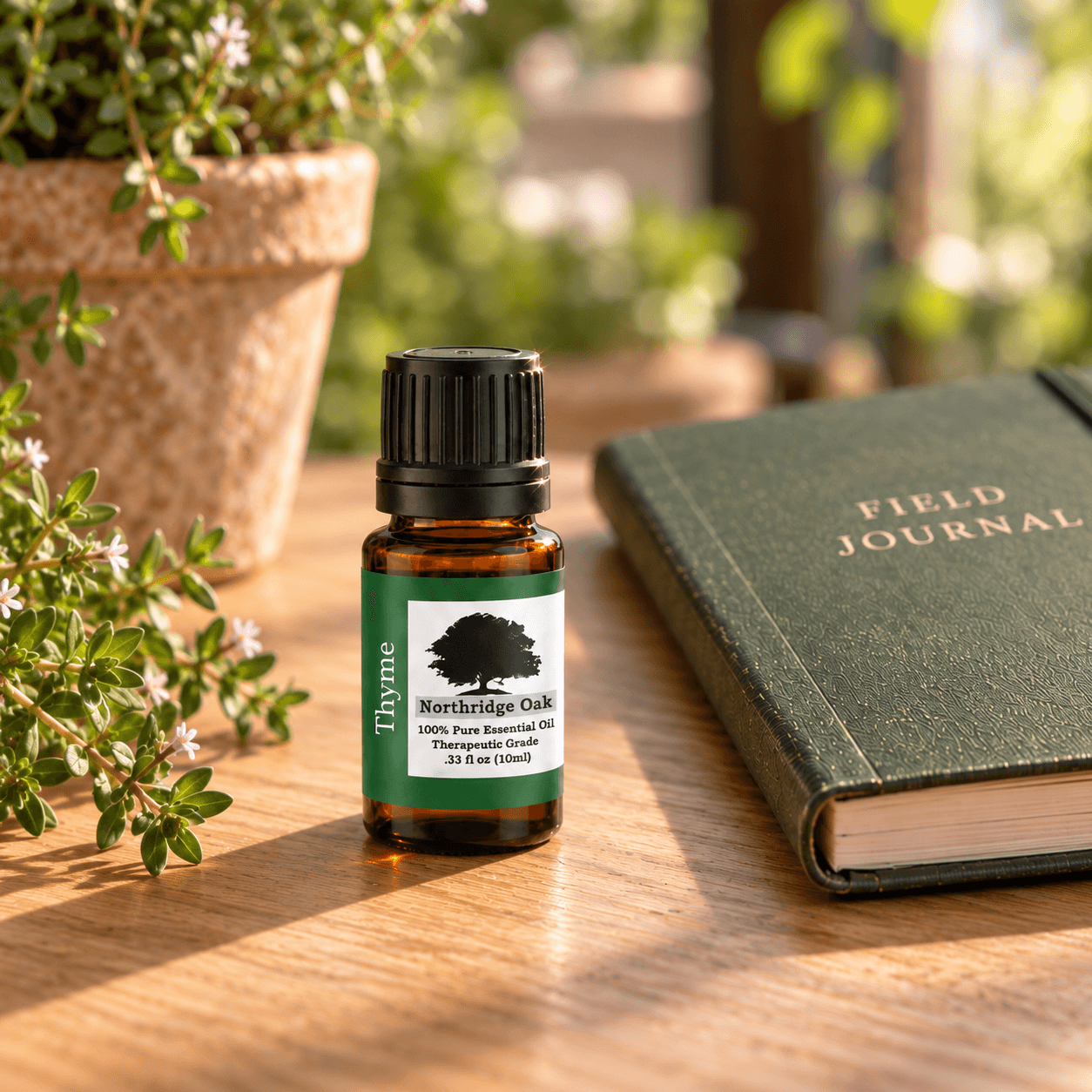
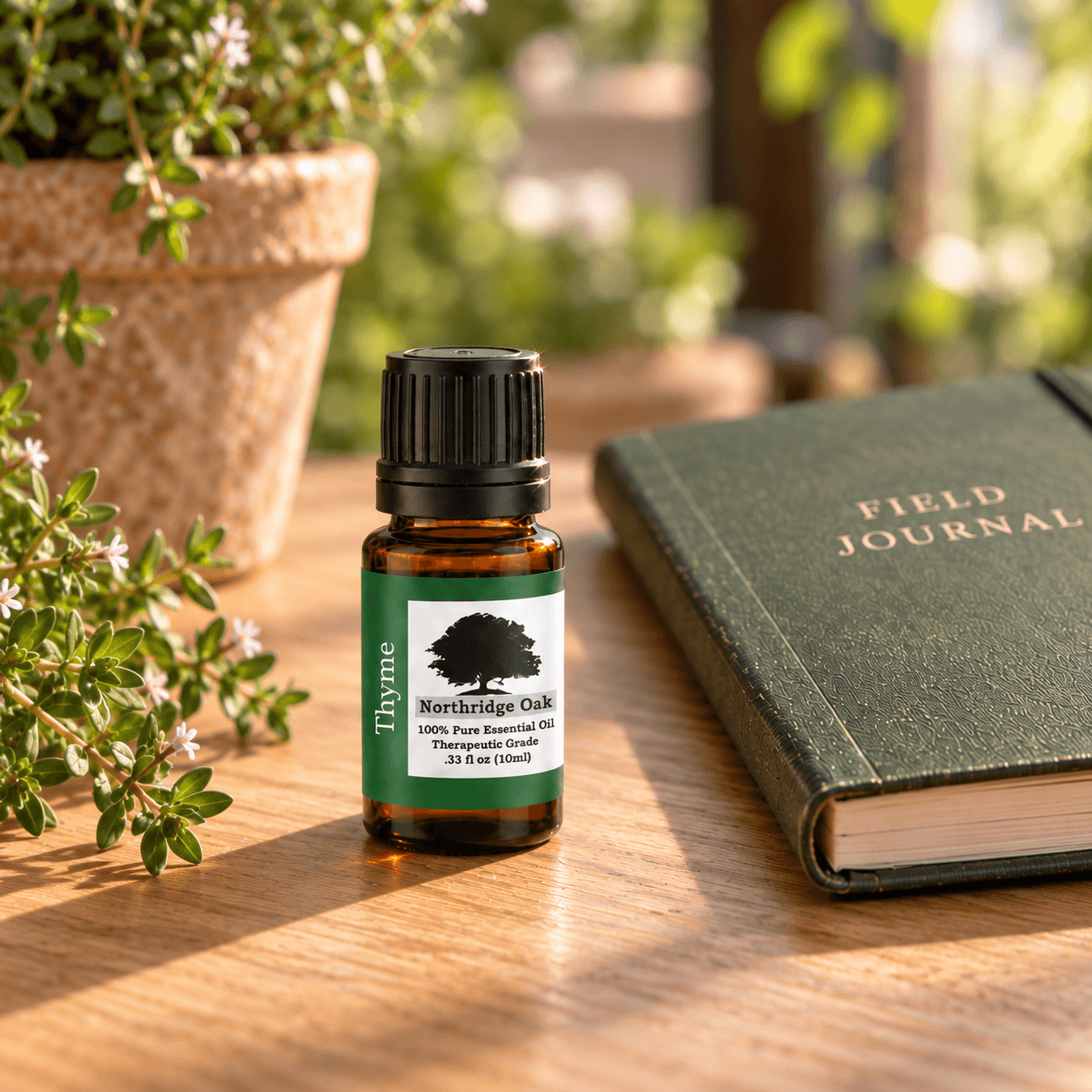
Thyme Essential Oil benefits begin with an aroma that feels clean, confident and unmistakably herbal. Steam-distilled from Thymus vulgaris, this potent oil can add warmth to diffuser blends, character to natural home aromas and an intriguing research story to your essential-oil collection.
Meet Thyme Essential Oil
Thyme has been valued around the Mediterranean for generations as a culinary herb, aromatic plant and household botanical. The essential oil concentrates the plant’s volatile chemistry into a remarkably expressive fragrance. Northridge Oak Thyme originates in Spain and smells herbaceous, warmly spicy, green and lightly medicinal, with a dry finish that blends especially well with citrus, woods and other herbs.
Because Thyme is so aromatic, a little goes a long way. One drop can give a six-drop diffuser blend a fresh herbal center without overwhelming Lavender, Lemon, Rosemary or Cedarwood. This economy is part of the oil’s appeal: a 10 mL bottle supports many months of recipes when used one thoughtful drop at a time.
What makes Thyme distinctive?
Thyme oils can contain different proportions of thymol, carvacrol, linalool, geraniol and other aromatic molecules. These patterns are called chemotypes. Thymol-rich Thyme is bold, warm and phenolic; linalool-rich Thyme is usually softer and more floral. The botanical name alone therefore does not describe every bottle’s complete aroma or best-use profile.
Thymol and carvacrol have attracted extensive laboratory attention because their molecular structures interact with microbial membranes. Reviews of Thyme oil research describe antibacterial, antifungal, antioxidant and anti-inflammatory activity in laboratory systems. These results explain why Thyme appears so often in research on food preservation, cosmetic formulation and environmental hygiene.
What the research genuinely adds
A 2020 review titled Thymol and Thyme Essential Oil—New Insights into Selected Therapeutic Applications gathered research on Thyme and thymol across antimicrobial, respiratory, dermatological and food-related applications. Much of that evidence comes from cells, microbes, formulation studies and animals, so it is most useful for understanding mechanisms and guiding product development.
One especially memorable human study appeared in Archives of Dermatology in 1998. Eighty-six people with alopecia areata were randomized to massage either a carrier-oil mixture or a blend containing Thyme, Rosemary, Lavender and Cedarwood into the scalp daily. Independent photographic assessment found improvement in 44% of the active-blend group compared with 15% of the carrier group. Thyme was one part of a four-oil formula, which makes the study evidence for the complete blend rather than proof for Thyme alone.
Everyday ways to enjoy Thyme
For a bright herbal diffuser blend, combine 1 drop Thyme, 3 drops Lemon and 2 drops Rosemary in a 100 mL diffuser. For an evening woodland blend, use 1 drop Thyme, 3 drops Lavender and 2 drops Cedarwood. Follow the diffuser manufacturer’s instructions and let fresh air circulate.
Thyme also brings a satisfying “freshly tended herb garden” feeling to household aroma recipes. Add 1 drop Thyme and 4 drops Lemon to an unscented cleaning base formulated for the surface you are cleaning. The essential oil supplies aroma; the proven cleaning ingredients in the base perform the cleaning work.
A carefully diluted topical recipe
For an adult massage oil, add 1 drop Thyme and 3 drops Lavender to 30 mL of jojoba or fractionated coconut oil. This creates a gentle total concentration well below a typical 1% blend. Label the bottle, patch test, and use a small amount on intact skin. Thyme’s strength makes low dilution both comfortable and beautifully aromatic.
Quality changes the experience
Authenticity matters with an oil known for variable chemistry. Botanical identity, origin, harvest conditions and distillation influence the final profile. Third-party GC/MS testing provides a chemical fingerprint that helps verify identity and composition. Small-batch bottling then preserves a closer connection between the tested oil and the bottle you receive.
Thoughtful safety supports confident use
Enjoy Thyme in modest amounts, dilute it for topical use and keep it away from eyes and sensitive tissues. Store the bottle securely away from children and pets. Pregnancy, nursing, very young children and complex health needs call for individualized professional guidance. Our Essential Oil Safety Guide explains dilution, diffusion and storage in more depth.
The inviting takeaway
Thyme is an oil for people who enjoy vivid herbal aromas and appreciate ingredients with a serious research history. It can brighten a room, sharpen the character of a blend and inspire recipes that feel fresh, capable and rooted in the garden. Start with one drop beside Lemon or Lavender and discover how easily this powerful note becomes welcoming.
A practical way to begin
Start with three small experiments rather than trying every use at once. On the first day, smell one drop on an aroma strip beside separate strips of Lemon and Lavender. On another day, diffuse one drop Thyme with five drops of a preferred partner. Finally, prepare one low-dilution adult body oil or one contained home-aroma application. This sequence teaches strength, balance and personal preference in a memorable way.
Keep a simple record of the partner oils, drop counts, room size and how the aroma changes after fifteen minutes. Thyme can feel bright with citrus, soft with Lavender and forest-like with Cedarwood. A short notebook quickly reveals which side of the oil belongs in your routine.
Continue learning about Thyme Essential Oil
Make this article part of a complete Thyme routine:
- What Does Thyme Essential Oil Smell Like? Aroma and Chemotypes
- What Blends Well With Thyme Essential Oil?
- Thyme Essential Oil Diffuser Blends
- Thyme Essential Oil for Hair and Scalp
- Thyme Essential Oil for Skin and Acne Research
- Thyme Essential Oil for Cleaning and Home Aromas
- Thyme Essential Oil for Respiratory Aromatherapy
- Does Thyme Oil Repel Fleas and Mosquitoes?
- Thyme Essential Oil, Thymol and Oral-Care Research
- Thyme vs. Oregano Essential Oil
- Thyme Essential Oil Safety
- How Is Thyme Oil Made?
Bring the warm herbal character of Thyme home
Northridge Oak Thyme Essential Oil is 100% pure, undiluted, bottled in small batches and third-party GC/MS tested. Its confident herbaceous aroma means a single drop can transform a diffuser recipe, cleaning blend or thoughtfully diluted topical formula.
These statements have not been evaluated by the Food and Drug Administration. Northridge Oak products are not intended to diagnose, treat, cure or prevent disease.