Table of Contents
- Botanical identity
- Aroma side by side
- Thymol and carvacrol
- Which blends more easily?
- Try the difference in two diffuser blends
- Natural home aromas
- Topical formulation
- How research differs from home use
- Which bottle should you choose?
- A useful sensory test
- The comparison takeaway
- Compare their best blending partners
- Compare their role in a collection
- Try a blind aroma exercise
- Why testing adds clarity
- Try each oil in the same formula
- Use the comparison to shop intentionally
- Continue learning about Thyme Essential Oil
- Explore Thyme with confidence
- Frequently Asked Questions
Thyme vs. Oregano Essential Oil is a comparison of two bold Mediterranean herbs with overlapping chemistry and very different personalities. Both can smell warm, green and phenolic, yet Thyme often feels drier and more refined while Oregano leans deeper, hotter and more savory.
Botanical identity
Common Thyme essential oil is distilled from Thymus vulgaris. Oregano essential oil is commonly distilled from Origanum vulgare. Both plants belong to the Lamiaceae family, alongside Lavender, Rosemary, Basil, Marjoram and mint.
Aroma side by side
Thyme is strong, herbaceous, warmly spicy and dry. Depending on chemotype, it may have a medicinal thymol note or a softer linalool character. Oregano is usually hot, pungent, peppery and unmistakably savory. It can dominate a blend even more quickly than Thyme.
If you want a bright herb-garden accent for Lemon, Lavender or Rosemary, Thyme is often the easier choice. If you want a bold rustic note that immediately recalls crushed culinary herbs, Oregano supplies greater intensity.
Thymol and carvacrol
Thyme may be rich in thymol, carvacrol, linalool or other constituents depending on chemotype. Oregano oil commonly emphasizes carvacrol, often with thymol and p-cymene. Thymol and carvacrol are structural isomers: they contain the same kinds and numbers of atoms arranged differently.
Both molecules have extensive laboratory antimicrobial research. Their phenolic structures can interact with microbial membranes, which helps explain why Thyme and Oregano are frequently studied in food preservation, animal science, cosmetic formulations and environmental applications.
Which blends more easily?
Thyme usually offers more range in aromatic blending. One drop works with citrus, florals, woods, resins and herbs. Oregano is excellent when a composition intentionally needs a hot savory accent, but it generally calls for even more restraint.
Try the difference in two diffuser blends
Thyme Garden: 1 drop Thyme, 3 drops Lemon and 2 drops Lavender. The result is bright and botanical. Oregano Grove: 1 drop Oregano, 4 drops Lemon and 2 drops Sweet Orange. The result is warmer, sharper and more culinary.
Natural home aromas
Thyme feels at home in kitchen, entryway and workspace blends. Oregano can create a rustic farmhouse atmosphere, particularly with Lemon and Cedarwood. Both oils contribute aroma to cleaning routines while a properly formulated cleaning base does the practical cleaning.
Topical formulation
Both oils are powerful and suit low adult dilution. For a gentle aromatic body oil, choose one—not both—and add 1 drop to 30 mL carrier oil, then add three drops Lavender. Patch test and use on intact skin.
How research differs from home use
Laboratory studies may expose microbes directly to measured concentrations, purified constituents or engineered emulsions. A diffuser or body oil creates a different exposure. Research gives the chemistry context; practical recipes translate the aroma into comfortable everyday use.
Which bottle should you choose?
Choose Thyme for broader blending, an herb-garden atmosphere and recipes where Lemon, Lavender or Rosemary should remain recognizable. Choose Oregano Essential Oil for a hotter, more assertive savory character. Many enthusiasts enjoy owning both because one does not simply duplicate the other.
A useful sensory test
Place one drop of each oil on separate aroma strips. Smell from several inches away immediately, then return after fifteen and thirty minutes. Notice which one feels brighter, drier, warmer or more culinary. Your own aroma preference is valuable information.
The comparison takeaway
Thyme and Oregano share botanical heritage and important phenolic chemistry, yet they play different aromatic roles. Thyme is the versatile herbal accent; Oregano is the bold savory statement. Starting with one drop lets each oil show its character beautifully.
Compare their best blending partners
Thyme pairs especially well with Lavender, Bergamot, Rosemary, Cedarwood and Frankincense. Oregano benefits from generous Lemon, Sweet Orange, Cedarwood or Lavender. Their partners overlap, but Oregano usually needs a larger proportion of softer oil to create the same sense of balance.
Compare their role in a collection
Thyme is a versatile blender that moves from fresh morning diffusion to woodland evening recipes. Oregano is a specialist: a dramatic savory accent for robust home aromas. Someone new to herbal oils may reach for Thyme more often, while an experienced blender may value Oregano’s unmistakable intensity.
Try a blind aroma exercise
Have someone label two aroma strips without identifying them. Smell from a distance and write three words for each. The hotter, more culinary strip is often Oregano; the greener and drier one is often Thyme. Repeat after thirty minutes to compare their dry-down.
Why testing adds clarity
Natural constituent proportions vary. GC/MS data helps explain why one batch smells different from another and supports botanical identity. It makes discussions of thymol, carvacrol and related compounds more concrete than the common name alone.
Try each oil in the same formula
Prepare two separate aroma-strip accords: one drop Thyme with four drops Lemon, and one drop Oregano with four drops Lemon. Comparing them in identical proportions reveals the difference more clearly than smelling unrelated recipes. If the Oregano accord feels too forceful, add two more drops Lemon. The adjustment itself demonstrates why these related oils play different blending roles.
Use the comparison to shop intentionally
If you want one herb oil that crosses easily between citrus diffusion, floral blending and woodland aromas, Thyme offers broad range. If you already own several gentle oils and want one unmistakably bold savory accent, Oregano adds contrast. Choosing by aromatic role is more useful than asking which oil is universally better.
Continue learning about Thyme Essential Oil
Make this article part of a complete Thyme routine:
- Thyme Essential Oil: Benefits, Uses, Research and Safety
- What Does Thyme Essential Oil Smell Like?
- What Blends Well With Thyme?
- Thyme Diffuser Blends
- Thyme for Hair and Scalp
- Thyme for Skin and Acne Research
- Thyme for Cleaning and Home Aromas
- Thyme for Respiratory Aromatherapy
- Thyme Oil for Fleas and Mosquitoes
- Thyme, Thymol and Oral Care
- Thyme Essential Oil Safety
- How Is Thyme Oil Made?
Explore Thyme with confidence
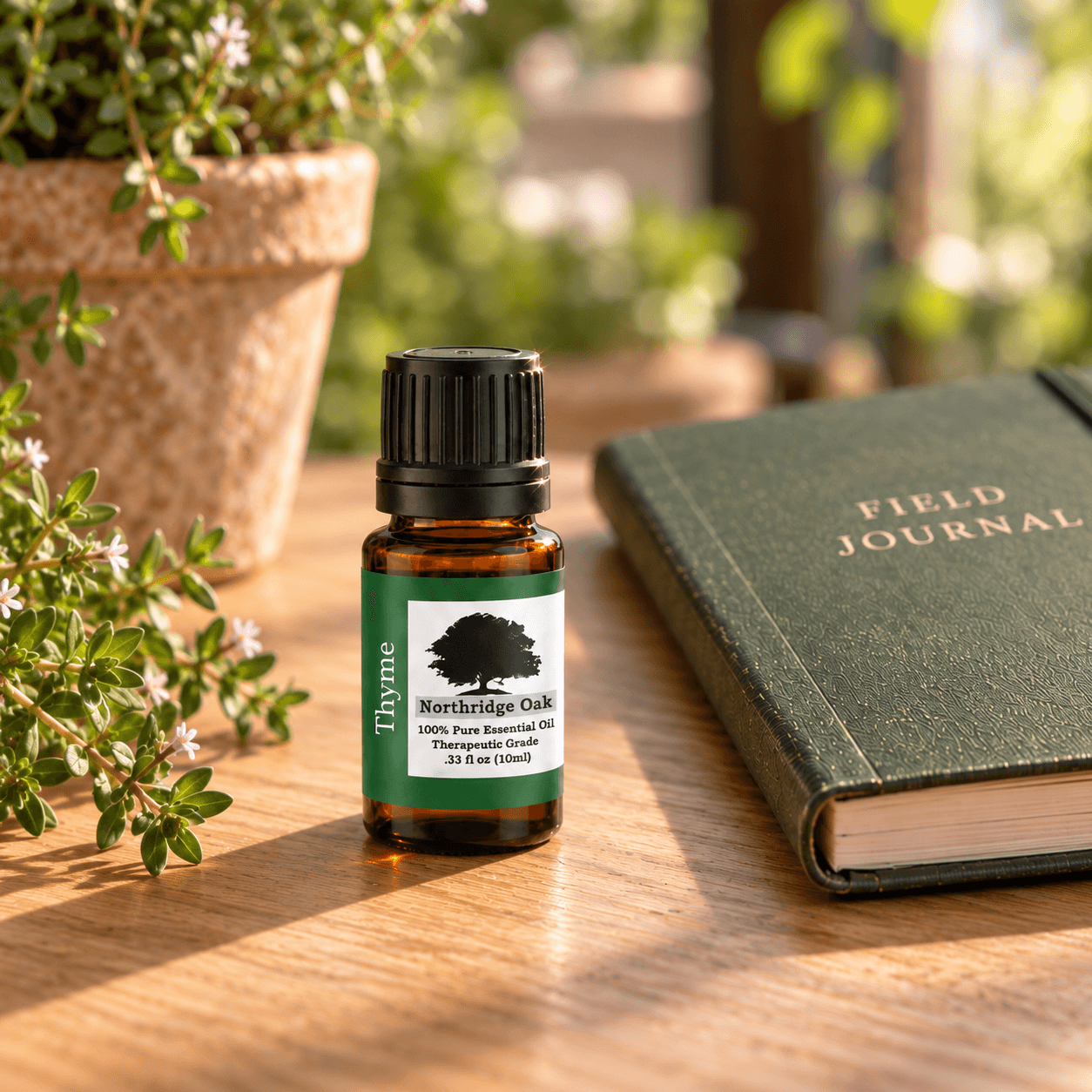
Northridge Oak Thyme Essential Oil is 100% pure, undiluted, bottled in small batches and third-party GC/MS tested. Begin with one drop and let its warm herbal character bring clarity and distinction to the recipe.
These statements have not been evaluated by the Food and Drug Administration. Northridge Oak products are not intended to diagnose, treat, cure or prevent disease.