Table of Contents
- Why chemotype matters
- Read the bottle and testing information
- A practical adult dilution table
- A gentle adult body-oil recipe
- How to patch test
- Comfortable diffusion
- Using Thyme around children
- Using Thyme around pets
- Pregnancy, nursing and health considerations
- Storage and freshness
- What to do after accidental contact
- Confident use is simple use
- Understand the simple dilution math
- Separate total dilution from Thyme’s share
- Write complete labels
- Choose the lowest satisfying amount
- Review the blend before every use
- Continue learning about Thyme Essential Oil
- Explore Thyme with confidence
- Frequently Asked Questions
Thyme Essential Oil safety begins with respecting what makes the oil so useful: it is concentrated, expressive and chemically variable. A single drop can shape an entire blend, so comfortable use depends on modest amounts, thoughtful dilution and knowing which Thyme chemotype is in the bottle.
Why chemotype matters
Thymus vulgaris can produce thymol, carvacrol, linalool, thujanol and other chemotypes. Thymol- and carvacrol-rich oils are typically warmer, stronger and more demanding on skin. Linalool-rich Thyme is usually gentler aromatically, though every concentrated essential oil still deserves careful use.
Read the bottle and testing information
Look for the botanical name, plant part, origin and extraction method. GC/MS testing adds a chemical fingerprint that helps verify composition. This is especially valuable for Thyme because the same species name can represent noticeably different constituent patterns.
A practical adult dilution table
0.25%: approximately 1 drop total essential oil in 20 mL carrier. 0.5%: approximately 1 drop in 10 mL. 1%: approximately 2 drops in 10 mL or 6 drops in 30 mL. Drop size varies, so these are convenient approximations rather than laboratory measurements.
For thymol-rich Thyme, begin at the lowest practical amount. One drop Thyme can be combined with gentler companion oils so it represents only a portion of the total essential-oil concentration.
A gentle adult body-oil recipe
Add 1 drop Thyme, 3 drops Lavender and 2 drops Frankincense to 30 mL jojoba or fractionated coconut oil. This is approximately 1% total essential oil, with Thyme near 0.17%. Label the bottle and patch test before broader use.
How to patch test
Apply a small amount of the finished diluted formula to a limited area of intact skin. Observe the area over the next day before using the blend more broadly. Patch testing helps you evaluate the finished recipe rather than the concentrated oil.
Comfortable diffusion
For a 100 mL diffuser, begin with 1 drop Thyme plus 4 or 5 drops of softer oils such as Lemon or Lavender. Diffuse for a limited period with fresh airflow. Thyme should add an herbal thread, not fill the room with overwhelming intensity.
Using Thyme around children
Children are smaller, breathe more rapidly and may respond differently to strong aromas. Keep use conservative, prioritize ventilation and store bottles and diffusers securely. For infants, very young children or a child with respiratory sensitivities, seek guidance tailored to the child and the specific chemotype.
Using Thyme around pets
Animals have species-specific metabolism and an exceptionally sensitive sense of smell. Use only in a well-ventilated shared room, let the animal leave freely and keep concentrated oil away from fur, paws, bedding, water and food. A personal inhaler for the adult user is often the simplest choice in a pet household.
Pregnancy, nursing and health considerations
These situations call for individualized guidance because chemotype, route and personal history all matter. Share the complete product label and GC/MS information with an appropriately qualified professional rather than relying only on the common name “Thyme.”
Storage and freshness
Close the cap promptly and store the bottle upright away from heat, sunlight and moisture. Label homemade blends with ingredients and date. Oxidation changes aroma and can make topical use less comfortable, so good storage is part of good formulation.
What to do after accidental contact
For eye exposure, ingestion or a significant unexpected reaction, contact Poison Control or appropriate medical services promptly and have the bottle available. For a small skin spill, remove contaminated clothing and wash gently with soap and water.
Confident use is simple use
Thyme does not need to be used heavily to be worthwhile. One measured drop, plenty of carrier or companion oils, clear labeling and good airflow preserve everything appealing about the aroma while keeping the routine easy to understand and repeat.
Understand the simple dilution math
For everyday estimating, a 10 mL bottle of carrier holds roughly 200 drops. Two drops total essential oil in that bottle is approximately 1%. Droppers and viscosity vary, so this is a practical guide rather than analytical measurement.
Separate total dilution from Thyme’s share
Six drops total essential oil in 30 mL carrier is approximately 1%. If only one of those drops is Thyme, Thyme’s individual share is approximately 0.17%. This is a useful way to enjoy a potent oil within a balanced formula.
Write complete labels
Include every ingredient, date, intended user and application. “Thyme Body Oil” is less helpful than “30 mL jojoba: 1 Thyme, 3 Lavender, 2 Frankincense—adult body use.” Clear labels support confident use and make good recipes repeatable.
Choose the lowest satisfying amount
If one drop produces the aroma you want, the formula is complete. This stretches the bottle, keeps diffusion pleasant and simplifies shared-space use. Thyme is an excellent teacher of restraint because its character remains vivid at very low amounts.
Review the blend before every use
Check the label, aroma and appearance, especially when a formula has been stored for several months. Use clean hands or applicators and close the bottle promptly. If the scent has changed markedly or the carrier smells stale, prepare a fresh small batch. Simple review habits support comfort and help ensure that the formula in your hand is still the one you intended to use.
Continue learning about Thyme Essential Oil
Make this article part of a complete Thyme routine:
- Thyme Essential Oil: Benefits, Uses, Research and Safety
- What Does Thyme Essential Oil Smell Like?
- What Blends Well With Thyme?
- Thyme Diffuser Blends
- Thyme for Hair and Scalp
- Thyme for Skin and Acne Research
- Thyme for Cleaning and Home Aromas
- Thyme for Respiratory Aromatherapy
- Thyme Oil for Fleas and Mosquitoes
- Thyme, Thymol and Oral Care
- Thyme vs. Oregano Essential Oil
- How Is Thyme Oil Made?
Explore Thyme with confidence
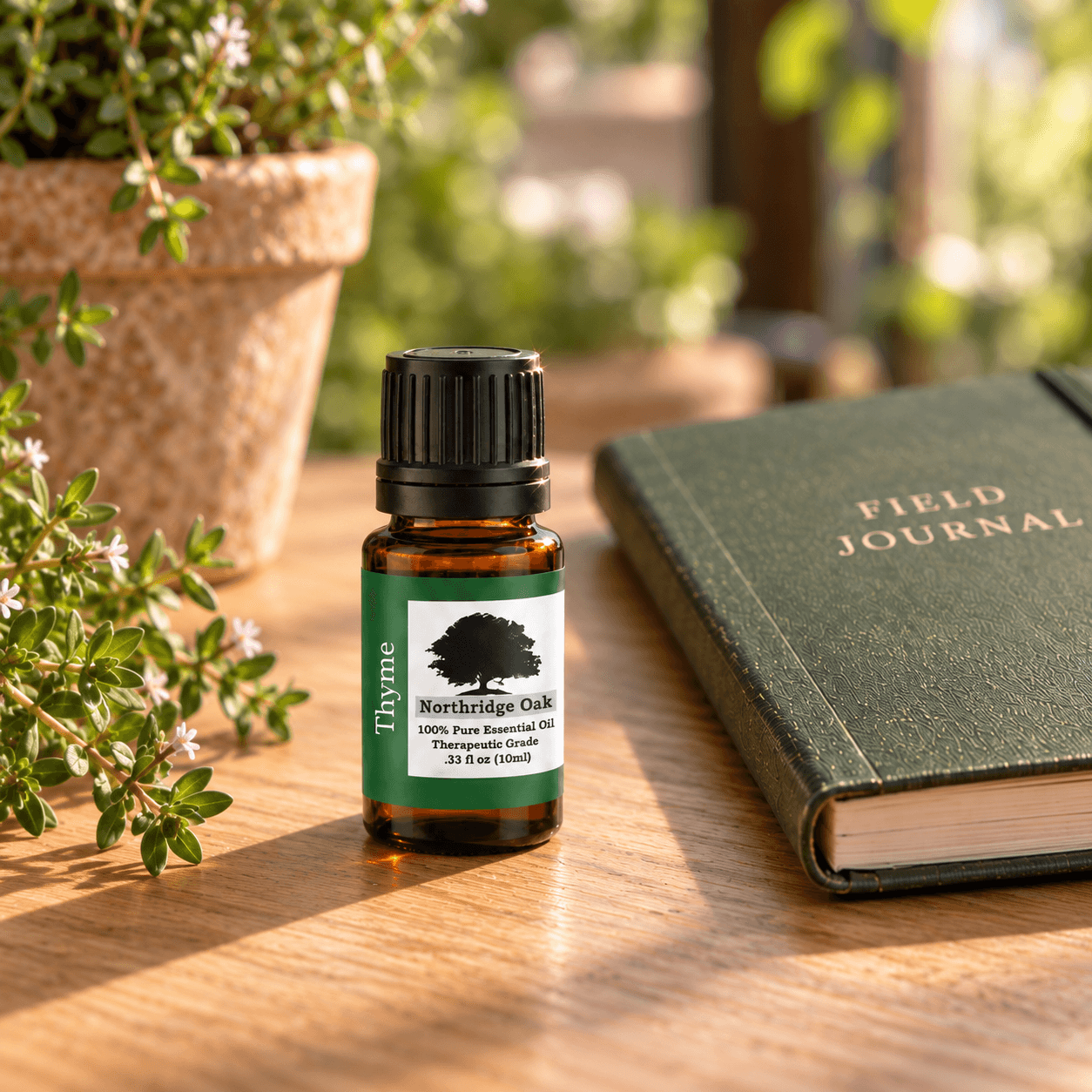
Northridge Oak Thyme Essential Oil is 100% pure, undiluted, bottled in small batches and third-party GC/MS tested. Begin with one drop and let its warm herbal character bring clarity and distinction to the recipe.
These statements have not been evaluated by the Food and Drug Administration. Northridge Oak products are not intended to diagnose, treat, cure or prevent disease.