Table of Contents
- Why Thyme attracts insect researchers
- What mosquito studies found
- What about Thyme Oil for fleas?
- Can Thyme Oil be used on dogs or cats for fleas?
- A fresh outdoor diffuser blend
- A garden-evening aroma blend
- A Thyme-scented home routine
- How to read insect-repellent research confidently
- Where Thyme fits best
- Continue learning about Thyme Essential Oil
- Bring Thyme’s garden character home
- Frequently Asked Questions
Does Thyme Oil repel fleas and mosquitoes? Thyme’s warm herbal aroma comes from active compounds such as thymol, carvacrol and other monoterpenes that researchers have studied for insect-repellent and insecticidal activity. The most useful way to enjoy that research at home is to match the oil to the setting: an outdoor aroma blend is very different from a veterinary flea treatment, and each deserves its own clear guidance.
Why Thyme attracts insect researchers
Thymus vulgaris can produce essential oils rich in thymol, carvacrol, p-cymene, gamma-terpinene and other volatile compounds. These molecules create the oil’s confident herbaceous aroma, and several can also influence insect behavior or survival under controlled laboratory conditions.
A 2020 review of Thyme essential oil and thymol research summarizes antimicrobial, antioxidant and biological activity across many experimental systems. For insect questions, the important detail is that results depend on the species, compound, concentration, delivery system and exposure time. “Thyme oil works on insects” is therefore only the beginning of the story.
What mosquito studies found
One laboratory study published in the Journal of the American Mosquito Control Association compared 38 plant-derived monoterpenes against mosquitoes. The researchers evaluated both fumigant and contact activity. Several naturally occurring compounds associated with aromatic plants showed meaningful activity, helping explain why essential-oil chemistry remains an active area of mosquito-control research. You can read the study record on PubMed.
Later formulation research explored ways to make Thyme essential oil more stable and dispersible. A study available through the National Library of Medicine tested encapsulated and nanoemulsion forms of Thyme oil against mosquito larvae. The formulated oil produced measurable larvicidal activity, and the delivery system affected performance.
That formulation detail matters. A nanoemulsion prepared by researchers is not the same as drops floating in household water. The study supports Thyme as a promising source of insect-active chemistry; it does not turn a homemade water spray into a standardized mosquito-control product.
What about Thyme Oil for fleas?
People searching for Thyme Oil for fleas are often trying to solve one of three problems: fleas on a pet, fleas in carpet or bedding, or a desire for a fresh botanical aroma during home cleaning. Thyme research gives us an interesting chemistry story, but pet flea control requires evidence for the specific flea species, formula, dose and animal.
The most direct published Thyme research is stronger for mosquitoes and certain laboratory or agricultural pests than for treating household flea infestations on dogs or cats. Thymol and related compounds may be biologically active, yet activity in a laboratory dish is not the same as a pet-safe, reliably dosed flea product.
A warm, practical approach is to use Thyme for the part it performs beautifully: creating a crisp herbal atmosphere in an adult-managed space. For fleas on an animal or an active home infestation, pair good housekeeping with guidance from a veterinarian and products labeled for the animal’s species, age and weight.
Can Thyme Oil be used on dogs or cats for fleas?
Keep concentrated Thyme Essential Oil off a pet’s coat, collar, paws and bedding unless a veterinarian who knows the individual animal has approved the exact product and method. Cats and dogs process aromatic compounds differently from people, and cats are especially sensitive to several essential-oil constituents.
This still leaves enjoyable ways to use Thyme in a pet household. Diffuse only in a well-ventilated room where the animal can leave freely, use a modest amount, and store the bottle securely. An adult personal inhaler or aroma strip offers another way to enjoy Thyme without scenting the pet’s immediate environment. Our Thyme Oil Safety Guide explains these choices in more detail.
A fresh outdoor diffuser blend
For a covered patio or screened porch, add 1 drop Thyme, 3 drops Lemon Essential Oil and 2 drops Cedarwood Essential Oil to a 100 mL diffuser. Follow the diffuser manufacturer’s directions and place the unit where children and animals cannot reach it.
This recipe is designed as an inviting outdoor aroma, not as a registered insect repellent. It smells bright, dry and woodsy: Lemon opens the blend, Thyme supplies the herbal center, and Cedarwood gives it a lasting outdoor character.
A garden-evening aroma blend
Combine 1 drop Thyme, 2 drops Lavender Essential Oil, 2 drops Cedarwood and 1 drop Geranium Essential Oil. The result feels softer and more floral while retaining Thyme’s unmistakable garden note.
For more measured recipes, visit our Thyme Oil Diffuser Blends guide and the companion article on what blends well with Thyme Oil.
A Thyme-scented home routine
Vacuuming carpets, laundering washable pet bedding and cleaning the places pets rest can support a complete flea-management plan. Thyme may be added for aroma only when the cleaning product and surface directions allow it. The proven ingredients in the cleaner do the cleaning work.
For a fresh herbal room aroma after cleaning, diffuse 1 drop Thyme with 4 drops Lemon for a short session in an empty, ventilated room. Allow the room to air before pets return. Our Thyme Oil for Cleaning and Home Aromas guide offers additional surface-conscious ideas.
How to read insect-repellent research confidently
Start with the insect species. A mosquito larva, an adult mosquito, a flea and a tick have different biology. Next, look at the test: was the substance applied by contact, released as a vapor or incorporated into an engineered formulation? Finally, check the concentration and time. A result after direct laboratory exposure may inspire product development without describing ordinary diffusion.
This simple framework makes the science more useful. It lets you appreciate Thyme’s researched chemistry while choosing recipes that fit real life.
Where Thyme fits best
Thyme is an excellent choice for people who enjoy a vivid herb-garden aroma and want an oil with a fascinating insect-research story. It pairs especially well with Lemon, Cedarwood, Lavender, Geranium and Rosemary. Because its character is strong, one drop often gives a complete six-drop recipe all the Thyme presence it needs.
If your goal is dependable bite protection, choose an EPA-registered repellent and follow its label. If your goal is a fresh botanical atmosphere for the patio, entryway or post-cleaning routine, Thyme can be a memorable aromatic partner.
Continue learning about Thyme Essential Oil
Make this article part of a complete Thyme routine:
- Thyme Oil Benefits, Uses, Research and Safety
- What Does Thyme Oil Smell Like?
- What Blends Well With Thyme Oil?
- Thyme Oil Diffuser Blends
- Thyme Oil for Hair and Scalp
- Thyme Oil for Skin and Acne
- Thyme Oil for Cleaning and Home Aromas
- Thyme Oil for Respiratory Aromatherapy
- Thyme Oil and Oral-Care Research
- Thyme Oil vs. Oregano Oil
- Thyme Oil Safety
- How Is Thyme Oil Made?
Bring Thyme’s garden character home
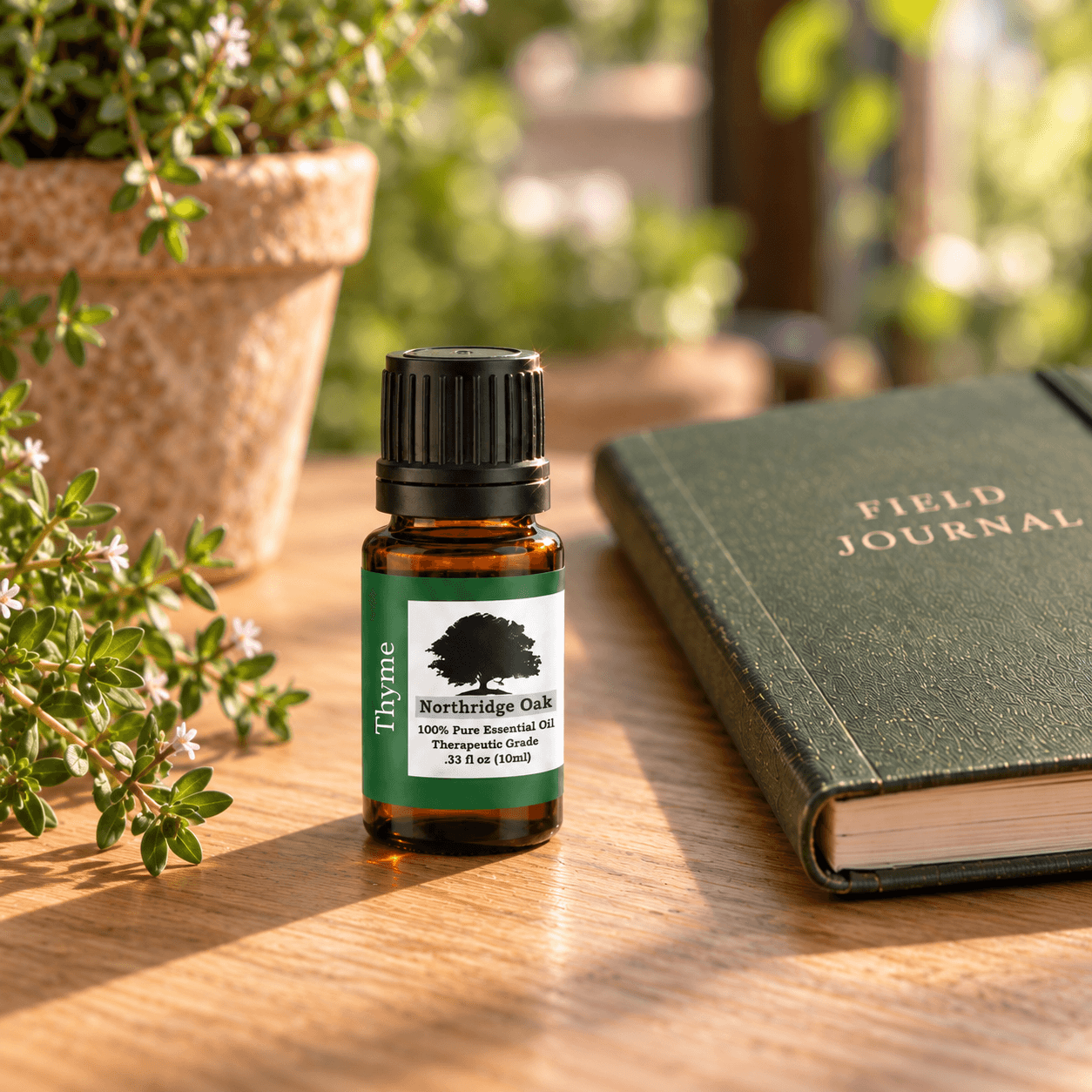
Northridge Oak Thyme Essential Oil is 100% pure, undiluted, bottled in small batches and third-party GC/MS tested. Begin with one measured drop beside Lemon or Cedarwood and enjoy how easily its fresh herbal note turns an ordinary home aroma into something distinctive.
These statements have not been evaluated by the Food and Drug Administration. Northridge Oak products are not intended to diagnose, treat, cure or prevent disease.