Table of Contents
- The short answer: sweet mint with a green finish
- Why carvone matters
- Spearmint versus peppermint scent
- How spearmint behaves in a blend
- Four ways to shape the aroma
- How it smells in different products
- A simple spearmint perfume-oil experiment
- Choosing a spearmint oil that smells true
- Let your nose lead the recipe
- Continue learning about Spearmint Essential Oil
- Frequently Asked Questions
Spearmint essential oil smells sweet, leafy and unmistakably minty, with a softer edge than peppermint and a cheerful herbal finish. Imagine crushing a fresh spearmint leaf between your fingers: the scent is cool and clean, yet rounded enough to feel welcoming rather than sharp.
That approachable aroma is why spearmint slips so naturally into bright morning diffuser blends, fresh-home sprays, garden-inspired soaps and body-care recipes. Understanding its scent also makes blending much easier, because you can choose partners that lift its sweetness, emphasize its green side or give it a warm base.
The short answer: sweet mint with a green finish
On a blotter, spearmint often opens with a lively mint note, then settles into something sweeter and slightly herbal. Some bottles reveal a faint fruity or tea-like quality. It is recognizable without being identical to mint candy, because a natural essential oil carries dozens of aromatic compounds rather than a single flavor impression.
Aroma varies with growing region, harvest timing, plant genetics and distillation. That variation is part of the beauty of botanical materials. A GC/MS report gives a chemical snapshot of the batch, while your nose tells you how those components arrive together as a complete aroma.
Why carvone matters
Carvone is commonly the leading constituent in Mentha spicata essential oil. Its particular form contributes the characteristic spearmint aroma. Limonene and other minor constituents help shape the brighter citrus-like and herbal facets, so the whole oil feels more dimensional than isolated carvone.
Chemistry is especially helpful when comparing mints. Peppermint is typically rich in menthol and menthone, molecules associated with its penetrating, cooling profile. Spearmint generally contains little menthol and centers on carvone. The result is a distinctive aromatic tool with its own sweetness, balance and blending behavior.
Spearmint versus peppermint scent
If peppermint feels brisk and icy, spearmint feels sweet and green. Peppermint can command a blend with a single drop. Spearmint tends to mingle more readily, which makes it friendly for people who want mint freshness without turning every recipe into a peppermint-forward blend.
For a side-by-side sniff, place one drop of each oil on separate paper scent strips and label them. Smell from several inches away, pause, then return after 15 and 45 minutes. The complete peppermint and spearmint comparison explains how their chemistry, recipes and use cases differ.
How spearmint behaves in a blend
Spearmint acts much like a top-to-middle note: it arrives quickly, gives the blend lift and leaves a gentle herbal sweetness behind. Citrus oils make it juicier, florals make it softer, other herbs make it greener and woods give it staying power.
A useful blending method is 3:2:1. Begin with 3 parts of the aroma you want to lead, 2 parts of a supporting oil and 1 part of an accent or base. Make the experiment on a scent strip or in a tiny sample bottle before scaling it into body care.
Four ways to shape the aroma
Bright and sparkling
Combine 3 drops spearmint, 2 drops lemon and 1 drop grapefruit in a 200 mL diffuser. Citrus echoes spearmint’s lively opening and creates a sunny, freshly tidied feeling.
Soft and garden-like
Blend 3 drops spearmint, 2 drops lavender and 1 drop geranium. Lavender rounds the mint while geranium adds a leafy floral note. This is especially pretty in an evening diffuser session.
Herbal and focused
Try 3 drops spearmint, 2 drops rosemary and 1 drop cedarwood. Rosemary strengthens the garden character, and cedarwood provides a calm, dry foundation.
Fresh and airy
Use 3 drops spearmint, 2 drops eucalyptus and 1 drop lemon. This blend suits a shower or a breezy daytime room, with ventilation and sensible diffuser breaks.
How it smells in different products
In a diffuser, spearmint feels airy and immediate. In carrier oil, its aroma becomes rounder and stays closer to the skin. In soap, the clean herbal impression feels familiar. In a room spray, alcohol helps disperse the essential oil and creates a brighter opening than water alone.
The surrounding formula matters. An unscented lotion may reveal spearmint’s leafy side, while a sweet body butter can make it smell almost confectionary. Make small test batches, note the number of drops and smell again the next day before deciding whether to adjust.
A simple spearmint perfume-oil experiment
For a 1% aromatic body oil, combine 1 drop spearmint, 1 drop lavender and 1 drop cedarwood in 1 tablespoon (15 mL) jojoba oil. Roll or dab onto the forearms after patch testing. The opening is sweet mint, the middle is softly floral, and the cedarwood creates a comfortable finish.
This is a body oil rather than a traditional fine fragrance, and its intimacy is part of the appeal. It gives you a personal way to learn how spearmint develops on your skin without needing a complicated formula.
Choosing a spearmint oil that smells true
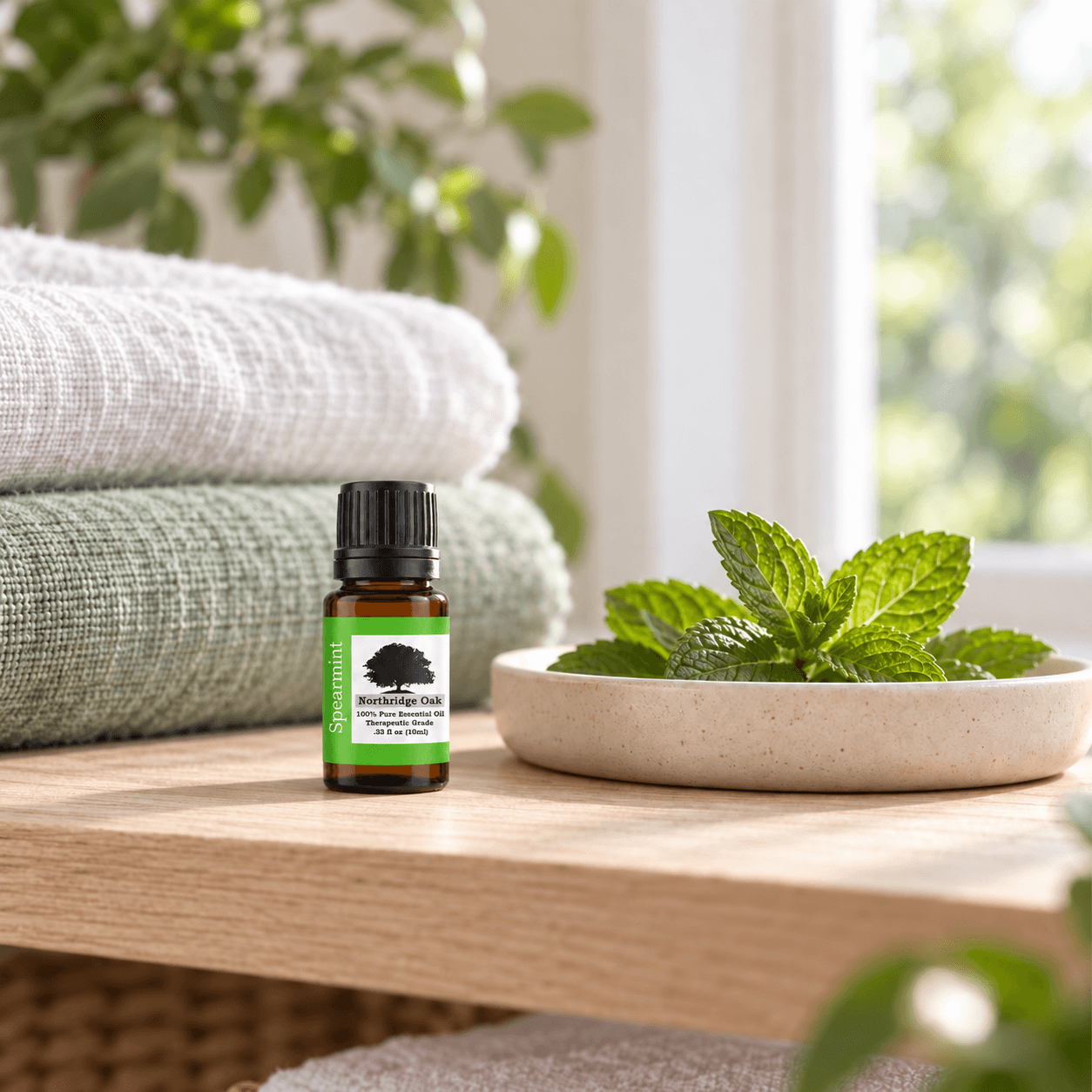
Look for the botanical name Mentha spicata, the extraction method, origin information and access to independent testing. A pure Spearmint Essential Oil delivers its recognizable aroma through the plant’s naturally occurring aromatic compounds. Northridge Oak’s 100% Pure Spearmint Essential Oil is undiluted, third-party GC/MS tested and bottled in a 10 mL size that is easy to explore drop by drop.
Let your nose lead the recipe
Spearmint’s charm is its balance: clearly fresh, gently sweet and green enough to feel botanical. Start with a simple three-oil blend, smell it in stages and write down what you notice. That small ritual turns “What does it smell like?” into a practical blending skill you can use across your whole essential-oil collection.
Continue learning about Spearmint Essential Oil
Make this article part of a complete spearmint routine:
- Spearmint Oil Benefits and Uses: Research, Recipes and Safety
- What Blends Well With Spearmint Oil?
- Spearmint Oil Diffuser Blends: 20 Fresh, Sweet Recipes
- Spearmint Oil for Skin and Acne: What Research Shows
- Spearmint Oil for Facial Hair and PCOS: What Studies Actually Tested
- Spearmint Oil for Hair and Scalp: Benefits, Research and Recipes
- Spearmint Oil for Nausea and Digestive Aromatherapy
- Spearmint Oil for Oral Care and Fresh-Breath Products
- Spearmint Oil for Cleaning and Fresh Home Aromas
- Spearmint Oil Safety: Dilution, Children, Dogs and Cats
- Peppermint vs. Spearmint Essential Oil: What’s Different?
These statements have not been evaluated by the Food and Drug Administration. Northridge Oak products are not intended to diagnose, treat, cure or prevent disease.