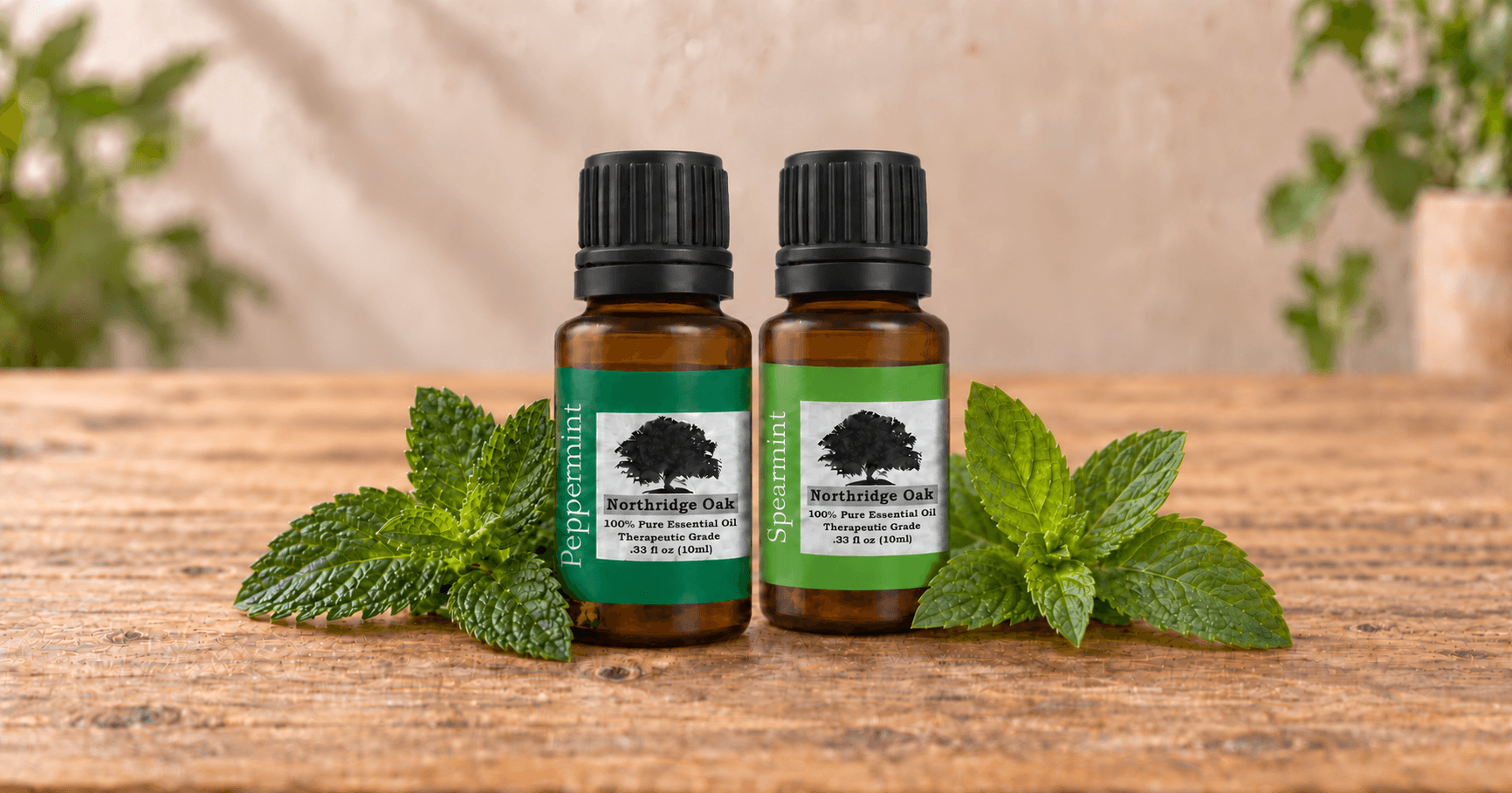
Peppermint and Spearmint are clearly related—both deliver that fresh mint character we love—yet they are delightfully different. Peppermint brings a cool, sharp, menthol-forward brightness. Spearmint offers a sweeter, greener, softer mint that feels gentler and more playful.
100% Pure Spearmint Essential Oil – 10 mL
$14.67
100% Pure Spearmint Essential Oil Bright, sweet and wonderfully fresh, Northridge Oak Spearmint Essential Oil brings the familiar lift of mint with a softer, greener character than Peppermint. Its carvone-rich aroma feels cheerful and refreshing in diffuser blends, personal-care recipes,… read more

Knowing which one to reach for (or how to blend them) opens up a whole new range of aromatic possibilities. The botanical names make the distinction simple and reliable:
- Peppermint: Mentha × piperita
- Spearmint: Mentha spicata
Both oils earn a welcome place in a home collection. The better choice simply depends on the scent, intensity, and project you have in mind.
Quick answer: What’s the real difference?
Peppermint is cooler, sharper, and richer in menthol and menthone. Spearmint is sweeter, greener, and typically higher in carvone. Peppermint usually needs fewer drops and delivers a crisp, penetrating aroma. Spearmint is gentler and easier to use as a main mint note. They can often be blended together for a layered, more interesting mint experience.
Why you’ll love knowing the difference
- Better blends every time – You’ll instantly know when to reach for cool brightness versus soft sweetness.
- Smarter substitutions – No more guessing whether one mint can stand in for the other.
- More creative freedom – Mixing the two creates a richer, more dimensional mint aroma than either alone.
- Confident choices – You’ll match the right oil to the mood, the season, or the specific recipe.
- Greater enjoyment – Understanding the chemistry and character of each mint makes aromatherapy more fun and intentional.
Ready to explore both sides of mint? Try Northridge Oak Peppermint Essential Oil for classic cool brightness and Northridge Oak Spearmint Essential Oil for that sweeter green character. Both are 100% pure, undiluted, and third-party GC/MS tested.
Peppermint vs. Spearmint at a glance
| Feature | Peppermint essential oil | Spearmint essential oil |
|---|---|---|
| Botanical name | Mentha × piperita | Mentha spicata |
| Signature constituent | Commonly menthol and menthone | Commonly carvone |
| Aroma | Cool, sharp, penetrating, familiar | Sweet, green, soft, chewing-gum-like |
| Perceived intensity | Strong; usually needs fewer drops | Gentler; easier to use as a main note |
| Best aromatic role | Crisp accent or fresh lead | Sweet mint heart note |
| Popular pairings | Eucalyptus, Lemon, Rosemary, Frankincense | Lavender, citrus, Basil, Rosemary |
Composition can vary with cultivar, climate, harvest, and distillation, so a GC/MS report always gives the clearest picture of a specific bottle.
The chemistry behind the aroma
A comparative study of mint essential oils found that peppermint is largely characterized by menthol and menthone, while Spearmint oils are typically carvone-rich. That single difference helps explain why peppermint creates such a distinct cool sensation and why Spearmint smells sweeter and less icy.
Chemistry isn’t the only reason we experience aroma the way we do, but it gives us a solid, reliable starting point for choosing and blending.
When to choose peppermint
Reach for Peppermint when you want:
- a strong, instantly recognizable mint aroma
- a cool accent in a citrus or evergreen diffuser blend
- a small amount of mint to brighten a heavier formula
- a menthol-rich oil for a properly diluted adult body or scalp blend
- the specific oil used in published topical tension-headache research
Our pillar guide covers 25 peppermint essential oil uses, and the peppermint dilution chart makes topical formulas easy and consistent.
When to choose spearmint
Choose Spearmint when you want:
- a softer, sweeter mint profile
- a mint-forward aroma without peppermint’s icy intensity
- a playful pairing with citrus or Lavender
- a gentle aromatic bridge between herbs and fruit notes
- fresh variety in your diffuser rotation
Spearmint’s gentler aromatic profile still comes in a highly concentrated essential oil, so measured dilution helps create a comfortable skin-care experience.
Can you substitute one for the other?
For many diffuser blends, yes—with a simple adjustment. When replacing Peppermint with Spearmint, you may want a few extra drops of Spearmint. When replacing Spearmint with Peppermint, start with roughly half as much Peppermint and add one drop at a time until the aroma feels right.
Keep the original oil specified when:
- you are following a research protocol that specifies one species
- the formula relies on menthol’s cooling character
- the safety guidance was written for a particular oil
- the product label requires an exact botanical ingredient
Use the full botanical name as your guide when choosing between mint oils.
Three peppermint and spearmint diffuser blends
Double Mint Morning
- 2 drops Peppermint
- 3 drops Spearmint
- 3 drops Grapefruit
Bright, sweet, and perfect for opening up a room at the start of the day.
Green Garden
- 1 drop Peppermint
- 3 drops Spearmint
- 2 drops Rosemary
- 2 drops Lemon
Herbal and fresh with a crisp citrus finish.
Soft Mint Evening
- 1 drop Peppermint
- 2 drops Spearmint
- 4 drops Lavender
Lavender softens both mints and keeps the peppermint from dominating.
Discover 20 more ideas in our peppermint essential oil diffuser blend collection.
How each mint changes common pairings
With citrus
Peppermint makes Lemon, Grapefruit, or Bergamot feel colder and sharper. Spearmint makes them sweeter and juicier.
With Lavender
Peppermint creates lively contrast—cool mint against soft floral. Spearmint blends into Lavender more smoothly and gently.
With Rosemary
Peppermint and Rosemary produce a bracing, clear herbal profile. Spearmint and Rosemary feel more like a sunny garden.
With woods
Peppermint cuts through Cedarwood or fir with a cool top note. Spearmint softens the transition and adds a green heart.
Topical-use differences
Peppermint’s menthol content delivers the pronounced cool sensation many people enjoy in a scalp, foot, or muscle massage blend. It also requires extra care around eyes, mucous membranes, infants, and young children.
Spearmint is often perceived as less intense, yet it can still irritate skin if used undiluted. Always use an oil-specific safety reference and a measured carrier-oil dilution for either mint.
Frequently asked questions
Are peppermint and spearmint the same plant?
No. Peppermint is Mentha × piperita; Spearmint is Mentha spicata. They are related mint species with distinctly different characteristic chemistry.
Which one contains more menthol?
Peppermint is typically menthol-rich. Spearmint is usually characterized by carvone, while Peppermint typically features more menthol.
Which smells stronger?
Most people experience Peppermint as stronger, cooler, and more penetrating. Spearmint is generally sweeter and softer.
Can I mix peppermint and spearmint together?
Absolutely. They create a lovely layered mint aroma. Let Spearmint provide the sweet body and use fewer drops of Peppermint for the cool accent.
Which is better for a diffuser?
Both work beautifully. Choose Peppermint for an icy, crisp atmosphere and Spearmint for a sweet green mint.
Can I replace peppermint with spearmint in a skin recipe?
Check the guidance for the specific oil and recalculate the entire formula before making a topical substitution.
Which mint was studied for tension-type headache?
Peppermint (Mentha piperita) is the mint species used in the published topical tension-headache research.
How can I verify which mint oil I am buying?
Look for the full botanical name, plant part, extraction method, complete ingredient statement and quality-testing information; these details give you confidence in exactly which mint oil you are buying.
Enjoy both sides of mint
Understanding the difference between these two classic mints makes every blend more intentional and more enjoyable. Whether you love the cool snap of Peppermint, the soft sweetness of Spearmint, or the layered beauty of using them together, you now have a clear map for choosing and combining them with confidence.
Shop Northridge Oak Peppermint Essential Oil and Spearmint Essential Oil to experience both profiles side by side. One 10 mL bottle of each opens up dozens of diffuser blends, topical formulas, and everyday aromatic rituals—all while helping you live the life you love.
Continue your Peppermint Learning Center
Start with the pillar guide to 25 peppermint essential oil uses, DIY recipes, and refreshing aromatherapy, then explore every supporting guide:
- Peppermint essential oil diffuser blends
- Peppermint oil for hair and scalp
- Peppermint essential oil for headaches
- Peppermint essential oil for focus and energy
- Peppermint essential oil cleaning recipes
- Peppermint oil spray for bugs
- DIY peppermint shower steamers
- How to dilute peppermint essential oil
- What blends well with peppermint essential oil
Sources
- Wu et al.: Chemical Composition and Antioxidant Properties of Essential Oils from Peppermint, Native Spearmint, and Scotch Spearmint
- NCCIH: Peppermint Oil—Usefulness and Safety
Essential oils are highly concentrated. Always follow appropriate usage and dilution guidance for each individual oil. Some oils require additional precautions, so familiarize yourself with an oil’s safety information before use. Keep essential oils out of reach of children and pets.
These statements have not been evaluated by the Food and Drug Administration. This content is for educational purposes and is not intended to diagnose, treat, cure, or prevent any disease.
Continue learning about Spearmint Essential Oil
Make this comparison part of a complete spearmint routine:
- Spearmint Oil Benefits and Uses: Research, Recipes and Safety
- What Does Spearmint Oil Smell Like?
- What Blends Well With Spearmint Oil?
- Spearmint Oil Diffuser Blends
- Spearmint Oil for Skin and Acne
- Spearmint Oil for Facial Hair and PCOS
- Spearmint Oil for Hair and Scalp
- Spearmint Oil for Nausea and Digestive Aromatherapy
- Spearmint Oil for Oral Care
- Spearmint Oil for Cleaning and Fresh Home Aromas
- Spearmint Oil Safety
Frequently Asked Questions
Are peppermint and spearmint the same plant?
No. Peppermint is Mentha × piperita; Spearmint is Mentha spicata. They are related mint species with distinctly different characteristic chemistry.
Which one contains more menthol?
Peppermint is typically menthol-rich. Spearmint is usually characterized by carvone rather than menthol.
Which smells stronger?
Most people experience Peppermint as stronger, cooler, and more penetrating. Spearmint is generally sweeter and softer.
Can I mix peppermint and spearmint together?
Absolutely. They create a lovely layered mint aroma. Let Spearmint provide the sweet body and use fewer drops of Peppermint for the cool accent.
Which is better for a diffuser?
Both work beautifully. Choose Peppermint for an icy, crisp atmosphere and Spearmint for a sweet green mint.
Can I replace peppermint with spearmint in a skin recipe?
Do not assume equal safety or function. Check guidance for the specific oil and recalculate the entire formula before substituting.
Which mint was studied for tension-type headache?
The published topical research involved Peppermint (Mentha piperita) preparations, not Spearmint.
How can I verify which mint oil I am buying?
Look for the full botanical name, plant part, extraction method, complete ingredient statement, and quality-testing information rather than relying only on a front-label name.