Table of Contents
- TRY FRANKINCENSE FOR YOURSELF—GET A FREE BOTTLE
- The Quick Frankincense Buying Checklist
- 1. Look for the Full Botanical Name
- 2. Confirm the Oil Comes From Frankincense Resin
- 3. Verify the Extraction Method
- 4. Understand What “100% Pure” Should Mean
- 5. Look for GC-MS Testing
- 6. Know What GC-MS Does Not Prove by Itself
- 7. Examine the Product Label and Description
- 8. Do Not Judge Quality by Price Alone
- 9. Do Not Judge Purity by Aroma Alone
- 10. Consider Freshness and Storage
- Common Frankincense Buying Red Flags
- Questions to Ask an Essential-Oil Company
- Why Choose Northridge Oak Frankincense Essential Oil?
- Put Your Frankincense to Work
- Frequently Asked Questions
- What is the best Frankincense Essential Oil?
- How can I tell if Frankincense Essential Oil is real?
- What color should pure Frankincense Essential Oil be?
- Should Frankincense Essential Oil contain boswellic acids?
- Is organic Frankincense automatically better?
- Is expensive Frankincense always higher quality?
- Is Frankincense fragrance oil the same as essential oil?
- Does GC-MS testing guarantee that an oil is pure?
- Which species does Northridge Oak sell?
- Choose Clarity Over Hype
- Research and Regulatory References
- FAQs
The best Frankincense Essential Oil is not necessarily the bottle with the fanciest label, the highest price or the boldest promises.
TRY FRANKINCENSE FOR YOURSELF—GET A FREE BOTTLE
Ready to experience frankincense for yourself? Claim your FREE bottle of Northridge Oak Frankincense Essential Oil—just pay shipping. You’ll also get access to our Frankincense Oil Uses guide, packed with DIY recipes and diffuser blends.
It is the bottle that tells you exactly what it is—and gives you meaningful reasons to trust what is inside.
Frankincense is one of the world's most treasured aromatic materials. Its resin has traveled ancient trade routes, perfumed homes and sacred spaces, appeared in beauty rituals and remained part of traditional practices for thousands of years.
That history gives the name “Frankincense” enormous value. Unfortunately, it also creates opportunities for vague labeling, dilution, substitution and adulteration.
A bottle may contain genuine steam-distilled Frankincense Essential Oil. Another may contain a fragrance blend, an infused carrier oil, a mixture of Boswellia species or essential oil stretched with cheaper materials. From the front label alone, they can look surprisingly similar.
This guide shows you how to look beyond marketing and choose pure, high-quality Frankincense Essential Oil with confidence.
The Quick Frankincense Buying Checklist
| What to check | What you want to see |
|---|---|
| Botanical name | A clearly identified Boswellia species, such as Boswellia serrata |
| Source material | Frankincense resin or oleo-gum-resin |
| Extraction method | Steam-distilled or hydrodistilled essential oil |
| Ingredient clarity | Frankincense Essential Oil without undisclosed carrier oil or synthetic fragrance |
| Testing | Batch-specific GC-MS testing interpreted against the declared species |
| Testing independence | Third-party analysis rather than relying only on an internal statement |
| Company transparency | Clear product details, contact information and realistic usage guidance |
| Packaging | Tightly sealed dark glass that protects the oil from light |
| Freshness | Proper storage and an aroma consistent with fresh Frankincense |
| Claims | Specific, educational language rather than miracle promises |
If a seller does not tell you the species, extraction method or whether the product is diluted, you do not have enough information to make a confident comparison.
1. Look for the Full Botanical Name
“Frankincense” is not one tree. It is a family of aromatic resins produced by multiple species in the Boswellia genus.
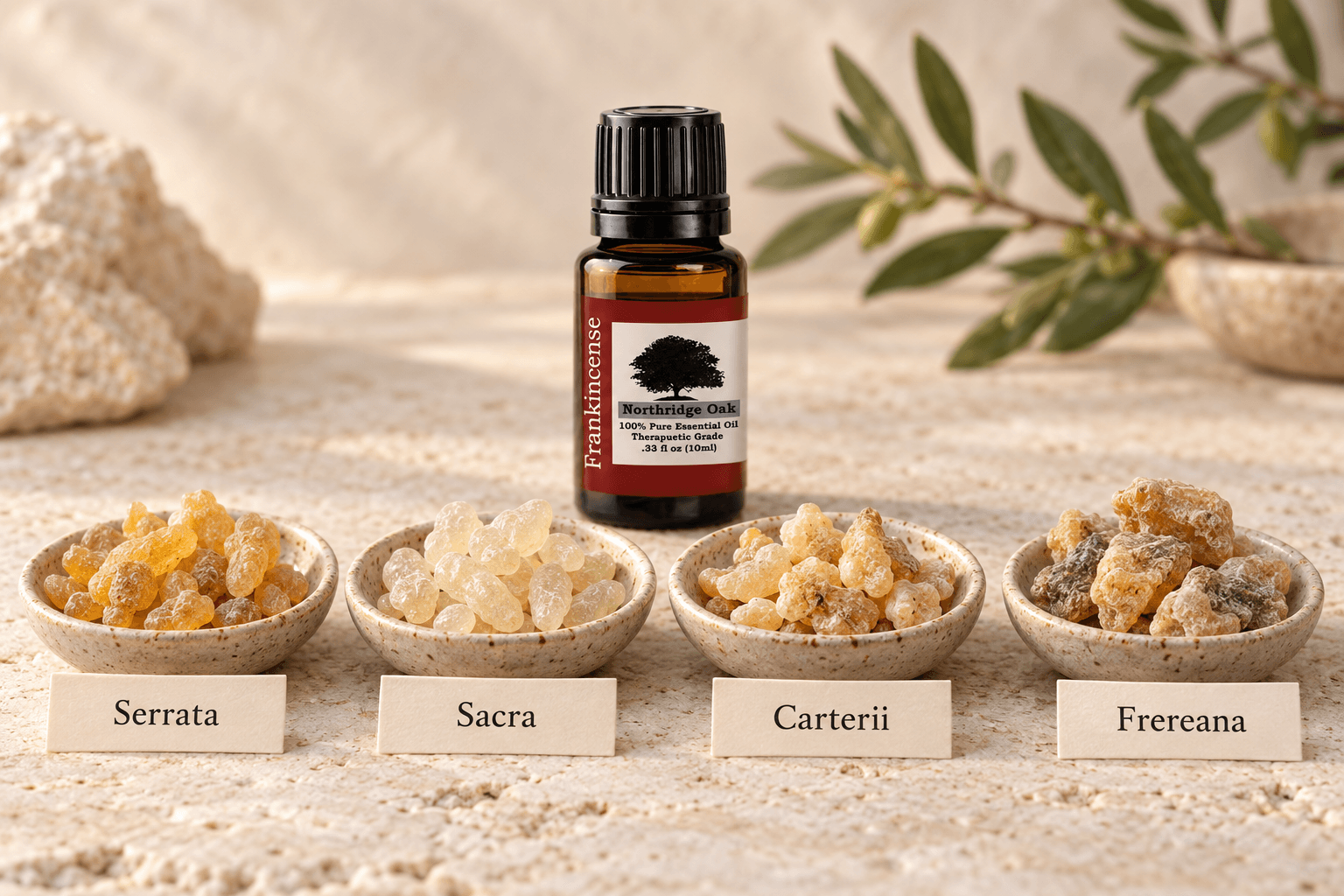
Common commercial species include:
Boswellia serrata
Boswellia sacra
Boswellia carteri or carterii
Boswellia frereana
Boswellia papyrifera
Boswellia rivae
Each can produce genuine Frankincense Essential Oil, but their aromas and natural chemical profiles are not identical.
The botanical name matters because it gives the supplier, testing laboratory and customer a more precise identity than the word “Frankincense” alone.
Northridge Oak Frankincense Essential Oil is clearly identified as Boswellia serrata.
Is One Frankincense Species the Best?
There is no single species that is universally best for every person.
Boswellia serrata is an excellent choice if you enjoy a warm, earthy, resinous and versatile aroma. It works beautifully in diffuser blends, facial and body oils, massage blends, rollers and natural perfume.
Boswellia sacra/carterii oils are often brighter and more pine-like. Boswellia frereana may appeal to someone seeking a distinctive Somali Frankincense with a dry, bright resinous character.
The best species is the one that fits the aromatic experience you want—provided the oil is pure, fresh and correctly identified.
Compare them in our guide to the different types of Frankincense.
2. Confirm the Oil Comes From Frankincense Resin
Frankincense Essential Oil is normally distilled from the aromatic resin or oleo-gum-resin of a Boswellia tree.
The resin begins as a milky exudate that emerges through carefully made incisions in the bark. It hardens into fragrant tears, which can then be sorted, traded, burned as incense or distilled.
A trustworthy product description should identify the source material. This helps distinguish true essential oil from other products marketed under similar names.
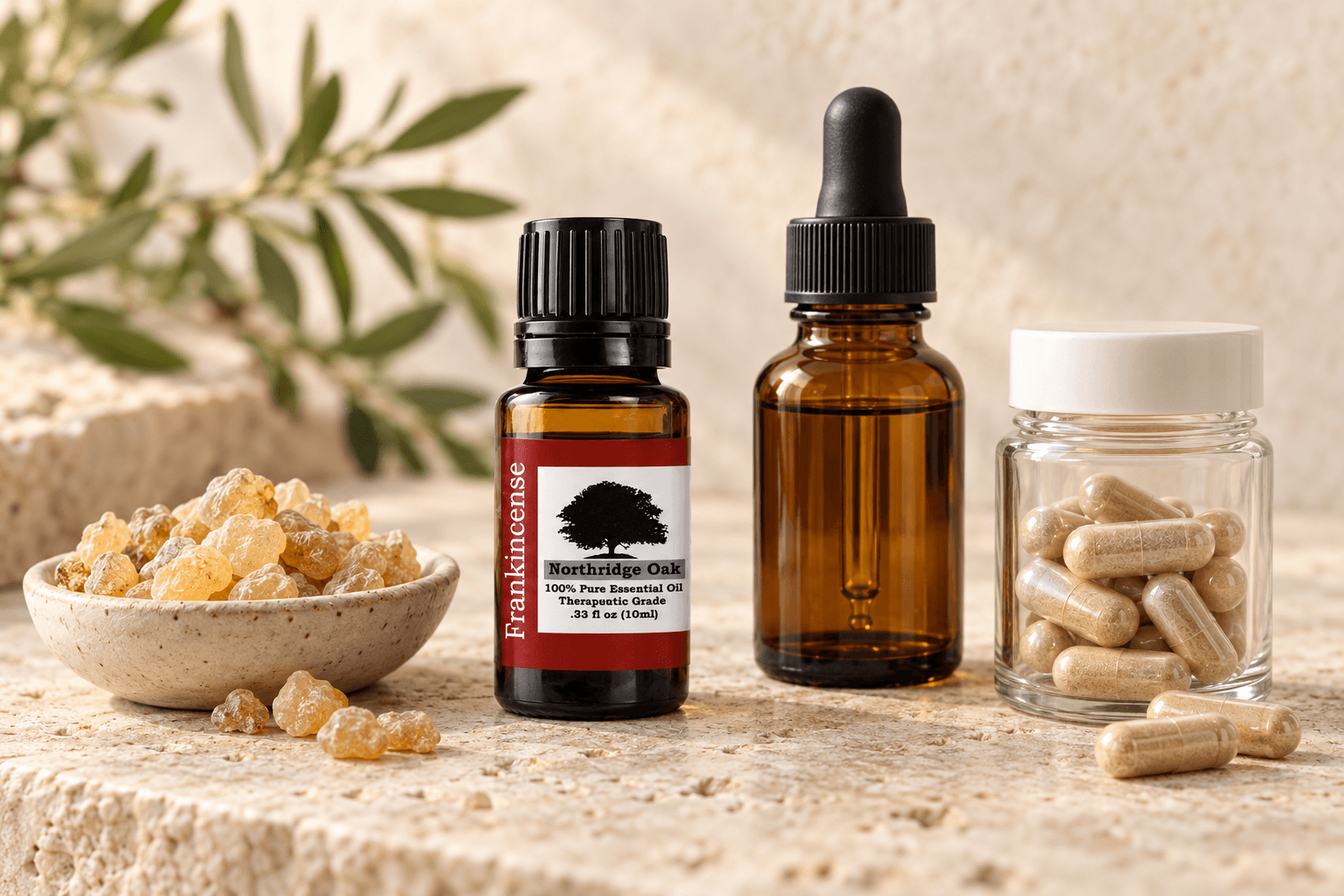
Frankincense Essential Oil Is Not the Same As…
Frankincense Fragrance Oil
Fragrance oil is a formulated aromatic product. It may contain synthetic fragrance ingredients, natural aromatic materials or both. A skilled perfumer can make a beautiful Frankincense fragrance, but it is not the same thing as essential oil distilled from Boswellia resin.
Frankincense-Infused Oil
An infused oil is created by placing resin or another botanical material in a carrier oil. The finished product is primarily the carrier oil and will not have the same composition or concentration as steam-distilled essential oil.
Boswellia Extract
An extract uses a selected process or solvent to concentrate particular compounds from the resin. Some extracts are standardized for boswellic acids and used in dietary supplements or research.
Boswellic acids are nonvolatile. They do not pass into steam-distilled Frankincense Essential Oil in meaningful amounts. That does not make the essential oil incomplete; it means the distillate and extract capture different parts of the resin.
Whole Frankincense Resin
Resin tears are the original harvested material. They retain volatile and nonvolatile components and are commonly used as incense or in traditional preparations. Essential oil captures the volatile aromatic fraction in a convenient liquid form.
Read the full explanation in Frankincense Essential Oil vs. Resin, Extract and Supplements.
3. Verify the Extraction Method
Pure Frankincense Essential Oil is commonly produced by steam distillation or hydrodistillation of the resin.
During steam distillation, heat and water vapor carry the resin's volatile aromatic molecules into a condenser. As the vapor cools, the essential oil separates from the aromatic water.
The extraction method matters because “Frankincense oil” can be used loosely in the marketplace. A seller should be able to tell you whether the product is:
Steam-distilled essential oil
Hydrodistilled essential oil
Solvent extract
CO2 extract
Resin infusion
Fragrance composition
Pre-diluted essential-oil blend
These products can each have legitimate purposes. The problem arises when they are presented as though they are interchangeable.
Northridge Oak Frankincense is steam-distilled from Boswellia serrata resin.
4. Understand What “100% Pure” Should Mean
For a single essential oil, “100% pure” should mean the bottle contains only the declared essential oil:
No carrier oil
No cheaper essential oil added to stretch it
No synthetic fragrance
No isolated aroma chemical added to imitate a desirable profile
No undisclosed resin extract
No filler
Purity is not the same as quality. An oil can be genuine but poorly stored, oxidized or distilled from low-quality material. Conversely, an oil can smell pleasant and still be adulterated.
That is why “100% pure” should be supported by responsible sourcing, clear identity and testing—not treated as proof by itself.
What About “Therapeutic Grade”?
“Therapeutic grade” is widely used in the essential-oil industry to communicate a company's quality standard. It is not, by itself, a universal government certification or a substitute for botanical identification and batch analysis.
Rather than relying on one phrase, look at the entire quality system:
Does the company identify the botanical species?
Does it disclose the extraction method?
Is the oil tested?
Is the testing relevant to the individual batch?
Does the company give clear and realistic usage guidance?
A meaningful quality promise should be visible in the details.
5. Look for GC-MS Testing
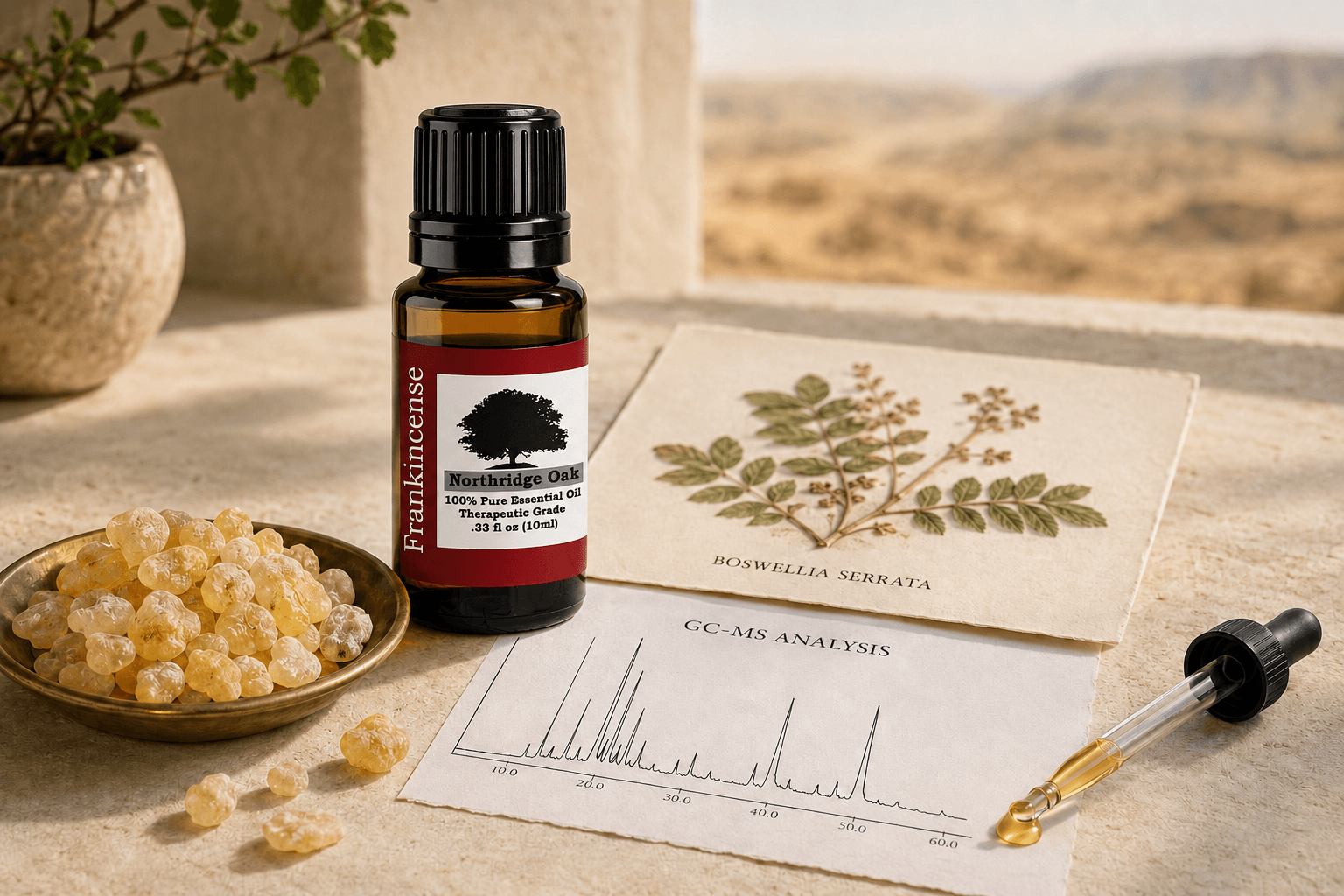
GC-MS stands for gas chromatography–mass spectrometry. It is one of the most useful analytical tools for examining essential-oil composition.
What Gas Chromatography Does
Gas chromatography separates the volatile compounds in an essential-oil sample. As the components move through the instrument, they emerge at different times and create peaks in a chromatogram.
What Mass Spectrometry Does
Mass spectrometry examines the mass pattern of each separated compound. That information helps analysts identify the substances associated with the peaks.
Together, GC-MS can produce a detailed picture of the oil's volatile chemical profile.
Why GC-MS Matters for Frankincense
Frankincense species naturally have different chemical patterns. A knowledgeable analyst can compare the tested profile with the expected range for the declared botanical material and investigate unexpected peaks, unusual concentrations or possible contamination.
The value is not theoretical. A 2022 study examined 21 commercial samples sold as Boswellia carteri essential oil. Researchers reported several forms of adulteration or contamination, including synthetic limonene, castor oil, synthetic octyl acetate, other plant materials, phthalates and substituted or mixed Boswellia species.
The study also used chiral GC-MS, which examines the orientation of certain molecules and can provide additional information when natural and synthetic materials appear chemically similar on a standard analysis.
The lesson is simple: Frankincense authenticity cannot always be determined by smell or label alone.
Why Third-Party Testing Is Valuable
Third-party testing places the analysis in the hands of a laboratory outside the company selling the product. It gives the quality process an additional layer of independence.
Northridge Oak sends every batch of Frankincense Essential Oil for third-party GC-MS testing to help verify identity, purity and chemical composition.
6. Know What GC-MS Does Not Prove by Itself
GC-MS is powerful, but a quality decision should not be reduced to the presence of a report or the phrase “GC-MS tested.”
The usefulness of the result depends on:
Whether the sample actually came from the batch being sold
The condition of the testing instrument
The analytical method used
The compounds and ranges used for comparison
Whether the declared species was considered
The knowledge and judgment of the person interpreting the data
Whether additional techniques are needed for a sophisticated authenticity question
Some forms of adulteration can be difficult to detect with a basic GC-MS screen alone. Chiral analysis, isotope-ratio testing, physical measurements or other methods may sometimes be useful.
Testing is best understood as part of a larger system that includes responsible sourcing, supplier relationships, botanical identification, batch tracking, appropriate packaging and informed interpretation.
7. Examine the Product Label and Description
A high-quality oil should not make you guess.
Look for:
Common name: Frankincense Essential Oil
Botanical name: for example, Boswellia serrata
Net amount: such as 10 mL
Extraction method
Plant material: resin or oleo-gum-resin
Whether the product is diluted
Lot or batch identification when applicable
Company name and contact information
Appropriate directions and precautions
The website description should provide more context than the bottle can hold, including origin, aroma, suggested uses, quality information and internal links to educational resources.
8. Do Not Judge Quality by Price Alone
Real Frankincense Essential Oil requires resin, skilled harvesting, transport, distillation, testing, packaging and responsible storage. A price that seems impossibly low deserves closer examination.
However, the highest price does not guarantee the best oil.
Price can be affected by:
Species
Resin grade and availability
Country of origin
Harvest size
Supply-chain length
Distillation yield
Organic certification
Packaging
Testing costs
Brand positioning
Retail markup
Use price as one clue, not as proof. A transparent, fairly priced oil with clear botanical identity and testing is a stronger choice than an expensive mystery bottle.
9. Do Not Judge Purity by Aroma Alone
Aroma is essential to the experience—but it is not a laboratory test.
Natural Frankincense varies. Two authentic batches from the same species can smell different because of:
Growing region
Rainfall and temperature
Soil
Individual tree chemistry
Harvest timing
Resin age and grade
Distillation conditions
Storage
A synthetic or adulterated oil can also be engineered to smell appealing, especially during a quick first impression.
Use your nose to decide whether you enjoy the oil. Use identity, testing and transparency to evaluate whether you trust it.
How to Evaluate the Aroma
Place one drop on a fragrance-testing strip or unscented cotton ball. Smell it at four points:
Immediately
After 15 minutes
After one hour
The following day
A genuine natural oil should develop rather than smell flat and identical at every stage. You may notice a brighter opening, a warm resinous heart and a softer woody finish.
This exercise is excellent for understanding the oil, but it cannot prove purity.
10. Consider Freshness and Storage
Even an excellent oil can deteriorate if it is exposed to too much oxygen, heat, moisture or light.
Look for dark amber or another protective glass bottle with a secure cap. Store Frankincense:
Tightly closed
Away from sunny windows
Away from hot vehicles
Away from steamy bathrooms
In a cool, dry cabinet
Out of reach of children and pets
As you use the bottle, oxygen gradually replaces the oil in the headspace. Buying a size you can reasonably use helps keep the oil from sitting half-empty for years.
Signs an Oil May Have Changed
Pay attention if the oil develops:
A noticeably harsher or stale aroma
Unexpected cloudiness or sediment not previously present
A dramatic change in consistency
A damaged cap or loose seal
Evidence that water entered the bottle
Natural batch variation is normal, so a difference between two bottles does not automatically mean a problem. The concern is a substantial change within the same bottle over time.
Common Frankincense Buying Red Flags
| Red flag | Why it matters |
| No botanical species listed | You cannot tell which Frankincense the seller claims to offer |
| No extraction method | The product may be an infusion, extract or fragrance rather than essential oil |
| “For external use” but no dilution clarity | The bottle may already contain carrier oil without saying so plainly |
| Miracle or guaranteed results | Strong promises can distract from basic identity and quality information |
| Clear plastic packaging | Light and certain packaging materials may affect long-term quality |
| No company contact information | It may be difficult to ask questions or report a concern |
| Extremely low price with no explanation | The economics may not match authentic sourcing, distillation and testing |
| “GC-MS tested” without species or batch context | Testing language is more useful when it is tied to a clearly identified oil |
| “Frankincense fragrance oil” presented as equivalent | A fragrance composition is not the same as steam-distilled essential oil |
| Claims that essential oil is rich in boswellic acids | Boswellic acids are nonvolatile and do not meaningfully transfer through steam distillation |
Questions to Ask an Essential-Oil Company
You do not need to become a chemist to purchase a good oil. Ask a few straightforward questions:
What is the full botanical species?
Which plant material was distilled?
How was the oil extracted?
Is it undiluted?
Is the oil batch tested?
Who performs or interprets the testing?
How should the oil be stored?
What usage and dilution guidance does the company provide?
A trustworthy company should be able to answer without hiding behind vague marketing language.
Why Choose Northridge Oak Frankincense Essential Oil?
We believe an essential oil should earn your trust through clarity.
Northridge Oak Frankincense Essential Oil is:
Clearly identified as Boswellia serrata
Steam-distilled from Frankincense resin
100% pure and undiluted
Made without fillers or synthetic fragrance
Third-party GC-MS tested by batch
Bottled in the USA
Supported by practical education, recipes and safety guidance
Its warm, earthy and resinous aroma works beautifully for daily diffusion, meditation, natural perfume, massage and skincare.
We also want you to understand what you are purchasing. That is why our Frankincense educational collection covers:
You should never have to purchase an oil first and figure out what it is later.
Put Your Frankincense to Work
Once you choose a quality bottle, begin with these simple uses.
Diffuse It by Itself
Add 5 to 7 drops to your diffuser, adjusting for its size and manufacturer instructions. This is the easiest way to learn the oil's complete aroma.
Make a Warm Citrus Blend
4 drops Frankincense
3 drops Blood Orange
2 drops Lavender
The citrus brightens Frankincense while Lavender softens its warm resinous character.
Make a Simple Facial Oil
1 fluid ounce jojoba oil
3 drops Frankincense Essential Oil
Combine in a clean, dry dropper bottle. Apply one or two drops to slightly damp skin, avoiding the immediate eye area.
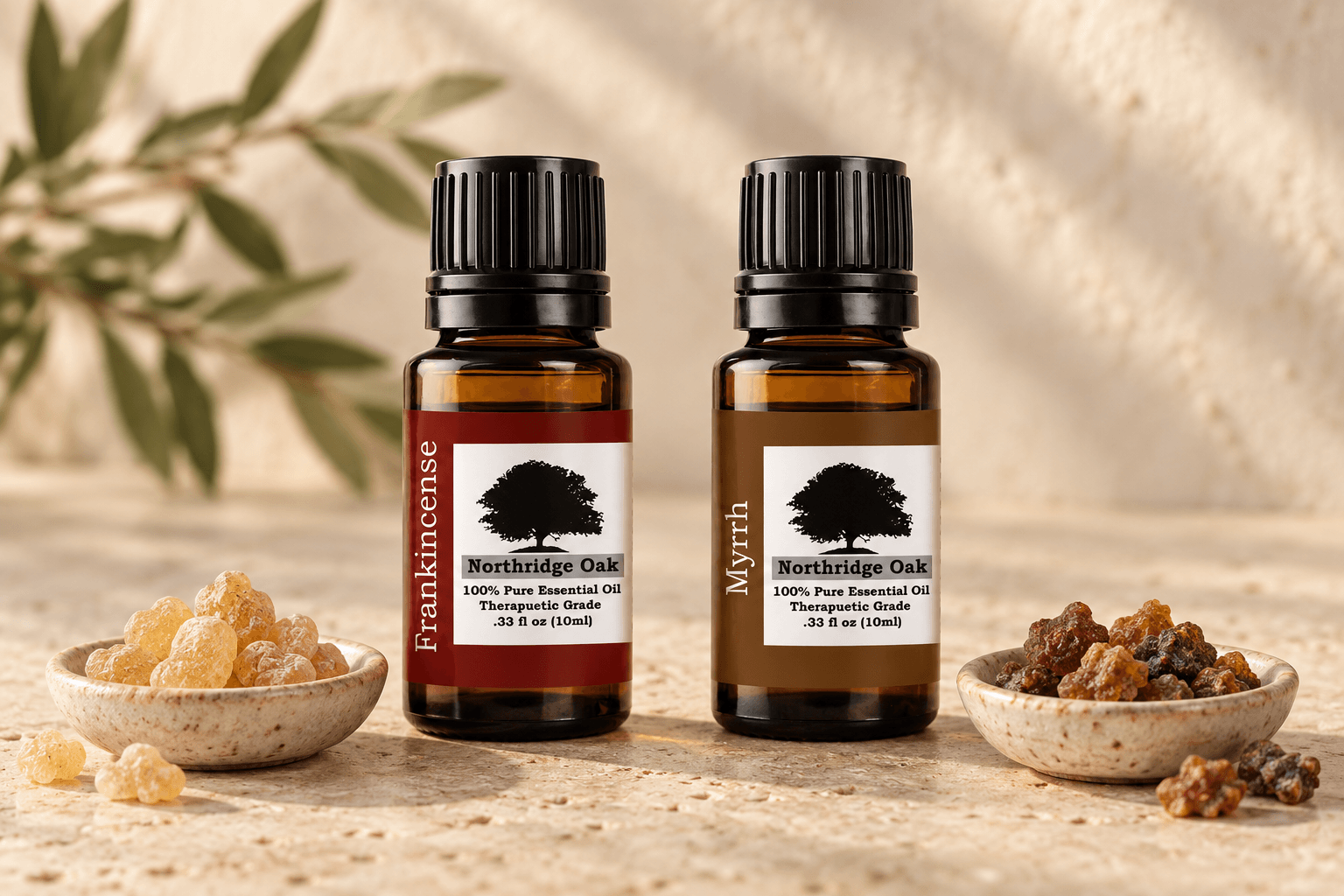
Pair It With Myrrh
4 drops Frankincense
2 drops Myrrh
3 drops Blood Orange
Frankincense brings light and openness; Myrrh adds depth and warmth.
Frequently Asked Questions
What is the best Frankincense Essential Oil?
The best oil is correctly identified, pure, fresh, appropriately packaged and supported by meaningful quality information. Boswellia serrata is an excellent choice for a warm, versatile aroma suited to diffusion, skincare, massage and natural perfume.
How can I tell if Frankincense Essential Oil is real?
There is no reliable home test that proves authenticity. Check the botanical species, source material, extraction method, dilution status, company transparency and batch testing. Aroma can help you evaluate preference and freshness, but laboratory analysis is needed for meaningful chemical authentication.
What color should pure Frankincense Essential Oil be?
Color can range from nearly clear to pale yellow, golden or other light natural shades depending on species, batch and distillation. Color alone cannot confirm purity.
Should Frankincense Essential Oil contain boswellic acids?
No. Boswellic acids are nonvolatile resin compounds and are not expected in meaningful amounts in ordinary steam-distilled essential oil. They are associated with the whole resin and selected extracts.
Is organic Frankincense automatically better?
Organic certification can provide useful information about agricultural and handling practices, but it does not automatically prove identity, freshness or freedom from adulteration. Evaluate it alongside species identification, testing, sourcing and storage.
Is expensive Frankincense always higher quality?
No. Authentic sourcing and testing create real costs, so unusually cheap oil deserves scrutiny. However, high price alone does not prove purity. Look for evidence, not prestige pricing.
Is Frankincense fragrance oil the same as essential oil?
No. Fragrance oil is a formulated aromatic product that may contain synthetic or natural fragrance materials. Frankincense Essential Oil is the volatile oil obtained by distilling Boswellia resin.
Does GC-MS testing guarantee that an oil is pure?
GC-MS provides valuable information about volatile composition and can reveal many authenticity problems. Its value depends on sampling, analytical method and expert interpretation. Sophisticated questions may require chiral GC-MS or additional methods, so testing should be part of a broader quality system.
Which species does Northridge Oak sell?
Northridge Oak sells steam-distilled Boswellia serrata Frankincense Essential Oil. It is undiluted and third-party GC-MS tested.
Choose Clarity Over Hype
Frankincense has been treasured for too long to be reduced to a vague name on a bottle.
The best companies tell you the species, the plant material, the extraction method and whether the oil is diluted. They test the product, package it appropriately and give you useful information instead of depending on miracle language.
Once those standards are met, the final choice becomes personal: Do you enjoy the aroma? Does the oil fit the blends and rituals you want to create? Do you trust the company behind it?
Northridge Oak Boswellia serrata Frankincense gives you the identity, purity, testing and versatility to answer yes.
Shop Northridge Oak 100% Pure Frankincense Essential Oil and experience a third-party GC-MS-tested oil for yourself.
100% Pure Frankincense Essential Oil – 10 mL
$35.00
Warm, woody and resinous, Northridge Oak Frankincense Essential Oil is steam distilled from Boswellia serrata resin grown in India. This 100% pure, undiluted essential oil is third-party GC–MS tested for identity and purity, then bottled in the USA. Use Frankincense in diffusers, properly… read more

Ready to experience frankincense for yourself? Claim your FREE bottle of Northridge Oak Frankincense Essential Oil—just pay shipping.
Research and Regulatory References
Ojha PK, et al. Comparison of volatile constituents present in commercial and lab-distilled Frankincense (Boswellia carteri) Essential Oils for authentication. Plants. 2022.
Hussain H, et al. Chemistry and biology of essential oils of genus Boswellia. Evidence-Based Complementary and Alternative Medicine. 2013.
U.S. Food and Drug Administration. Fragrances in Cosmetics.
U.S. Food and Drug Administration. Cosmetic Ingredient Names.
Masyita A, et al. Terpenes and terpenoids as main bioactive compounds of essential oils. Food Chemistry: X. 2022.
Essential oils are highly concentrated. Always follow appropriate usage and dilution guidance for each individual oil. Some oils require additional precautions, so familiarize yourself with an oil's safety information before use. Keep essential oils out of reach of children and pets.
These statements have not been evaluated by the Food and Drug Administration. This information is for educational purposes only and is not intended to diagnose, treat, cure, or prevent any disease.
Frequently Asked Questions
What is the best Frankincense Essential Oil?
The best oil is correctly identified, pure, fresh, appropriately packaged and supported by meaningful quality information. Boswellia serrata is an excellent choice for a warm, versatile aroma suited to diffusion, skincare, massage and natural perfume.
How can I tell if Frankincense Essential Oil is real?
There is no reliable home test that proves authenticity. Check the botanical species, source material, extraction method, dilution status, company transparency and batch testing. Aroma can help you evaluate preference and freshness, but laboratory analysis is needed for meaningful chemical authentication.
What color should pure Frankincense Essential Oil be?
Color can range from nearly clear to pale yellow, golden or other light natural shades depending on species, batch and distillation. Color alone cannot confirm purity.
Should Frankincense Essential Oil contain boswellic acids?
No. Boswellic acids are nonvolatile resin compounds and are not expected in meaningful amounts in ordinary steam-distilled essential oil. They are associated with the whole resin and selected extracts.
Is organic Frankincense automatically better?
Organic certification can provide useful information about agricultural and handling practices, but it does not automatically prove identity, freshness or freedom from adulteration. Evaluate it alongside species identification, testing, sourcing and storage.
Is Frankincense fragrance oil the same as essential oil?
No. Fragrance oil is a formulated aromatic product that may contain synthetic or natural fragrance materials. Frankincense Essential Oil is the volatile oil obtained by distilling Boswellia resin.