Table of Contents
- TRY FRANKINCENSE FOR YOURSELF—GET A FREE BOTTLE
- What Is Frankincense?
- Types of Frankincense at a Glance
- Boswellia Serrata: Indian Frankincense
- Boswellia Sacra: Sacred Frankincense
- Boswellia Carterii vs. Boswellia Sacra: Are They the Same?
- Boswellia Frereana: Maydi Frankincense
- Other Frankincense Species You May Encounter
- Which Type of Frankincense Is Best?
- Does Species Determine the Quality of Frankincense Oil?
- Why Northridge Oak Uses Boswellia Serrata
- Try the Difference for Yourself
- Frequently Asked Questions
- Explore Boswellia Serrata Frankincense
- Research and Botanical References
- FAQs
Frankincense is often spoken of as though it comes from one tree and produces one universal oil. In reality, there are several types of frankincense, each shaped by its botanical species, native landscape, resin and natural chemistry.
TRY FRANKINCENSE FOR YOURSELF—GET A FREE BOTTLE
Ready to experience frankincense for yourself? Claim your FREE bottle of Northridge Oak Frankincense Essential Oil—just pay shipping. You’ll also get access to our Frankincense Oil Uses guide, packed with DIY recipes and diffuser blends.
Some frankincense trees grow across the seasonally dry regions of the Indian subcontinent. Others cling to rugged limestone slopes in Oman and Yemen or thrive in the dry shrublands of northern Somalia. Each tree produces its own version of the resin that has been treasured for thousands of years.
That is why one frankincense essential oil may smell bright and pine-like while another feels deeper, earthier, warmer or more balsamic. None of these variations makes an oil automatically “real” or “fake.” They are members of the same remarkable botanical family, each with its own personality.
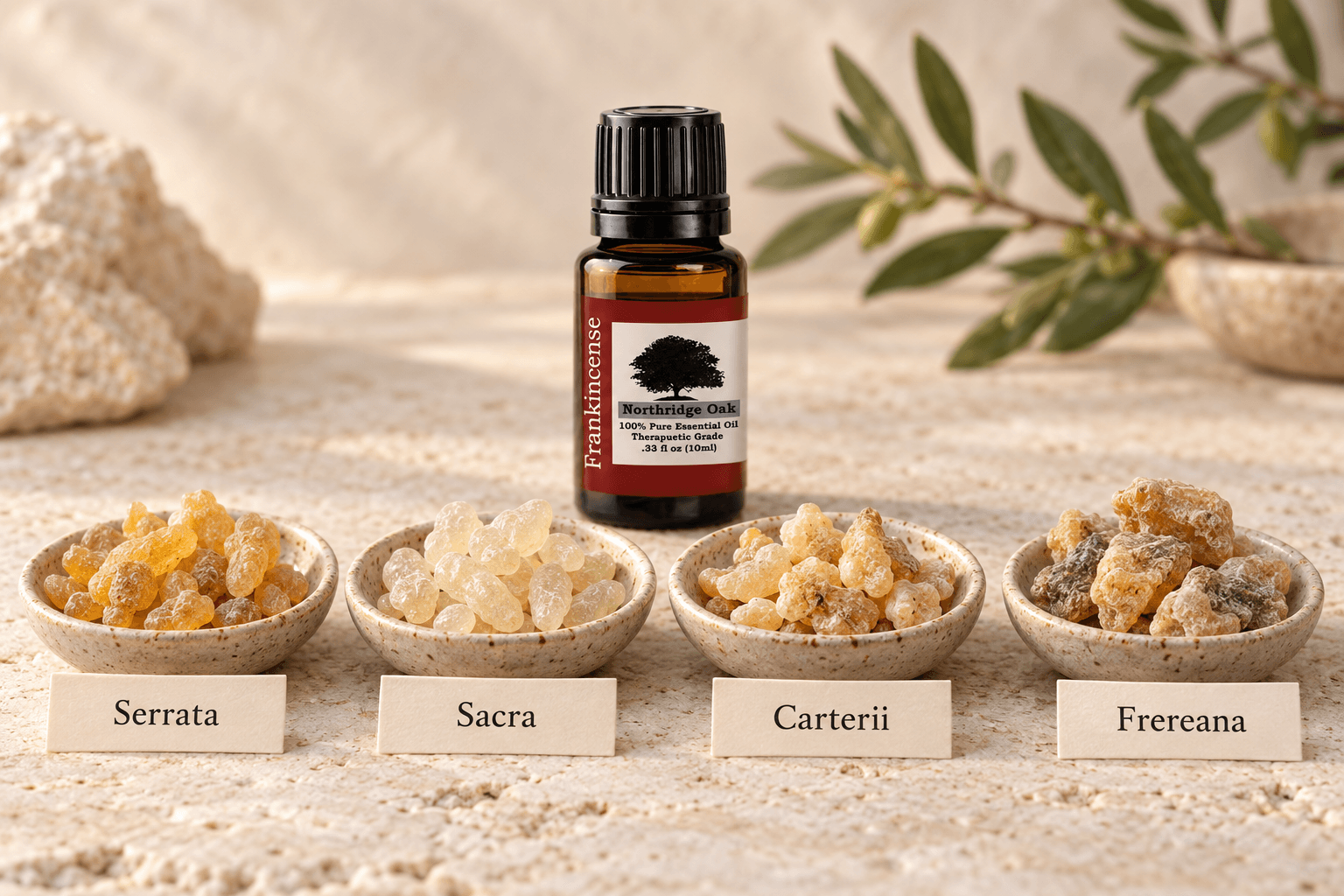
The types most often encountered are:
Boswellia serrata
Boswellia sacra
Boswellia carteri or carterii
Boswellia frereana
You may also encounter Boswellia papyrifera, Boswellia rivae, Boswellia neglecta and other regional species.
This guide will help you understand the differences, read a frankincense label with confidence and choose the oil that best fits the experience you want.
What Is Frankincense?
Frankincense is the aromatic oleo-gum-resin produced by trees in the Boswellia genus. These trees belong to the Burseraceae family, which also includes Commiphora trees—the source of myrrh.
Harvesters make careful incisions in the bark, allowing drops of milky resin to emerge. The resin hardens into fragrant “tears” that can be sorted, burned as incense, extracted or steam-distilled into essential oil.
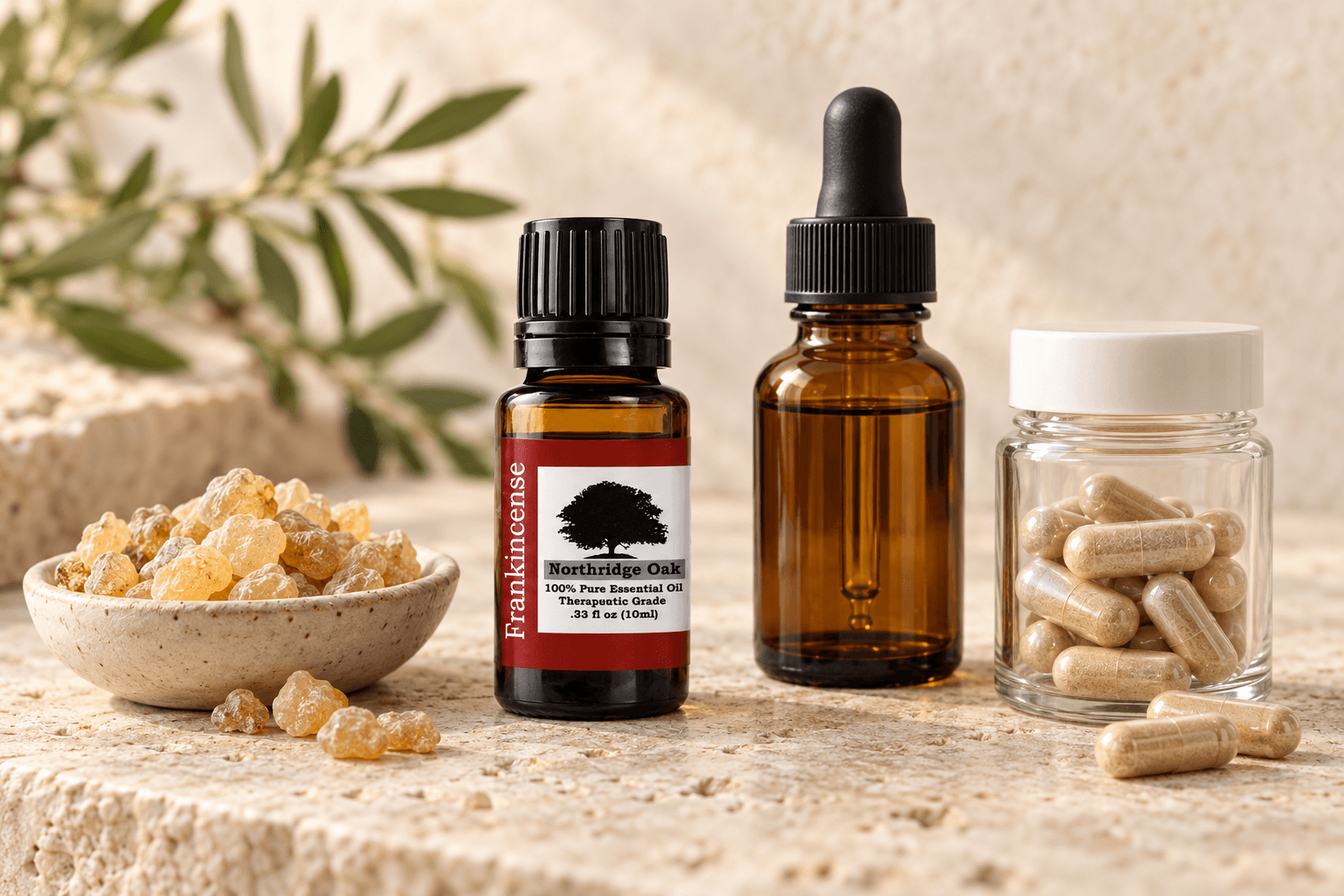
The resin and essential oil are related, but they are not chemically identical. Steam distillation carries the smaller volatile aromatic compounds into the essential oil. Larger nonvolatile compounds, including the boswellic acids found in the resin, do not transfer into ordinary steam-distilled essential oil in meaningful amounts.
This distinction is important when comparing studies, products and uses. A bottle of frankincense essential oil is an aromatic distillate—not liquid resin and not the same thing as a concentrated Boswellia supplement.
Learn more in our complete Frankincense Essential Oil guide.
Types of Frankincense at a Glance
| Type | Native association | General aromatic character | Often chosen for |
|---|---|---|---|
| Boswellia serrata | Indian subcontinent | Warm, earthy, resinous, woody and gently spicy | Grounding blends, skincare rituals, massage oils and everyday aromatherapy |
| Boswellia sacra | Oman, Yemen and Somalia | Bright, fresh, resinous, pine-like and sometimes citrus-like | Meditation, incense-inspired blends and fresh resinous diffusion |
| Boswellia carteri/carterii | Common trade name associated with Somali frankincense | Often described as fresh, green, pine-like, lemony and resinous | Diffusion, perfumery, spiritual blends and general aromatherapy |
| Boswellia frereana | Northern and northeastern Somalia | Fresh, dry, resinous, slightly spicy and often bright | Distinctive perfumery, incense traditions and collectors exploring different species |
These descriptions are useful starting points, not rigid rules. Growing region, weather, soil, harvest timing, resin handling and distillation can all change the aroma and chemical profile of an oil—even within the same species.
Boswellia Serrata: Indian Frankincense
Boswellia serrata is native to the Indian subcontinent. It grows primarily in seasonally dry tropical regions and has a deep connection to Indian tradition.
Its resin is sometimes called Indian frankincense or salai guggul. The resin and its extracts have a particularly visible place in Ayurvedic tradition and modern Boswellia research. Remember, however, that research on boswellic-acid-rich resin extracts does not automatically describe the steam-distilled essential oil.
What Does Boswellia Serrata Smell Like?
The essential oil is commonly experienced as:
Warm
Resinous
Earthy
Woody
Gently spicy
Softly citrus-like in some batches
Its grounded, rounded aroma makes it easy to use alone and easy to blend. It can soften the sharp edges of bright citrus oils, add warmth to florals and deepen woodsy combinations.
Why Choose Boswellia Serrata?
Choose Boswellia serrata if you want a warm and versatile frankincense that fits naturally into:
Evening diffuser blends
Meditation or reflection
Facial and body oils
Massage blends
Earthy perfumes
Resinous seasonal blends
Daily aromatherapy
Northridge Oak chose Boswellia serrata because its rich aroma works beautifully across home fragrance, personal care and everyday essential-oil routines. Our oil is steam-distilled, undiluted and third-party GC-MS tested.
Explore Northridge Oak 100% Pure Boswellia serrata Frankincense Essential Oil.
Boswellia Sacra: Sacred Frankincense
Boswellia sacra is native to Oman, Yemen and Somalia. These trees grow in extremely dry landscapes, often rooted in rocky slopes that appear almost too harsh to support life.
The resin of B. sacra is closely associated with the historic frankincense trade of southern Arabia. Omani resin, including grades commonly marketed as Hojari, is especially prized in incense and perfumery.
What Does Boswellia Sacra Smell Like?
Depending on the batch and origin, B. sacra essential oil may smell:
Bright
Pine-like
Fresh
Resinous
Lightly citrus-like
Green or mineral-like
Alpha-pinene is frequently prominent in the essential oil, but natural variation can be considerable. Some samples contain higher amounts of alpha-thujene or other monoterpenes.
Why Choose Boswellia Sacra?
People often choose B. sacra for:
A bright, classic frankincense aroma
Meditation or contemplative routines
Fresh resinous diffuser blends
Natural perfumery
Exploring the heritage of Omani frankincense
Boswellia Carterii vs. Boswellia Sacra: Are They the Same?
This is one of the most confusing questions in the frankincense world.
You will see both Boswellia carteri and Boswellia carterii on product labels and in essential-oil books. In commerce, the name is often used for frankincense associated with Somalia and the Horn of Africa.
However, the Royal Botanic Gardens, Kew currently treats Boswellia carteri Birdw. as a synonym of Boswellia sacra Flück. In other words, under that accepted botanical treatment, carteri is not considered a separate accepted species.
Why, then, do both names remain common?
Botanical names can change as taxonomists reevaluate plants.
Older books, supplier documents and research papers may retain earlier names.
Trade names sometimes continue long after taxonomy changes.
Regional resin traditions may use names differently.
“Carterii” remains familiar to essential-oil consumers and suppliers.
This does not mean every bottle labeled carteri and every bottle labeled sacra will smell identical. Oils may still come from different locations, harvests, resin grades, chemotypes or distillation practices. The label tells part of the story; the batch analysis tells much more.
What Does Carterii Frankincense Smell Like?
Oils sold as Boswellia carteri or carterii are often described as:
Fresh
Green
Pine-like
Lemony
Dry
Resinous
Their bright profile makes them popular in diffusers, meditation blends, natural perfumes and fresh woodsy combinations.
Boswellia Frereana: Maydi Frankincense
Boswellia frereana is native to northern and northeastern Somalia. Its resin is commonly known as maydi and has a long history of local use and trade.
Compared with other commercial frankincense species, B. frereana can feel less familiar to the average essential-oil shopper. For collectors, perfumers and anyone fascinated by regional frankincense traditions, that is part of its appeal.
What Does Boswellia Frereana Smell Like?
Its aroma is often described as:
Fresh
Dry
Resinous
Bright
Gently spicy
Pine-like in alpha-pinene-rich batches
A 2021 analysis of resin collected from individual B. frereana trees found substantial natural variation. Alpha-pinene and alpha-thujene were dominant across the oils, but their proportions differed widely from tree to tree. This is a perfect example of why species alone cannot predict every detail of an essential oil.
Why Choose Boswellia Frereana?
Choose B. frereana if you want:
A distinctive Somali frankincense
A bright, dry resinous aroma
Something less commonly found than serrata or sacra
A new material for natural perfumery
A deeper exploration of frankincense diversity
Other Frankincense Species You May Encounter
The Boswellia genus extends well beyond the four names most often seen on retail shelves.
Boswellia Papyrifera
B. papyrifera is associated with northeastern Africa, including Ethiopia, Eritrea and Sudan. Its resin has long been an important commercial source of frankincense and incense.
Boswellia Rivae
B. rivae grows in parts of Ethiopia, Somalia and Kenya. Its oil can contain varying amounts of alpha-pinene, limonene, alpha-thujene, delta-3-carene and other monoterpenes. Researchers have also explored its potential to support pastoral communities through sustainable resin collection.
Boswellia Neglecta
B. neglecta is associated with eastern Africa. Its resins and oils can show considerable chemical diversity, which makes accurate sourcing and testing especially important.
Boswellia Occulta
B. occulta was formally described relatively recently and is known for unusual methoxyalkane-rich chemistry in some resins. Its discovery also demonstrated how much remains to be learned about frankincense species and regional trade.
Which Type of Frankincense Is Best?
There is no single species that is best for every person and every purpose. The best type depends on what you want from the oil.
Choose Serrata If You Want…
A warm, earthy and versatile aroma
An oil suited to skincare and massage blends
A grounding addition to meditation
Easy pairing with citrus, floral and woodsy oils
A connection to Indian frankincense tradition
Choose Sacra or Carterii If You Want…
A brighter, fresher and more pine-like aroma
A connection to Oman, Somalia and the ancient Arabian trade
Crisp resinous diffuser blends
A classic material for incense-inspired perfumery
Choose Frereana If You Want…
A distinctive Somali frankincense
A dry, bright resinous profile
A less common species to explore
Something different for perfumery or aromatic collecting
If you are new to frankincense, Boswellia serrata is an excellent place to begin. Its warm, balanced aroma is approachable and adaptable, and a single bottle can move easily from the diffuser to a properly diluted facial oil, body oil, roller or perfume blend.
Does Species Determine the Quality of Frankincense Oil?
Species matters, but it does not determine quality by itself.
A genuine Boswellia sacra oil can be poorly stored, oxidized or adulterated. A carefully distilled Boswellia serrata can be fresh, beautifully balanced and accurately identified. Botanical name alone cannot tell you everything you need to know.
Quality also depends on:
Correct botanical identification
Geographic origin
Resin quality and handling
Distillation method
Freshness and storage
Whether the oil has been diluted or adulterated
Batch-specific chemical testing
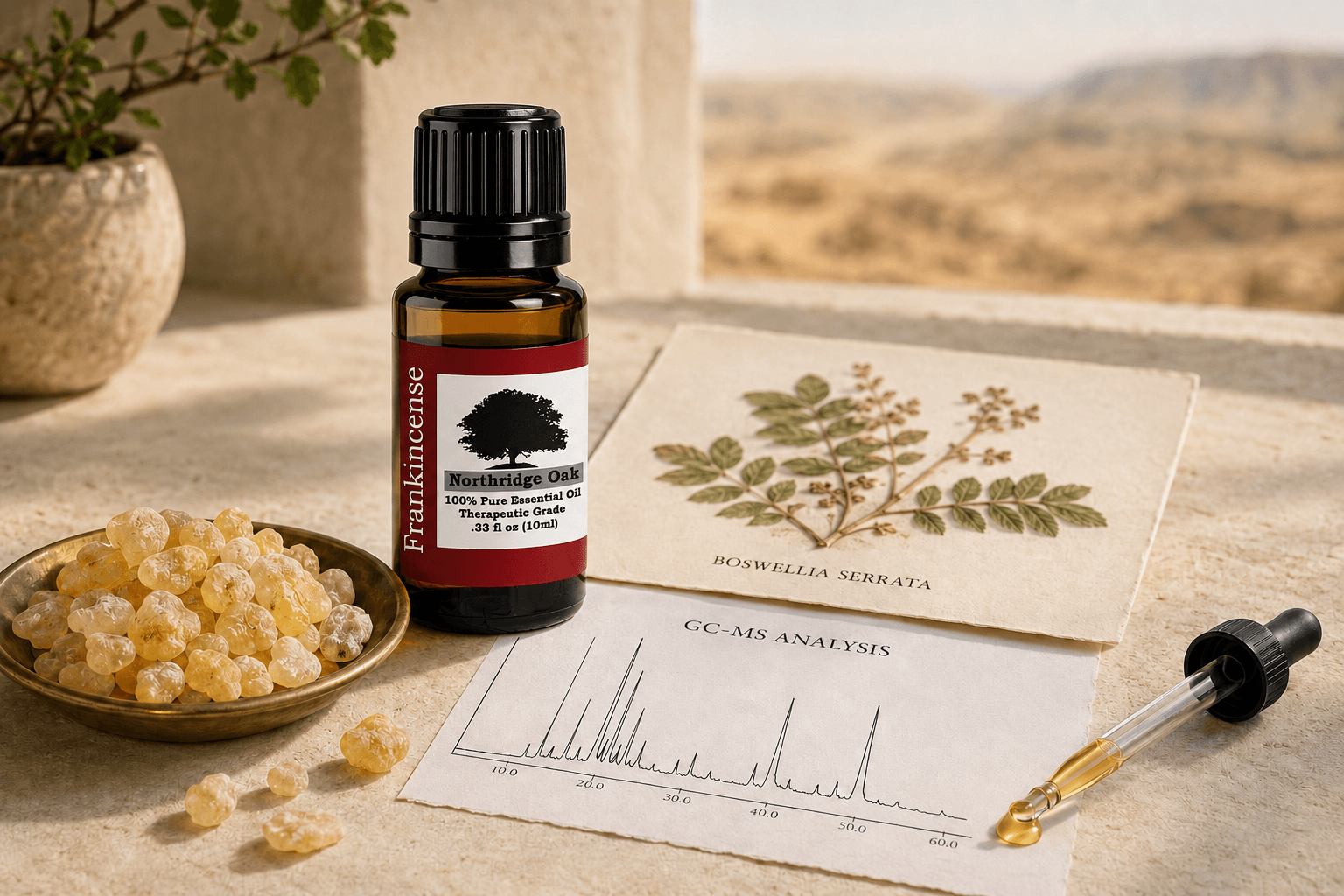
That is why third-party GC-MS testing matters. Gas chromatography separates the volatile compounds, while mass spectrometry helps identify them. The resulting chemical profile can be compared with what is expected for the declared botanical material and evaluated for unexpected constituents.
GC-MS is not magic, and it should be interpreted by knowledgeable professionals. But combined with responsible sourcing and clear labeling, it provides valuable evidence about what is actually in the bottle.
Why Northridge Oak Uses Boswellia Serrata
We want one bottle of frankincense to be genuinely useful—not something that sits untouched because customers are unsure what to do with it.
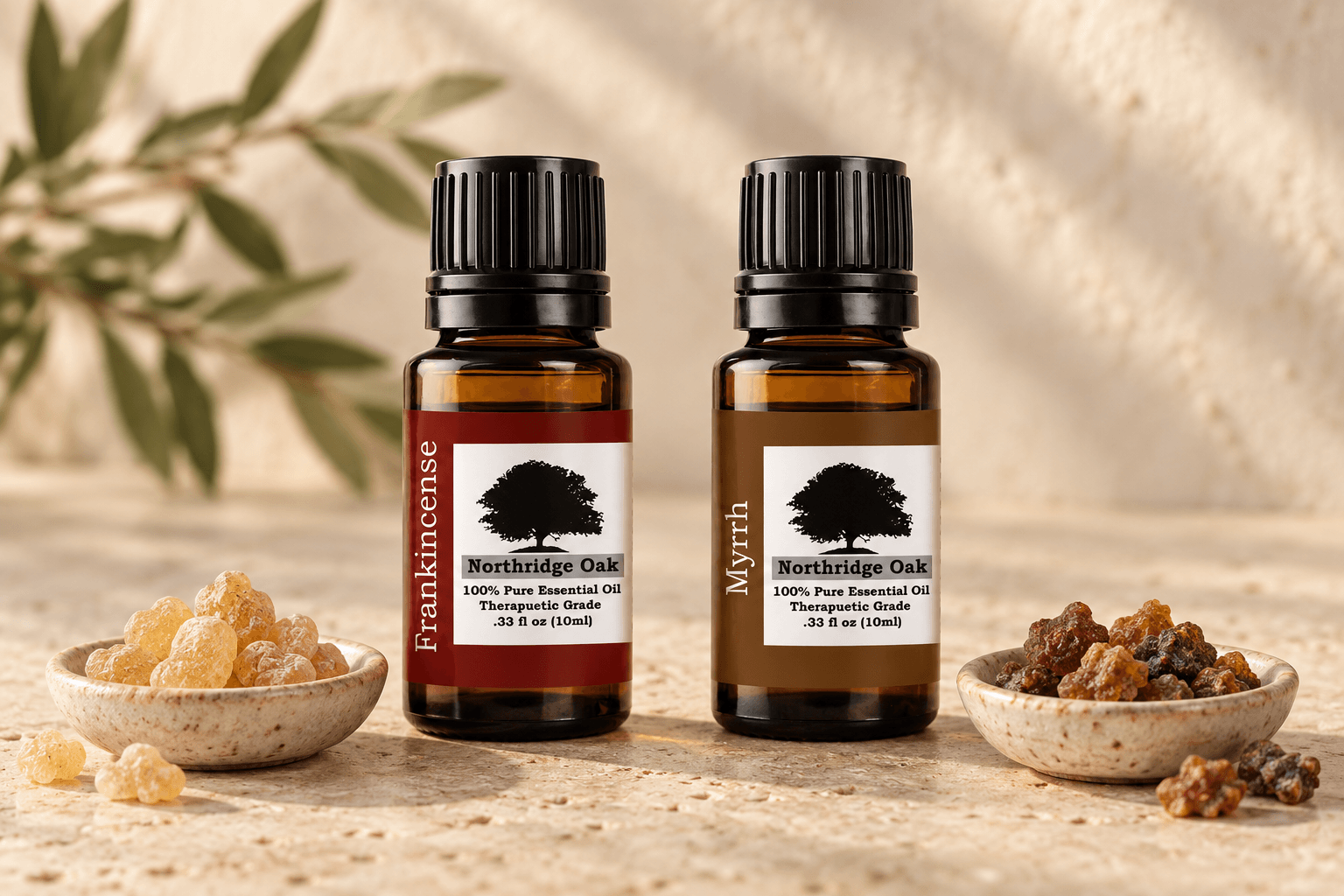
Boswellia serrata gives us the warm, resinous and grounding aroma we want in an everyday frankincense. It blends beautifully with Lavender, Peppermint, citrus oils, Myrrh, Patchouli, Cedarwood and Eucalyptus.
You can use it to create:
A quiet evening diffuser blend
A warm personal perfume
A facial or body oil
A grounding roller
A massage blend
Bath salts
A meaningful aromatic ritual
Every batch is third-party GC-MS tested, and the botanical species is clearly identified on the product page. You know which frankincense you are purchasing and can explore it with confidence.
For skincare ideas, visit Frankincense Oil for Face and Skin. For aromatic recipes, explore our guide to diffusing Frankincense Essential Oil.
Try the Difference for Yourself
Reading aroma descriptions can only take you so far. Essential oils are sensory, and the best way to understand Boswellia serrata is to open the bottle and experience it.
Place one drop on a fragrance-testing strip or an unscented cotton ball. Smell it immediately, then return after 15 minutes and again after an hour. Notice how the bright opening gives way to warmer, deeper resinous notes.
Next, try it in your diffuser:
Warm Citrus Frankincense
4 drops Frankincense
3 drops Blood Orange
2 drops Lavender
Quiet Forest
4 drops Frankincense
3 drops Cedarwood
2 drops Eucalyptus
Simple Frankincense Facial Oil
1 fluid ounce jojoba oil
3 drops Frankincense Essential Oil
Combine the facial-oil ingredients in a clean, dry dropper bottle. Apply one or two drops to slightly damp skin, avoiding the eye area.
One oil, three completely different experiences—that versatility is what makes Boswellia serrata such a valuable essential-oil staple.
Frequently Asked Questions
How many types of frankincense are there?
The Boswellia genus contains numerous accepted species, and several produce resins traded as frankincense. The types most frequently encountered by essential-oil shoppers include B. serrata, B. sacra/carteri, B. frereana and B. papyrifera.
Is Boswellia serrata real frankincense?
Yes. Boswellia serrata is an accepted species native to the Indian subcontinent and a longstanding source of genuine frankincense resin and essential oil.
Is Boswellia carterii the same as Boswellia sacra?
Kew's Plants of the World Online currently treats Boswellia carteri as a synonym of the accepted name Boswellia sacra. Nevertheless, carteri and carterii remain common names in commerce, older research and essential-oil literature.
Which frankincense smells best?
That depends on personal preference and the individual batch. People who enjoy warm, earthy aromas may prefer B. serrata. Those who want a brighter, pine-like profile may gravitate toward B. sacra/carterii. Anyone seeking a distinctive dry Somali frankincense may enjoy B. frereana.
Which type of frankincense is best for skin?
Several frankincense species are used in personal-care products. Boswellia serrata is a beautiful choice for facial and body oils because of its warm aroma and versatility. Regardless of species, use a pure, accurately identified oil and dilute it appropriately before topical use.
Which type does Northridge Oak sell?
Northridge Oak Frankincense Essential Oil is steam-distilled from Boswellia serrata. It is undiluted, third-party GC-MS tested and contains no fillers or synthetic fragrance.
Can I mix different frankincense species?
Yes. Perfumers and essential-oil enthusiasts sometimes combine species to create a more layered frankincense profile. A bright sacra-style aroma can be paired with the warmer character of serrata. When using the blend topically, calculate your dilution using the total amount of essential oil.
Explore Boswellia Serrata Frankincense
Frankincense is not one aroma from one place. It is a diverse family of resins and essential oils shaped by remarkable trees, ancient trade routes and the people who have harvested them across generations.
Understanding the species helps you appreciate what is in the bottle. But the most important test is still your own experience: how the aroma develops, how it blends with the oils you love and how naturally it fits into your daily rituals.
Shop Northridge Oak 100% Pure Frankincense Essential Oil and discover the warm, grounding character of Boswellia serrata for yourself.
Ready to experience frankincense for yourself? Claim your FREE bottle of Northridge Oak Frankincense Essential Oil—just pay shipping.
Research and Botanical References
Royal Botanic Gardens, Kew. Boswellia serrata Roxb.. Plants of the World Online.
Royal Botanic Gardens, Kew. Boswellia sacra Flück.. Plants of the World Online.
Royal Botanic Gardens, Kew. Boswellia carteri Birdw.. Plants of the World Online.
Royal Botanic Gardens, Kew. Boswellia frereana Birdw.. Plants of the World Online.
Hussain H, et al. Chemistry and biology of essential oils of genus Boswellia. Evidence-Based Complementary and Alternative Medicine. 2013.
Niebler J, Buettner A. Frankincense revisited, Part I: Comparative analysis of volatiles in commercially relevant Boswellia species. Chemistry & Biodiversity. 2016.
Johnson S, et al. The chemical composition of single-tree Boswellia frereana resin samples. Natural Product Communications. 2021.
DeCarlo A, et al. Evaluating the potential of Boswellia rivae to provide sustainable livelihood benefits in eastern Ethiopia. Plants. 2023.
Essential oils are highly concentrated. Always follow appropriate usage and dilution guidance for each individual oil. Some oils require additional precautions, so familiarize yourself with an oil's safety information before use. Keep essential oils out of reach of children and pets.
These statements have not been evaluated by the Food and Drug Administration. This information is for educational purposes only and is not intended to diagnose, treat, cure, or prevent any disease.
Frequently Asked Questions
How many types of frankincense are there?
The Boswellia genus contains numerous accepted species, and several produce resins traded as frankincense. The types most frequently encountered by essential-oil shoppers include B. serrata, B. sacra/carteri, B. frereana and B. papyrifera
Is Boswellia serrata real frankincense?
Yes. Boswellia serrata is an accepted species native to the Indian subcontinent and a longstanding source of genuine frankincense resin and essential oil.
Is Boswellia carterii the same as Boswellia sacra?
Kew's Plants of the World Online currently treats Boswellia carteri as a synonym of the accepted name Boswellia sacra. Nevertheless, carteri and carterii remain common names in commerce, older research and essential-oil literature.
Which frankincense smells best?
That depends on personal preference and the individual batch. People who enjoy warm, earthy aromas may prefer B. serrata. Those who want a brighter, pine-like profile may gravitate toward B. sacra/carterii. Anyone seeking a distinctive dry Somali frankincense may enjoy B. frereana.
Which type of frankincense is best for skin?
Several frankincense species are used in personal-care products. Boswellia serrata is a beautiful choice for facial and body oils because of its warm aroma and versatility. Regardless of species, use a pure, accurately identified oil and dilute it appropriately before topical use.
Which type does Northridge Oak sell?
Northridge Oak Frankincense Essential Oil is steam-distilled from Boswellia serrata. It is undiluted, third-party GC-MS tested and contains no fillers or synthetic fragrance.
Can I mix different frankincense species?
Yes. Perfumers and essential-oil enthusiasts sometimes combine species to create a more layered frankincense profile. A bright sacra-style aroma can be paired with the warmer character of serrata. When using the blend topically, calculate your dilution using the total amount of essential oil.