Table of Contents
- TRY FRANKINCENSE FOR YOURSELF—GET A FREE BOTTLE
- Frankincense Forms at a Glance
- Everything Begins With Frankincense Resin
- What Is Frankincense Essential Oil?
- Does Frankincense Essential Oil Contain Boswellic Acids?
- What Is Whole Frankincense Resin?
- Frankincense Resin vs. Essential Oil
- What Is Boswellia Powder?
- What Is Boswellia Extract?
- What Are Frankincense or Boswellia Supplements?
- Can You Ingest Frankincense Essential Oil Instead of Taking a Supplement?
- Which Form of Frankincense Should You Choose?
- Why Choose GC-MS-Tested Frankincense Essential Oil?
- Three Easy Ways to Experience Frankincense Essential Oil
- One Tree, Several Remarkable Preparations
- Research and Regulatory References
- FAQs
Frankincense essential oil, resin, Boswellia extract and frankincense supplements all begin with the same extraordinary group of trees. That shared origin causes many people to assume the products are interchangeable.
TRY FRANKINCENSE FOR YOURSELF—GET A FREE BOTTLE
Ready to experience frankincense for yourself? Claim your FREE bottle of Northridge Oak Frankincense Essential Oil—just pay shipping. You’ll also get access to our Frankincense Oil Uses guide, packed with DIY recipes and diffuser blends.
They are not—and understanding the difference makes frankincense even more fascinating.
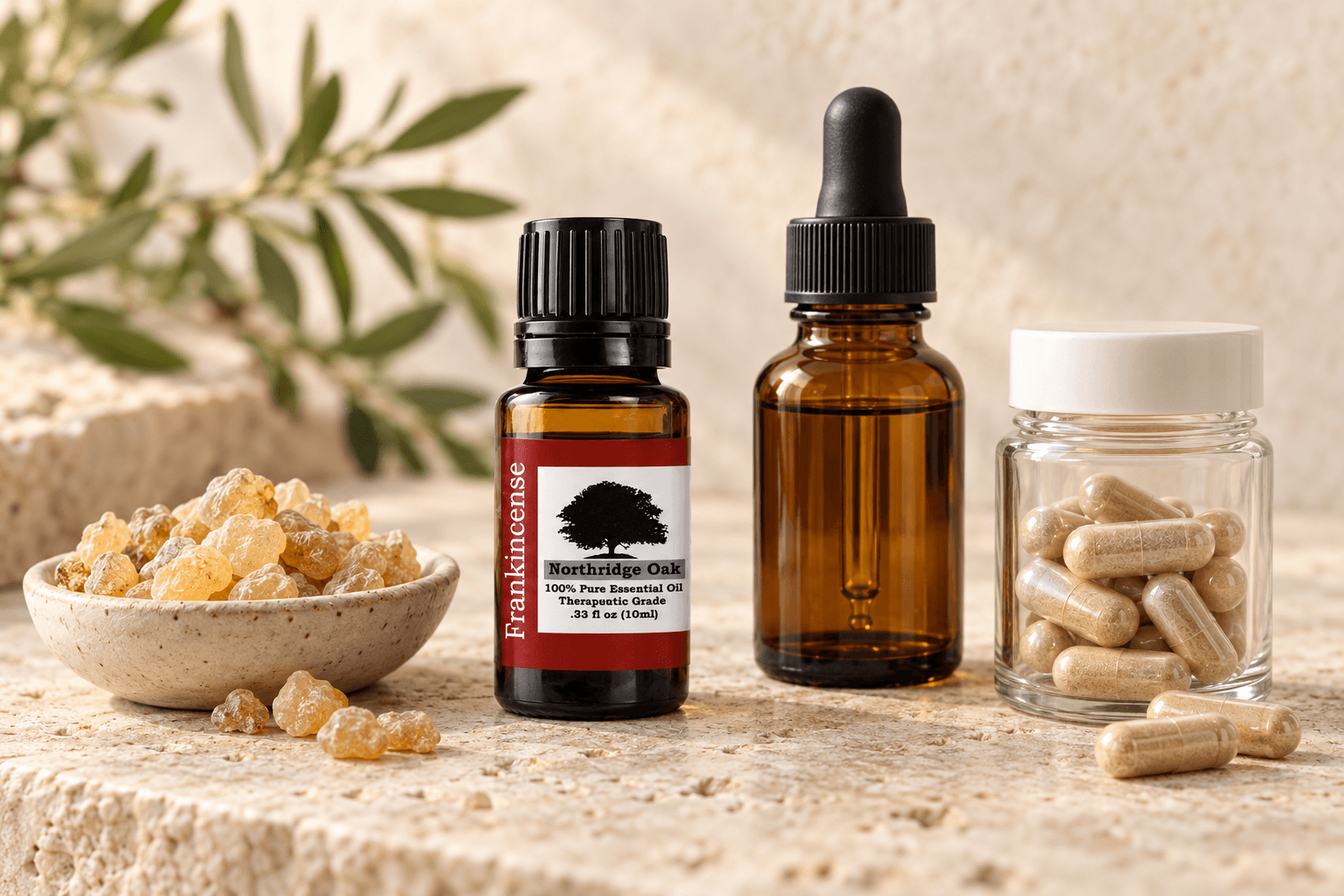
The resin produced by a Boswellia tree contains a wide range of aromatic and nonaromatic natural compounds. Steam distillation captures the resin's volatile aromatic molecules and produces essential oil. Other extraction methods concentrate nonvolatile compounds such as boswellic acids. Whole resin may be burned as incense or prepared in other traditional ways, while standardized extracts are commonly placed into capsules.
Each preparation preserves a different part of the plant's chemistry. That is why a clinical study of a standardized Boswellia serrata extract cannot automatically tell you what a bottle of steam-distilled frankincense essential oil will do—and why research on the essential oil should not automatically be assigned to a supplement.
The goal is not to crown one form “best.” The goal is to choose the right frankincense for the experience you want.
Frankincense Forms at a Glance
| Form | How it is made | What it emphasizes | Common uses |
|---|---|---|---|
| Frankincense essential oil | Volatile compounds are captured from resin through steam distillation | Aromatic terpenes and other volatile compounds | Diffusion, natural perfumery, aromatic routines and properly diluted topical blends |
| Whole frankincense resin | Resin tears are collected and dried | The broad natural resin matrix, including volatile and nonvolatile compounds | Incense, perfumery traditions, ceremony and traditional preparations |
| Boswellia powder | Dried resin is ground | Ground whole resin with naturally variable composition | Traditional preparations and as raw material for further extraction |
| Boswellia extract | Resin is processed with a selected extraction method | Specific soluble compounds; some extracts are standardized for boswellic acids | Research, formulated products and supplement manufacturing |
| Boswellia supplement | Powder or extract is placed in capsules, tablets or another oral dosage form | Depends entirely on the ingredient and standardization stated on the label | Oral dietary supplementation |
Everything Begins With Frankincense Resin
Frankincense is the fragrant oleo-gum-resin produced by trees in the Boswellia genus. Harvesters make careful incisions in the bark, and milky resin slowly emerges. As it dries, it forms the golden, amber, ivory or greenish tears recognized around the world.
The resin is the tree's complete aromatic raw material. It contains:
Volatile aromatic compounds
Resin acids
Gum components
Triterpenes
Boswellic acids
Other naturally occurring plant compounds
The exact composition varies by Boswellia species, individual tree, growing region, harvest and resin grade.
Northridge Oak's Frankincense Essential Oil comes from Boswellia serrata, a species native to the Indian subcontinent. You can compare the major species in our guide to the different types of Frankincense.
What Is Frankincense Essential Oil?
Frankincense essential oil is the concentrated aromatic oil obtained by steam-distilling frankincense resin.
During distillation, steam moves through the resin and carries its volatile molecules into a condenser. As the vapor cools, the essential oil separates from the water. The result is a highly concentrated liquid with frankincense's warm, resinous aroma.
Depending on the species and batch, the essential oil may contain varying amounts of:
Alpha-pinene
Alpha-thujene
Limonene
Sabinene
Myrcene
P-cymene
Other monoterpenes and sesquiterpenes
These volatile compounds give each oil its aroma and are the focus of research involving frankincense essential oil.
What Is Frankincense Essential Oil Used For?
Frankincense essential oil is the form to choose when you want:
A warm, grounding aroma in a diffuser
A resinous note in a natural perfume
A properly diluted facial or body oil
A massage blend
A personal aromatic roller
A simple way to include frankincense in daily self-care
An oil that blends easily with citrus, floral, mint, wood and resin oils
Explore practical ideas in our complete Frankincense Essential Oil guide and Frankincense diffuser-blend collection.
Does Frankincense Essential Oil Contain Boswellic Acids?
This is the most important chemical distinction in the entire frankincense conversation:
Ordinary steam-distilled frankincense essential oil does not contain boswellic acids in meaningful amounts.
Boswellic acids are large, nonvolatile triterpenes. They do not evaporate with steam, so they remain behind during distillation instead of entering the essential oil.
That does not make the essential oil weak, inferior or “missing” something it should contain. Essential oil is meant to capture the plant's volatile aromatic fraction. An extract designed to concentrate boswellic acids captures a different fraction. They are different preparations created for different purposes.
Think of a lemon. Lemon essential oil is not nutritionally identical to lemon juice, yet both are authentic products from the same fruit. One emphasizes aromatic compounds in the peel; the other contains water-soluble compounds from the juice. Frankincense works on a similar principle.
Why the Boswellic-Acid Distinction Matters
Boswellic acids are featured in much of the research on oral Boswellia extracts. When an article cites that research and then directs readers to apply or ingest frankincense essential oil, it has quietly switched from one preparation to another.
The essential oil deserves to be understood through its own volatile chemistry and its own research—not through compounds it does not contain.
What Is Whole Frankincense Resin?
Whole resin is frankincense in the form closest to the tree. After the resin tears harden, they are cleaned and may be sorted by size, color, origin and grade.
For thousands of years, frankincense resin has been traded as an exceptionally valuable aromatic material. It has been used in incense, perfumery, ceremony and traditional wellness practices across the Middle East, Africa, India and beyond.
What Does Frankincense Resin Smell Like?
The aroma changes as resin warms or burns. It may begin fresh, bright and citrus-like, then develop deeper balsamic, pine-like, woody or smoky notes.
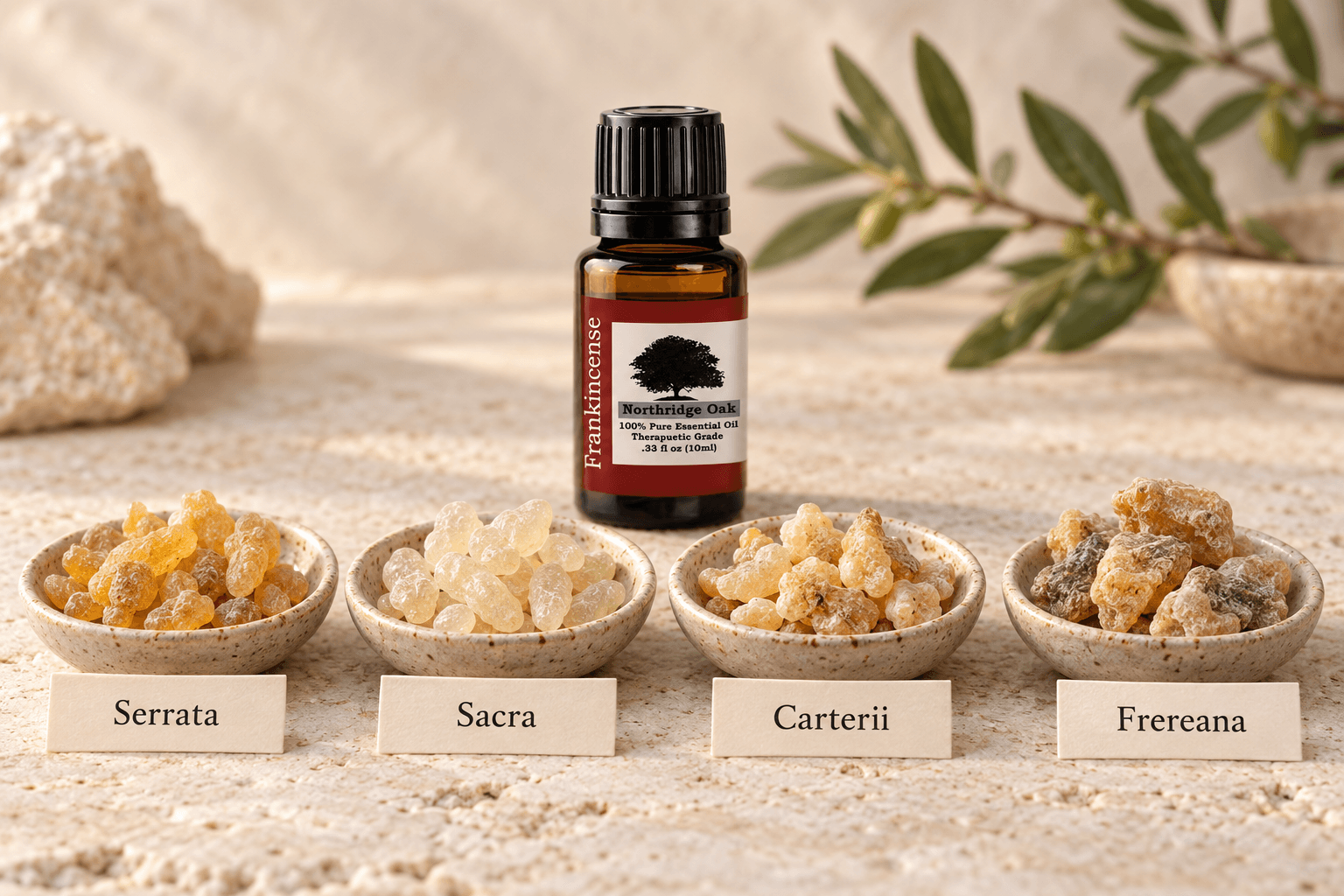
Species also matters. Boswellia sacra, serrata, frereana and other species produce resins with distinct personalities. Resin grades from the same species can also look and smell different.
How Is Frankincense Resin Used?
Whole resin is commonly chosen for:
Traditional incense
Aromatic resin warmers
Perfumery tinctures and extracts
Historical or cultural exploration
Collecting different regional grades
Burning resin produces smoke and should be approached with appropriate ventilation and awareness of other people and animals in the space. Essential oil diffusion offers a different way to experience frankincense aroma without burning the whole resin.
Frankincense Resin vs. Essential Oil
Both products are genuine frankincense, but they deliver different experiences.
Choose whole resin if you want the ancient ritual of working with resin tears, the evolving aroma produced by warmth or combustion, or a material for traditional incense and perfumery.
Choose essential oil if you want a convenient, concentrated aromatic liquid that can be added by the drop to a diffuser, roller, facial oil, body oil or perfume blend.
Essential oil is easier to measure and blend. Whole resin retains a broader range of nonvolatile compounds, but most of those compounds will not become airborne simply because the resin is sitting in a dish.
Many frankincense enthusiasts enjoy both: resin for an occasional traditional aromatic experience and essential oil for everyday use.
What Is Boswellia Powder?
Boswellia powder is usually dried frankincense resin that has been ground. Because it begins as whole resin, it can contain both volatile and nonvolatile components, although composition and potency naturally vary.
Powder is not the same as a standardized extract. Grinding changes the physical form but does not selectively concentrate a particular compound.
This distinction is easy to miss on supplement labels. A capsule may contain:
Ground Boswellia serrata resin
A concentrated Boswellia serrata extract
An extract standardized to a stated percentage of boswellic acids
A blend of powder and extract
A proprietary combination with other ingredients
Those products may all be marketed as “Boswellia,” but they are not equivalent milligram for milligram.
What Is Boswellia Extract?
An extract is produced by using a solvent or another controlled process to separate and concentrate selected compounds from the resin.
The finished chemical profile depends on:
The Boswellia species
The starting resin
The extraction solvent
Temperature and processing conditions
The ratio of raw material to finished extract
Any standardization target
Some extracts are standardized to contain a stated amount of total boswellic acids or specific boswellic acids. Standardization is intended to make batches more consistent for formulation and research.
What Does “Standardized” Mean?
If an extract is standardized to 65% boswellic acids, the manufacturer is stating that the ingredient has been adjusted or selected to contain that specified proportion according to its testing method.
That percentage does not automatically establish quality, effectiveness or suitability. It is one piece of information that should be considered along with identity testing, extraction method, serving size, other ingredients and the reliability of the manufacturer.
What Are Frankincense or Boswellia Supplements?
Boswellia supplements are oral products containing powdered resin, extract or both. Capsules are common, but tablets, softgels, liquids and combination products also exist.
Research involving oral Boswellia usually evaluates a particular extract at a particular dose. Results from that study apply most directly to the tested preparation—not automatically to every supplement bearing the word “frankincense.”
The National Center for Complementary and Integrative Health notes that Boswellia serrata extracts have been evaluated in human research, including studies related to osteoarthritis and other areas, but conclusions depend on the condition, preparation and quality of the available evidence.
How to Compare Boswellia Supplements
Read the Supplement Facts panel and look for:
The full botanical name, such as Boswellia serrata
Whether the ingredient is resin powder or extract
The amount per serving
The extract ratio, if provided
Any standardization statement
Other active and inactive ingredients
Clear manufacturer and testing information
An impressive number on the front label means little if the company does not explain what is actually inside the capsule.
Northridge Oak sells frankincense essential oil, not an oral Boswellia supplement. Our oil is intended for aromatic use and properly diluted topical recipes; it is not intended for ingestion.
Can You Ingest Frankincense Essential Oil Instead of Taking a Supplement?
No. Frankincense essential oil and a Boswellia supplement are not interchangeable.
Swallowing essential oil does not deliver the boswellic acids studied in standardized resin extracts. It delivers a concentrated dose of volatile aromatic compounds designed for an entirely different use.
Adding a drop to water does not truly dilute essential oil because oil and water separate. The drop can remain concentrated and contact sensitive tissues.
If your interest comes from research involving an oral Boswellia extract, look at the exact preparation used in that research rather than substituting essential oil. Northridge Oak Frankincense Essential Oil should not be ingested.
Which Form of Frankincense Should You Choose?
Start with the result or experience you want.
Choose Frankincense Essential Oil If You Want To…
Diffuse frankincense
Make aromatic blends
Add frankincense to natural perfume
Create a properly diluted face or body oil
Use frankincense in massage
Enjoy it conveniently every day
Choose Whole Resin If You Want To…
Experience traditional resin incense
Explore different resin grades and origins
Work with frankincense in natural perfumery
Connect with the material in a form close to the tree
Choose a Standardized Extract or Supplement If You Want To…
Explore research involving oral Boswellia preparations
Purchase a product with a defined serving size
Compare a label with the exact extract used in a study
Each option is authentic. The mistake is not choosing one form over another; it is expecting one preparation to contain the chemistry of all the others.
Why Choose GC-MS-Tested Frankincense Essential Oil?
Once you decide that essential oil is the right form, quality and identity matter.
Frankincense oils from different species and regions can naturally have different chemical profiles. Adulteration, dilution, poor storage and incorrect labeling can make the marketplace even more confusing.
Northridge Oak Frankincense Essential Oil is:
Steam-distilled from Boswellia serrata resin
Undiluted
Free from fillers and synthetic fragrance
Third-party GC-MS tested
Bottled in the USA
GC-MS testing helps examine the volatile chemical profile of the oil and compare it with the expected botanical material. It gives us much more information than aroma or price alone.
Shop Northridge Oak 100% Pure Frankincense Essential Oil.
Three Easy Ways to Experience Frankincense Essential Oil
1. Simple Frankincense Diffusion
Add 5 to 7 drops of Frankincense Essential Oil to your diffuser, adjusting for the diffuser size and manufacturer instructions. Its warm resinous aroma is beautiful by itself.
2. Frankincense and Orange Diffuser Blend
4 drops Frankincense
3 drops Blood Orange
2 drops Lavender
This blend pairs frankincense's warm depth with bright citrus and a soft floral finish.
3. Simple Frankincense Facial Oil
1 fluid ounce jojoba oil
3 drops Frankincense Essential Oil
Combine in a clean, dry dropper bottle. Apply one or two drops to slightly damp skin, avoiding the eye area. Discover more recipes in Frankincense Oil for Face and Skin.
Ready to experience frankincense for yourself? Claim your FREE bottle of Northridge Oak Frankincense Essential Oil—just pay shipping.
One Tree, Several Remarkable Preparations
Frankincense resin, essential oil and Boswellia extracts do not compete with one another. They reveal different sides of an extraordinary botanical material.
Whole resin connects us with an ancient aromatic tradition. Extracts allow researchers and formulators to concentrate nonvolatile compounds. Essential oil captures frankincense's volatile aromatic chemistry in a form that is easy to diffuse, blend and incorporate into everyday rituals.
If what you want is the unmistakable aroma of frankincense—and the freedom to create diffuser blends, perfumes, facial oils, massage oils and rollers—choose a pure, correctly identified essential oil.
Experience Northridge Oak Boswellia serrata Frankincense Essential Oil and discover how much one bottle can do.
100% Pure Frankincense Essential Oil – 10 mL
$35.00
Warm, woody and resinous, Northridge Oak Frankincense Essential Oil is steam distilled from Boswellia serrata resin grown in India. This 100% pure, undiluted essential oil is third-party GC–MS tested for identity and purity, then bottled in the USA. Use Frankincense in diffusers, properly… read more

Research and Regulatory References
National Center for Complementary and Integrative Health. Boswellia: Usefulness and Safety.
Kieliszek M, et al. Biological activity of some aromatic plants and their metabolites, with an emphasis on health-promoting properties. 2020. Notes that boswellic acids are nonvolatile and absent from distilled frankincense essential oil.
Masyita A, et al. Terpenes and terpenoids as main bioactive compounds of essential oils, their roles in human health and potential application as natural food preservatives. Food Chemistry: X. 2022.
Hussain H, et al. Chemistry and biology of essential oils of genus Boswellia. Evidence-Based Complementary and Alternative Medicine. 2013.
U.S. Food and Drug Administration. Questions and Answers on Dietary Supplements.
U.S. Food and Drug Administration. Structure/Function Claims.
Essential oils are highly concentrated. Always follow appropriate usage and dilution guidance for each individual oil. Some oils require additional precautions, so familiarize yourself with an oil's safety information before use. Keep essential oils out of reach of children and pets.
These statements have not been evaluated by the Food and Drug Administration. This information is for educational purposes only and is not intended to diagnose, treat, cure, or prevent any disease.
Frequently Asked Questions
Is Boswellia the same as frankincense?
Boswellia is the botanical genus of trees that produce the resin known as frankincense. A product labeled “Boswellia” may be resin powder or extract, while “frankincense essential oil” normally refers to the volatile oil distilled from the resin.
Is frankincense oil the same as Boswellia oil?
The names may both refer to essential oil distilled from Boswellia resin, but always read the botanical species and ingredient details. “Boswellia oil” is not a sufficiently specific product description by itself.
Are boswellic acids found in frankincense essential oil?
Not in meaningful amounts. Boswellic acids are nonvolatile compounds that remain behind during steam distillation. They are associated with the whole resin and certain extracts rather than ordinary frankincense essential oil.
Which is better: frankincense oil or Boswellia extract?
Neither is universally better. Essential oil is ideal for diffusion, perfumery and diluted topical blends. Extracts are used in supplements and research involving nonvolatile resin compounds. Choose according to the intended use.
Can I open a Boswellia capsule and use it like essential oil?
No. Capsule powder does not dissolve or behave like essential oil and may contain extracts, excipients or other ingredients. Use each product only according to its intended form and label directions.