Table of Contents
- Frankincense and Myrrh at a Glance
- What Is Frankincense?
- What Is Myrrh?
- Frankincense vs. Myrrh: What Is the Difference?
- Why Have Frankincense and Myrrh Been Paired for Thousands of Years?
- Why Frankincense and Myrrh Smell So Good Together
- Frankincense and Myrrh Benefits in Everyday Life
- Frankincense and Myrrh Diffuser Blends
- DIY Frankincense and Myrrh Grounding Roller
- DIY Frankincense and Myrrh Facial Oil
- DIY Frankincense and Myrrh Body Oil
- DIY Frankincense and Myrrh Hand and Cuticle Oil
- DIY Frankincense and Myrrh Natural Perfume
- Can Frankincense and Myrrh Be Used Separately?
- Can You Substitute Frankincense for Myrrh?
- Tips for Blending Frankincense and Myrrh
- Frankincense and Myrrh Safety
- Experience This Ancient Pair for Yourself
- Research, Botanical and Historical References
- FAQs
Few aromatic pairings carry the history, mystery and beauty of Frankincense and Myrrh.
For thousands of years, these fragrant resins traveled together along ancient trade routes. They perfumed homes and temples, appeared in beauty and personal-care preparations, became part of traditional wellness practices and were exchanged as gifts of remarkable value.
Today, Frankincense and Myrrh Essential Oils bring that extraordinary story into everyday life. Add them to a diffuser and the room fills with a warm, resinous aroma unlike anything created by flowers, fruits or herbs. Blend them into a facial oil or perfume, and they create something deep, sophisticated and timeless.
Although Frankincense and Myrrh are often mentioned together, they are not the same oil. Frankincense is generally brighter, fresher and more expansive. Myrrh is darker, richer and more grounding. One lifts the blend; the other anchors it.
Together, they feel complete.
This guide explores where the oils come from, how their aromas and chemistry differ, why they have been paired for generations and how you can use them in diffuser blends, skincare, massage oils, rollers and natural perfume.
Frankincense and Myrrh at a Glance
| Feature | Frankincense | Myrrh |
|---|---|---|
| Plant genus | Boswellia | Commiphora |
| Northridge Oak species | Boswellia serrata | Commiphora myrrha |
| Plant family | Burseraceae | Burseraceae |
| Source material | Aromatic tree resin | Aromatic tree resin |
| General aroma | Warm, resinous, woody, earthy and lightly citrus-like | Deep, smoky, balsamic, earthy, bittersweet and gently medicinal |
| Aromatic role | Opens, brightens and expands a blend | Deepens, warms and anchors a blend |
| Common modern uses | Diffusion, meditation, skincare, massage and natural perfume | Grounding blends, skincare, perfume, meditation and body care |
| Pairs beautifully with | Myrrh, citrus, Lavender, woods, florals and mints | Frankincense, citrus, woods, Patchouli, Lavender and warm spices |
What Is Frankincense?
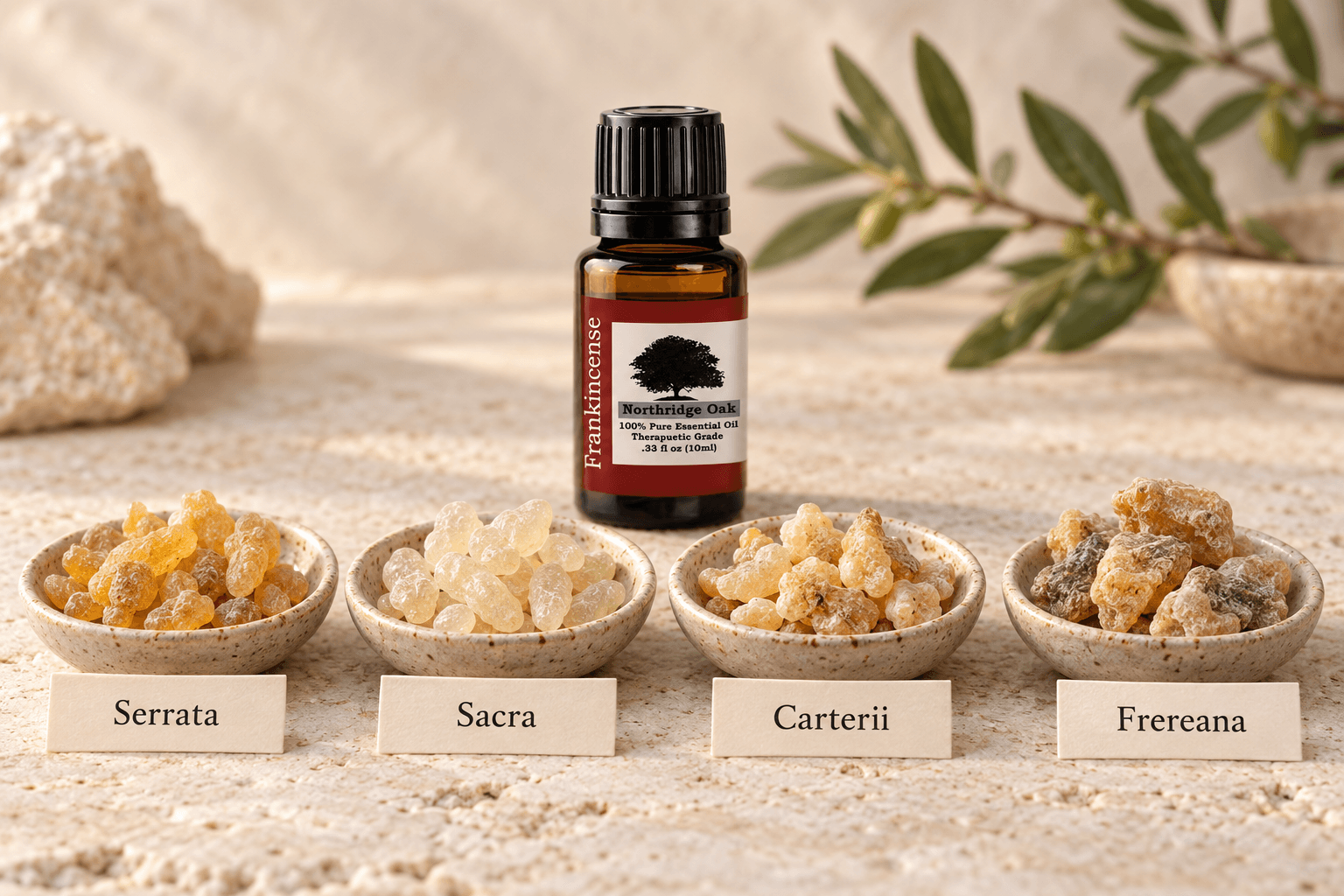
Frankincense is the oleo-gum-resin produced by trees in the Boswellia genus. These remarkable trees grow in some of the world's driest landscapes, including regions of Africa, the Arabian Peninsula and the Indian subcontinent.
Harvesters make careful incisions in the bark, allowing milky resin to emerge. The resin slowly hardens into fragrant tears that can be burned as incense, prepared in traditional ways or steam-distilled into essential oil.
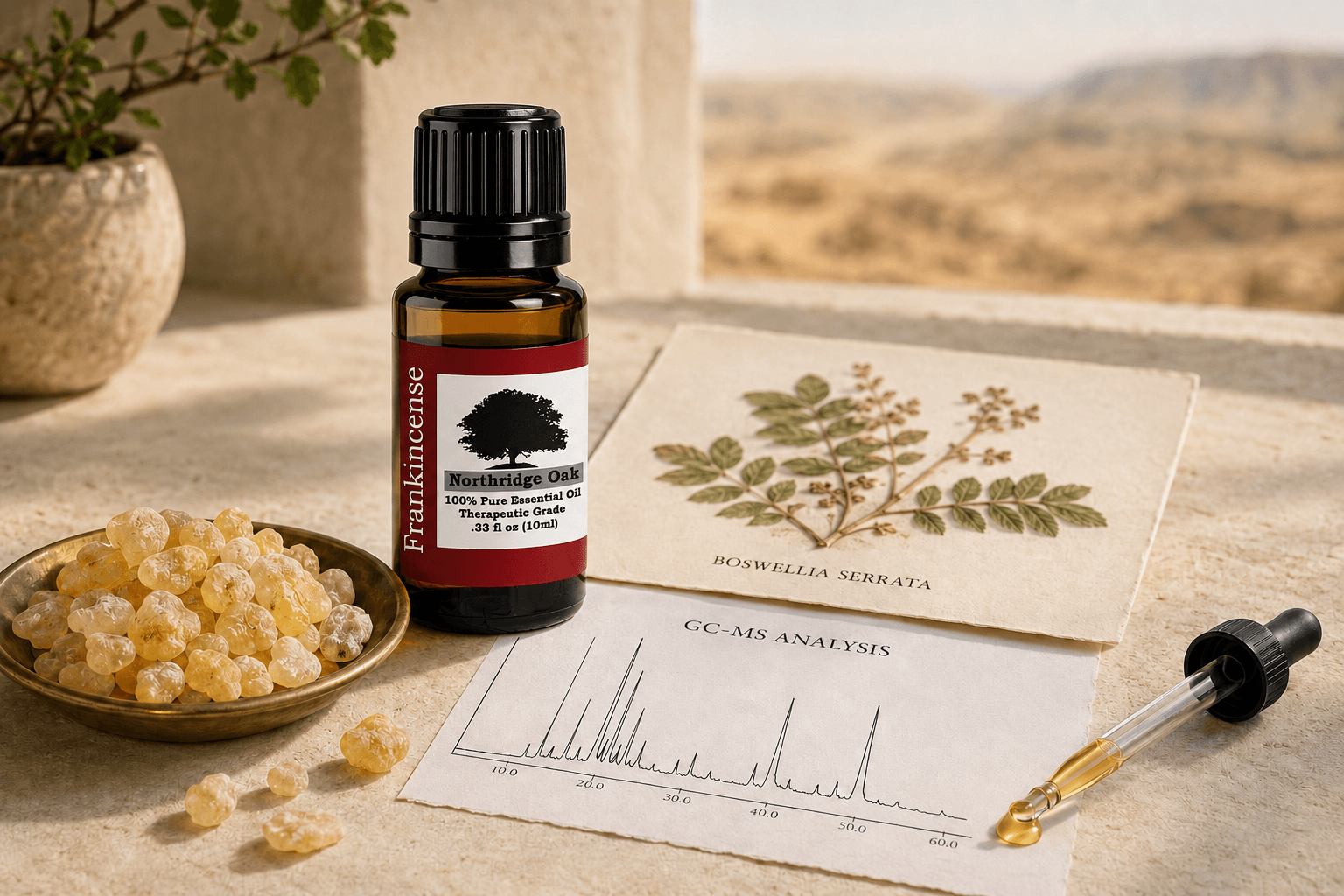
Northridge Oak Frankincense Essential Oil is steam-distilled from Boswellia serrata. It has a warm, resinous, woody aroma with earthy depth and a softly citrus-like brightness.
Frankincense works beautifully by itself, but it is also one of the most adaptable oils in a collection. It connects bright citrus and florals with heavier woods, spices and resins, making it invaluable in both diffuser blends and natural perfume.
What Does Frankincense Smell Like?
Imagine warm wood, dry earth and sunlit resin with a gentle citrus-pine freshness. The aroma often opens brighter than expected and becomes warmer and more balsamic as it develops.
In a blend, Frankincense can:
Add warmth without becoming overly sweet
Smooth the transition between top and base notes
Bring freshness to heavy wood or resin oils
Add depth to simple citrus combinations
Create a quiet, reflective atmosphere
Explore the oil in greater detail in our complete Frankincense Essential Oil guide.
What Is Myrrh?
Myrrh is the aromatic oleo-gum-resin produced by trees and shrubs in the Commiphora genus. Frankincense and Myrrh plants are botanical relatives: both belong to the resin-rich Burseraceae family.
Commiphora myrrha is native to dry regions extending from eastern and southeastern Ethiopia to northeastern Kenya and parts of the southern Arabian Peninsula. It is often a small, thorny tree or shrub with peeling bark and an extraordinary ability to survive in hot, arid landscapes.
The resin is usually darker and more reddish-brown than many Frankincense resins. When steam-distilled, it produces a deeply aromatic essential oil that may be thicker and more viscous than familiar oils such as Lavender, Lemon or Peppermint.
Northridge Oak Myrrh Essential Oil is produced from Commiphora myrrha. Its deep, earthy aroma brings richness and staying power to blends.
What Does Myrrh Smell Like?
Myrrh is more intense and mysterious than Frankincense. Its aroma is often described as:
Deep
Balsamic
Earthy
Smoky
Warm
Bittersweet
Resinous
Gently medicinal
Myrrh may feel powerful when smelled directly from the bottle. Give it a few minutes on a scent strip or combine it with Frankincense and citrus before deciding what you think. Once diluted or diffused, its harder edges soften and its warm, complex character becomes much easier to appreciate.
In a blend, Myrrh can:
Anchor lighter oils
Add depth and warmth
Make a perfume last longer on a scent strip
Turn a simple blend into something ancient and luxurious
Add a quiet, meditative quality
Frankincense vs. Myrrh: What Is the Difference?
Frankincense and Myrrh have much in common. Both are resins, both come from dryland trees, both belong to the same botanical family and both have been used in incense, perfume, cosmetics and traditional preparations.
The differences begin with the trees themselves.
Different Botanical Genera
Frankincense comes from Boswellia trees. Myrrh comes from Commiphora trees. They are relatives, not the same plant.
Northridge Oak uses:
Frankincense: Boswellia serrata
Myrrh: Commiphora myrrha
Different Aromatic Personalities
Frankincense is generally the brighter and more open of the two. Myrrh is darker, heavier and more tenacious.
If the blend were a room, Frankincense would open the curtains and let in warm sunlight. Myrrh would bring in the antique wood, worn leather and glowing amber.
Different Volatile Chemistry
Frankincense Essential Oil is commonly rich in monoterpenes such as alpha-pinene, alpha-thujene, limonene and related compounds, depending on the species and batch.
Myrrh Essential Oil often features heavier furanosesquiterpenes and sesquiterpenes. Research on Commiphora myrrha oils has identified compounds such as furanoeudesma-1,3-diene, curzerene, lindestrene and germacrone among prominent constituents.
This difference in volatile chemistry helps explain why Frankincense tends to feel brighter and why Myrrh has a deeper, longer-lasting aromatic presence.
Different Textures
Frankincense Essential Oil generally pours and drops with relative ease. Myrrh Essential Oil can be thicker, especially when cool or after the bottle has been open for some time.
If your Myrrh is slow to drop, hold the tightly closed bottle in your hands for a few minutes. Gentle warmth can make it easier to use. Do not microwave or place the bottle in boiling water.
Why Have Frankincense and Myrrh Been Paired for Thousands of Years?
Their partnership is far older than the modern essential-oil industry.
Frankincense and Myrrh were among the most valuable aromatic commodities of the ancient world. Merchants transported the resins by camel caravan from southern Arabia and the Horn of Africa toward Mediterranean markets along networks now commonly called the Incense Route.
The Metropolitan Museum of Art notes that ancient kingdoms in southwestern Arabia gained enormous wealth from this trade. Frankincense and Myrrh were prized for incense, perfumes, cosmetics, traditional preparations and religious or funerary ceremonies.
Their pairing also appears in traditional Chinese formulas, where the two resins have been combined for generations. Modern reviews have examined the phytochemistry of these traditional pairings and the ways combined preparations may behave differently from either material alone.
Research involving whole resins or extracts does not automatically describe a modern diffuser blend of the essential oils. But it confirms something people across cultures recognized long ago: these two aromatic materials naturally belong together.
Why Frankincense and Myrrh Smell So Good Together
The blend works because the oils fill different roles.
Frankincense brings brightness, lift and space. Myrrh brings depth, warmth and staying power. Frankincense helps Myrrh feel more open, while Myrrh gives Frankincense a richer foundation.
The pairing is especially beautiful when you add:
Blood Orange: Adds sweetness and sparkling citrus
Bergamot: Creates an elegant, softly floral citrus opening
Lavender: Softens the resins and makes the blend more restful
Cedarwood: Adds dry wood and strengthens the base
Patchouli: Creates an earthy, complex perfume
Geranium: Adds a rich green-floral character
Ylang Ylang: Makes the blend more exotic and luxurious
Clove: Adds warmth and spice in very small amounts
Frankincense and Myrrh Benefits in Everyday Life
A Grounding Aromatic Experience
Frankincense and Myrrh create a warm atmosphere that feels naturally suited to meditation, reflection, journaling, reading and quiet evenings. The aroma is rich without depending on synthetic fragrance.
A Beautiful Alternative to Ordinary Home Fragrance
Many home-fragrance products smell sweet, fruity or floral. Frankincense and Myrrh offer something entirely different: dry woods, warm resin, earth, smoke and subtle citrus.
Their aroma can make a room feel calm, intentional and sophisticated. It is especially appealing during fall and winter, but the right citrus pairing makes it beautiful throughout the year.
A Luxurious Addition to Skincare
Both oils have a long association with beauty and personal care. When properly diluted, Frankincense and Myrrh can be added to facial oils, body oils, hand oils and massage blends.
Frankincense is loved in routines for dry and mature-looking skin. Myrrh adds a rich aroma and feels especially at home in oils for dry hands, cuticles and body care. Together, they transform a simple carrier oil into a skincare ritual that feels ancient and indulgent.
A Natural Perfume Pairing
Frankincense and Myrrh are natural perfume materials with genuine complexity. They can form the heart and base of a personal fragrance without requiring a long ingredient list.
Add bright citrus for contrast, Lavender for softness or Cedarwood and Patchouli for an even deeper finish.
A Meaningful Gift
The historical and cultural importance of Frankincense and Myrrh gives the pair a significance few other essential oils possess. They make a thoughtful holiday gift, spiritual gift or introduction to resinous aromatics.
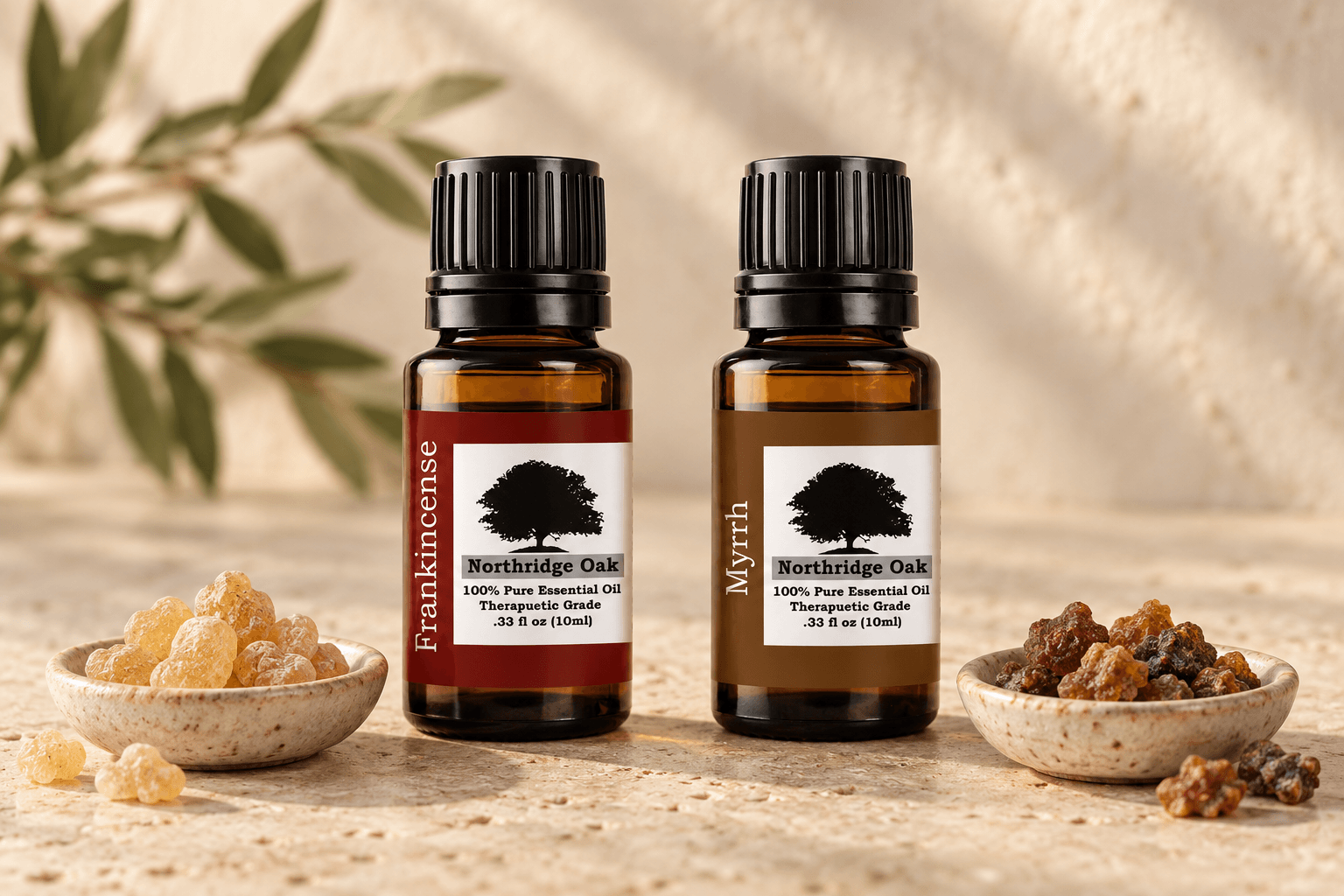
Northridge Oak offers a Frankincense and Myrrh Essential Oil pair, giving the recipient both oils to experience separately and together.
Frankincense and Myrrh Diffuser Blends
Adjust the number of drops to the size of your diffuser and the manufacturer's directions.
1. Ancient Calm
5 drops Frankincense
2 drops Myrrh
2 drops Lavender
Warm, resinous and softly floral. This is the ideal starting blend if Myrrh is new to you.
2. Gold, Frankincense and Myrrh
4 drops Frankincense
2 drops Myrrh
3 drops Blood Orange
Bright citrus creates a golden opening before the blend settles into warm resin.
3. Quiet Forest
4 drops Frankincense
2 drops Myrrh
3 drops Cedarwood
Dry woods and resin create a peaceful, cabin-like atmosphere.
4. Resin and Spice
4 drops Frankincense
2 drops Myrrh
3 drops Blood Orange
1 drop Clove
A rich fall and winter blend. Clove is powerful, so one drop is enough.
5. Sacred Garden
4 drops Frankincense
2 drops Myrrh
2 drops Geranium
1 drop Bergamot
Green floral notes lift the resins and create a sophisticated natural fragrance.
6. Deep Stillness
5 drops Frankincense
3 drops Myrrh
1 drop Patchouli
Earthy, deep and meditative. Use fewer total drops if you prefer a lighter aroma.
DIY Frankincense and Myrrh Grounding Roller
This personal aromatic blend is easy to keep beside your journal, meditation space or favorite chair.
You'll Need
4 drops Frankincense Essential Oil
2 drops Myrrh Essential Oil
1 drop Blood Orange Essential Oil
Fractionated coconut oil to fill a 10 mL roller bottle
Directions
Add the essential oils to the roller bottle, then fill with fractionated coconut oil. Insert the roller ball, cap and gently roll the bottle between your palms.
Apply lightly to the wrists or other pulse points whenever you want to enjoy the aroma. Avoid the face, eyes and mucous membranes.
DIY Frankincense and Myrrh Facial Oil
This simple 0.5% facial blend lets Frankincense lead while a touch of Myrrh adds depth.
You'll Need
1 fluid ounce jojoba oil or squalane
2 drops Frankincense Essential Oil
1 drop Myrrh Essential Oil
1-ounce amber glass dropper bottle
Directions
Combine everything in a clean, dry bottle and roll gently to mix. Apply one or two drops to slightly damp face and neck in the evening, avoiding the immediate eye area.
For more facial recipes, read Frankincense Oil for Face and Skin.
DIY Frankincense and Myrrh Body Oil
The deeper concentration used for body care allows both resins to shine.
You'll Need
2 fluid ounces sweet almond oil or fractionated coconut oil
8 drops Frankincense Essential Oil
4 drops Myrrh Essential Oil
2-ounce pump or dropper bottle
Directions
Combine the oils in a clean, dry bottle. Massage a small amount onto slightly damp skin after bathing, concentrating on dry areas.
DIY Frankincense and Myrrh Hand and Cuticle Oil
You'll Need
1 fluid ounce jojoba or sweet almond oil
4 drops Frankincense Essential Oil
2 drops Myrrh Essential Oil
1-ounce dropper bottle
Directions
Combine and roll gently to mix. Massage one or two drops into hands, nails and cuticles whenever they feel dry.
DIY Frankincense and Myrrh Natural Perfume
This warm resin perfume becomes richer as it rests.
You'll Need
5 drops Frankincense Essential Oil
3 drops Myrrh Essential Oil
2 drops Blood Orange Essential Oil
Fractionated coconut oil to fill a 10 mL roller bottle
Directions
Add the essential oils to the bottle and fill with carrier oil. Cap and gently roll to combine. Let the perfume rest for 24 to 48 hours before evaluating the finished aroma.
Apply lightly to pulse points. The citrus appears first, Frankincense forms the warm heart and Myrrh creates a deep resinous finish.
Can Frankincense and Myrrh Be Used Separately?
Absolutely. You do not need both oils for every recipe.
Use Frankincense alone when you want a warmer but brighter resin, an easy diffuser oil or a versatile addition to skincare and massage.
Use Myrrh alone when you want a deeper, darker aroma with strong base-note character. It is especially beautiful in hand oils, body oils and earthy natural perfumes.
Use them together when you want the complete resin experience: brightness and depth, lift and grounding, ancient familiarity and modern versatility.
Can You Substitute Frankincense for Myrrh?
You can substitute one for the other in a simple aromatic recipe, but the result will smell different.
Replacing Myrrh with Frankincense makes a blend lighter and brighter. Replacing Frankincense with Myrrh makes it deeper, heavier and more intense.
If a recipe calls for several drops of Frankincense, begin with about half as much Myrrh because Myrrh can dominate more easily. Smell the blend, then add more one drop at a time.
Tips for Blending Frankincense and Myrrh
Let Frankincense lead. A ratio of two parts Frankincense to one part Myrrh is an excellent starting point.
Add citrus if the blend feels too heavy.
Add Lavender or Geranium if you want softness.
Add Cedarwood or Patchouli if you want greater depth.
Give the blend time. Resin perfumes often smell more integrated after resting for a day or two.
Smell Myrrh on a scent strip instead of judging it only from the bottle.
Warm a tightly closed Myrrh bottle in your hands if the oil becomes slow to drop.
Frankincense and Myrrh Safety
Essential oils are highly concentrated. Dilute both oils before applying them to the skin, patch test new topical blends and keep them away from the eyes and mucous membranes. Do not apply essential oils to broken or irritated skin, and discontinue use if irritation occurs.
Do not ingest Northridge Oak essential oils. If you are pregnant, nursing, taking medication or managing a medical condition, seek individualized professional guidance before beginning a new essential-oil routine.
Store both bottles tightly closed and away from heat, moisture and direct sunlight. Myrrh can naturally become more viscous over time; this does not mean the oil is unusable.
Experience This Ancient Pair for Yourself
Frankincense and Myrrh have survived thousands of years of changing tastes because nothing else smells quite like them.
Frankincense brings warmth, light and openness. Myrrh brings depth, mystery and an unmistakable resinous finish. Together, they connect ancient aromatic tradition with the simple pleasure of creating something beautiful in your own home.
Begin with the Ancient Calm diffuser blend. Try the facial oil. Make a personal perfume and notice how it develops over several days. The best way to understand Frankincense and Myrrh is not simply to read about them—it is to experience how they transform when they meet.
Shop the Northridge Oak Frankincense and Myrrh Essential Oil pair, or explore Frankincense and Myrrh individually.
Northridge Oak - Frankincense and Myrrh - 100% Pure Essential Oils
$55.00
Frankincense and Myrrh Combo: Nature's Gift of Essential Oils Experience the Power of Frankincense and Myrrh Frankincense and myrrh essential oils are revered for their therapeutic properties. These 100% pure oils offer a multitude of benefits, making them a staple… read more
Research, Botanical and Historical References
Royal Botanic Gardens, Kew. Commiphora myrrha (T.Nees) Engl.. Plants of the World Online.
Royal Botanic Gardens, Kew. Burseraceae Kunth. Plants of the World Online.
The Metropolitan Museum of Art. Trade Between Arabia and the Empires of Rome and Asia.
Cao B, et al. Seeing the unseen of the combination of two natural resins, frankincense and myrrh: Changes in chemical constituents and pharmacological activities. Molecules. 2019. This review primarily concerns resins, extracts and traditional formulations rather than ordinary diffuser blends.
Marongiu B, et al. Chemical composition of the essential oil and supercritical CO2 extract of Commiphora myrrha. Natural Product Research. 2005.
Bouajaj S, et al. Frankincense and Myrrh Essential Oils and burn incense fume against micro-inhabitants of sacral environments. 2018.
Hanuš LO, et al. Myrrh—Commiphora chemistry. Review of phytochemistry and research.
Essential oils are highly concentrated. Always follow appropriate usage and dilution guidance for each individual oil. Some oils require additional precautions, so familiarize yourself with an oil's safety information before use. Keep essential oils out of reach of children and pets.
These statements have not been evaluated by the Food and Drug Administration. This information is for educational purposes only and is not intended to diagnose, treat, cure, or prevent any disease.
FAQs
What are Frankincense and Myrrh?
Frankincense and Myrrh are aromatic resins produced by related trees in the Burseraceae family. Frankincense comes from Boswellia species, while Myrrh comes from Commiphora species. Their resins can be steam-distilled into essential oils.
What are the benefits of Frankincense and Myrrh together?
Together, the oils create a warm, grounding aroma ideal for diffusion, meditation, natural perfume and properly diluted skincare. Frankincense brightens and opens the blend, while Myrrh adds depth and staying power.
What is the best ratio of Frankincense to Myrrh?
Start with two parts Frankincense to one part Myrrh. For example, use four drops of Frankincense and two drops of Myrrh. You can then adjust the balance to suit your preference.
What does Frankincense and Myrrh smell like?
The combination smells warm, resinous, woody, earthy, balsamic and lightly smoky. Frankincense adds brightness and a subtle citrus-pine quality, while Myrrh contributes deep, bittersweet warmth.
Can I diffuse Frankincense and Myrrh together?
Yes. Begin with five drops of Frankincense, two drops of Myrrh and two drops of Lavender, adjusting the total for your diffuser size and instructions.
Can Frankincense and Myrrh be used on the skin?
Yes, when appropriately diluted in a suitable carrier oil. The facial oil in this guide uses two drops of Frankincense and one drop of Myrrh in one fluid ounce of carrier oil.
Why is Myrrh Essential Oil so thick?
Myrrh contains heavier resinous aromatic compounds and can naturally become viscous. Warm the tightly closed bottle in your hands for a few minutes to help the oil flow. Never use a microwave or boiling water.