Table of Contents
- Quick answer: How do you dilute peppermint essential oil?
- Why you will love knowing how to dilute peppermint
- The simple dilution formula
- Peppermint essential oil dilution chart
- Which dilution should you choose?
- What can you dilute peppermint oil with?
- Recipe 1: 1% everyday peppermint roller
- Recipe 2: 1% peppermint scalp oil
- Recipe 3: 2% peppermint foot massage oil
- Recipe 4: 1% peppermint-lavender body oil
- How to patch test a diluted formula
- What if peppermint oil gets in your eye?
- Peppermint safety essentials
- Make dilution your new favorite habit
- Continue your Peppermint Learning Center
- Sources
- FAQs
Peppermint essential oil is wonderfully concentrated—just a few drops can fill a whole bottle of carrier oil with that bright, refreshing aroma. Dilution is not about “watering it down.” It is the simple, practical step that lets you spread a tiny amount evenly, measure more consistently, and enjoy peppermint’s benefits with greater comfort and confidence.
Once you know one easy formula, you can create rollers, scalp treatments, foot oils, and massage blends that feel just right for you. This guide is the clear, safety-focused companion to our pillar collection of 25 peppermint essential oil uses and DIY recipes.
Quick answer: How do you dilute peppermint essential oil?
Use this simple formula:
Carrier volume in mL × desired percentage × 20 drops per mL = approximate essential-oil drops
Example for a 1% dilution in 30 mL:
30 × 0.01 × 20 = 6 drops
That single calculation is all you need to scale almost any recipe. The 20-drops-per-mL figure is a helpful average—actual drop size can vary slightly with the bottle, oil temperature, and viscosity—so treat the numbers as reliable guides rather than laboratory precision.
Why you will love knowing how to dilute peppermint
- Confidence in every blend – No more guessing. You will know exactly how many drops belong in a roller, scalp oil, or massage bottle.
- Comfortable, everyday use – Proper dilution makes peppermint’s cool, uplifting scent enjoyable rather than overwhelming.
- Easy customization – Start low and adjust. You can create gentle daily rollers or stronger short-term body blends with the same straightforward math.
- Better results, less waste – A well-diluted formula spreads evenly and lasts longer than undiluted drops applied directly.
- Safe, thoughtful DIY – You protect your skin while still enjoying the true-to-plant aroma of pure peppermint.
Ready to make your first blend? Reach for Northridge Oak Peppermint Essential Oil—100% pure, undiluted Mentha piperita and third-party GC/MS tested—so every drop you measure is exactly what you expect.
The simple dilution formula
Carrier volume in mL × desired percentage × 20 drops per mL = approximate essential-oil drops
Write the percentage as a decimal. For larger or high-precision batches, measuring by weight with a scale is even more accurate.
Peppermint essential oil dilution chart
| Carrier oil amount | Approx. 0.5% | Approx. 1% | Approx. 2% | Approx. 3% |
|---|---|---|---|---|
| 5 mL | Too small to measure accurately by drops | 1 drop | 2 drops | 3 drops |
| 10 mL | 1 drop | 2 drops | 4 drops | 6 drops |
| 15 mL | 2 drops | 3 drops | 6 drops | 9 drops |
| 30 mL / 1 fl oz | 3 drops | 6 drops | 12 drops | 18 drops |
| 60 mL / 2 fl oz | 6 drops | 12 drops | 24 drops | 36 drops |
These are approximate drop counts, not medical doses. Start on the lower side—especially for frequent use, larger skin areas, sensitive skin, or applications near the head and neck.
Which dilution should you choose?
0.5%
A gentle level for people who already know peppermint works well for them but prefer a lighter aroma or a more conservative approach. Small bottles are hard to measure accurately at this strength, so aim for at least 10–30 mL.
1%
The practical everyday starting point for adult cosmetic use, scalp oils, or pulse-point rollers. Six drops in one ounce of carrier is easy to remember and comfortable for most people.
2%
A stronger adult body blend intended for short-term or limited-area use. Not every situation needs this concentration—let comfort be your guide.
3%
An occasional, limited-area adult option. Higher is not automatically better. Many people with sensitive skin prefer to stay well below this level.
Professional safety references list a dermal maximum higher than these routine percentages. A maximum is simply a ceiling, not a daily target. Most home users never need to approach it.
What can you dilute peppermint oil with?
Carrier oils are skin-friendly vegetable oils that help distribute the essential oil evenly.
- Jojoba – Light, stable, and excellent for rollers and scalp blends
- Fractionated coconut oil – Nearly odorless and easy to spread
- Grapeseed oil – Lightweight (though less stable than jojoba over long storage)
- Sweet almond oil – A classic massage base (avoid if nut allergies are a concern)
- Olive oil – Readily available and nourishing, with its own mild aroma
Water is not a carrier. Peppermint oil floats on water and can still contact skin in concentrated droplets.
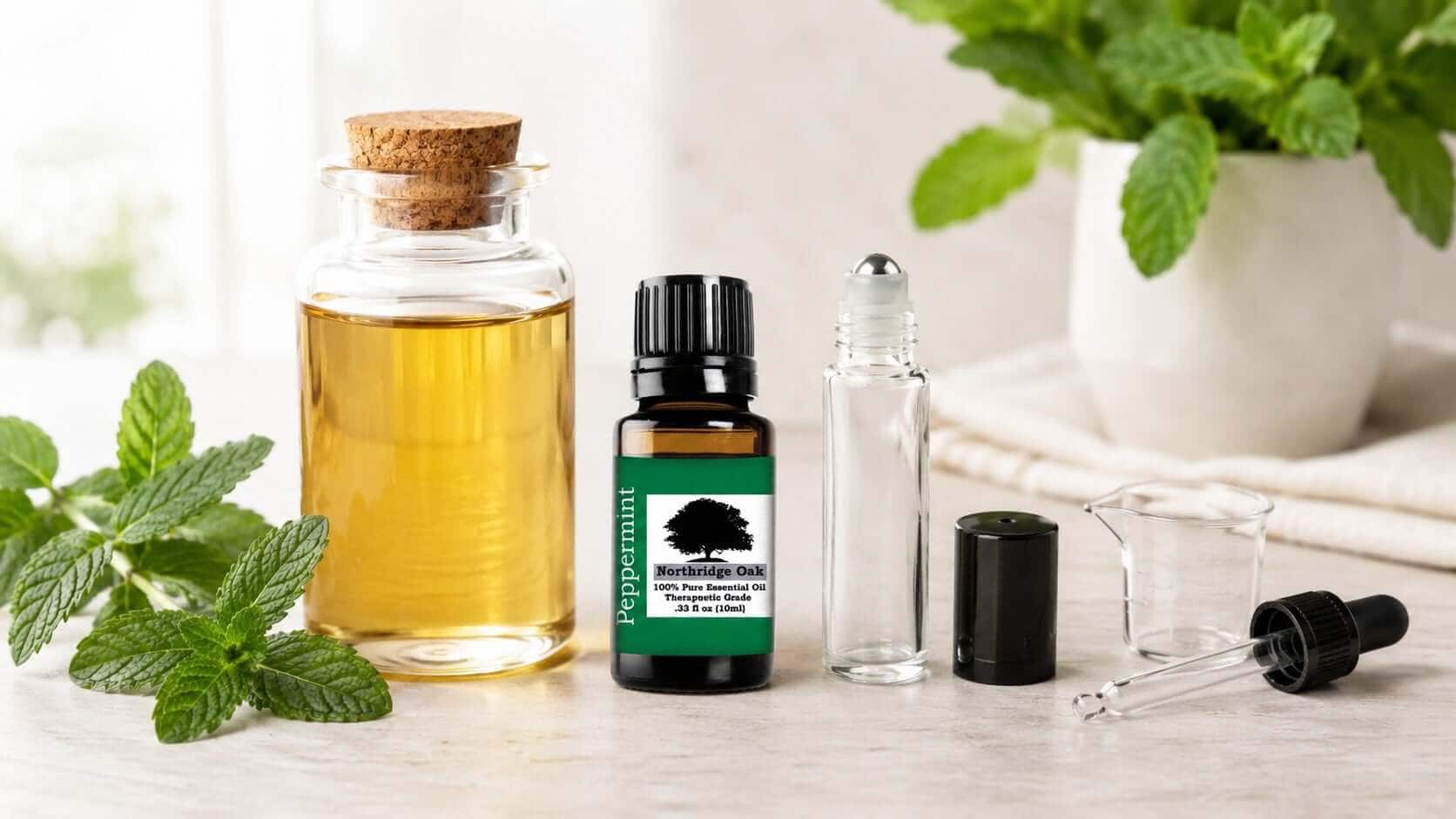
Recipe 1: 1% everyday peppermint roller
Ingredients
- 2 drops Peppermint Essential Oil
- 10 mL jojoba or fractionated coconut oil
- 10 mL roller bottle
Add the essential oil, fill with carrier, close the bottle, and roll it between your palms to mix. Patch-test first. Apply only to intact skin, away from the eyes and face.
Recipe 2: 1% peppermint scalp oil
- 6 drops Peppermint Essential Oil
- 1 fluid ounce (30 mL) jojoba oil
Massage a small amount into the scalp before shampooing. For full research context and step-by-step tips, see our peppermint oil for hair and scalp guide.
Recipe 3: 2% peppermint foot massage oil
- 6 drops Peppermint Essential Oil
- 1 tablespoon (15 mL) carrier oil
Mix in a small bottle. Apply sparingly to intact adult feet, then wash your hands thoroughly. Do not walk on oily floors, and avoid use on cracked or irritated skin.
Recipe 4: 1% peppermint-lavender body oil
- 3 drops Peppermint Essential Oil
- 3 drops Lavender Essential Oil
- 1 fluid ounce (30 mL) carrier oil
The total essential-oil concentration is approximately 1% because you count every drop of essential oil together. When blending multiple oils, always add up the full total.
How to patch test a diluted formula
- Apply a small amount of the finished blend to a patch of intact inner forearm skin.
- Leave the area uncovered and avoid other scented products.
- Watch for redness, burning, swelling, itching, or lasting discomfort.
- If any reaction appears, wash the area gently and discontinue use.
A patch test lowers uncertainty, though it cannot guarantee a future reaction will never occur.
What if peppermint oil gets in your eye?
Move away from the source and avoid rubbing. Because essential oil does not mix with water, ordinary flushing may not remove the oily residue efficiently. Contact Poison Control in the United States at 1-800-222-1222 or seek urgent medical guidance—especially for significant pain, vision changes, or any child’s exposure.
For skin discomfort, stop use and gently wash. A little carrier oil can help lift residual essential oil before soap and water. Seek medical advice for any serious or persistent reaction.
Peppermint safety essentials
- Never use undiluted on skin.
- Keep away from eyes, nostrils, mouth, ears, and other mucous membranes.
- Do not apply to broken or irritated skin.
- Do not swallow essential oil.
- Do not apply peppermint near the face of infants or young children—inhaled menthol can cause serious effects.
- Ask a qualified professional before use during pregnancy, breastfeeding, with a significant medical condition, or alongside any treatment plan.
- Label every blend with ingredients, percentage, and date.
- Store away from heat, light, children, and pets.
Make dilution your new favorite habit
A few minutes of measuring opens up a whole world of comfortable, aromatic DIY. Whether you are rolling a quick pulse-point blend, treating your scalp, or creating a refreshing foot oil, the same simple formula keeps everything consistent and enjoyable.
Shop Northridge Oak Peppermint Essential Oil and start your first well-diluted blend today. One 10 mL bottle gives you plenty of pure Mentha piperita for rollers, scalp oils, massage blends, and many more of the recipes waiting in the Peppermint Learning Center—all while helping you live the life you love.
100% Pure Peppermint Essential Oil – 10 mL
$7.50
100% Pure Peppermint Essential Oil Bright, crisp and unmistakably minty, Northridge Oak Peppermint Essential Oil brings a refreshing aroma to diffuser blends, personal-care routines and household DIY recipes. Its naturally cool, invigorating scent is a favorite when you want your… read more

Continue your Peppermint Learning Center
Start with the pillar guide to 25 peppermint essential oil uses, DIY recipes, and refreshing aromatherapy, then explore every supporting guide:
- Peppermint essential oil diffuser blends
- Peppermint oil for hair and scalp
- Peppermint essential oil for headaches
- Peppermint essential oil for focus and energy
- Peppermint essential oil cleaning recipes
- Peppermint oil spray for bugs
- DIY peppermint shower steamers
- Peppermint vs. Spearmint essential oil
- What blends well with peppermint essential oil
Sources
Essential oils are highly concentrated. Always follow appropriate usage and dilution guidance for each individual oil. Some oils require additional precautions, so familiarize yourself with an oil’s safety information before use. Keep essential oils out of reach of children and pets.
These statements have not been evaluated by the Food and Drug Administration. This content is for educational purposes and is not intended to diagnose, treat, cure, or prevent any disease.
Frequently Asked Questions
How many drops of peppermint oil go in 10 mL of carrier oil?
Approximately 1 drop for 0.5%, 2 drops for 1%, 4 drops for 2%, or 6 drops for 3%.
How many drops go in one ounce?
One fluid ounce is about 30 mL. Use approximately 3 drops for 0.5%, 6 for 1%, 12 for 2%, or 18 for 3%.
Can I dilute peppermint essential oil with water?
No. Oil and water separate. Use a true carrier oil for skin application.
Can I put peppermint oil directly on my skin?
No. Undiluted use raises the chance of irritation and makes it easy to transfer concentrated oil into the eyes.
Is a stronger dilution more effective?
Not automatically. The best concentration is simply the lowest level that feels right for the purpose and the person using it.
Does a 10 mL essential-oil bottle make a 10 mL roller?
No. A roller contains only a few drops of essential oil; the rest is carrier oil.
Do I count every oil when making a blend?
Yes. Dilution percentage is based on the total number of all essential-oil drops combined.
Can I use the same dilution on my face?
Peppermint is intense near the eyes and mucous membranes and is not ideal as a general facial oil. Choose a gentler, face-specific formula instead.