Table of Contents
- What kind of headache was peppermint oil studied for?
- What the peppermint oil headache study actually found
- Why peppermint oil feels cooling
- How to use peppermint oil for headaches at home
- A 15-minute peppermint headache reset routine
- How quickly might peppermint oil feel helpful?
- Peppermint oil for migraines, sinus headaches, and other head pain
- How to choose a quality peppermint essential oil
- Important safety for peppermint oil near the face
- When a headache needs prompt medical attention
- What you have learned
- Continue your Peppermint Learning Center
- Sources
- Frequently Asked Questions
Peppermint oil for headaches is more than a familiar home-remedy search. Controlled clinical research has tested a standardized topical peppermint preparation for tension-type headaches, and the results help explain why a cooling swipe of mint has become such a popular part of at-home headache routines.
The clearest evidence is for topical peppermint oil used for tension-type headaches. In a controlled study, a 10% peppermint oil solution in ethanol was applied to the forehead and temples. Researchers reported a significant reduction in headache intensity compared with placebo, with improvement beginning within 15 minutes and continuing through the one-hour observation period. A later scientific review described the efficacy of studied topical preparations as comparable to common pain relievers used in the trials.
Quick answer: Research supports a specifically prepared, topically applied peppermint oil solution for acute tension-type headache. For everyday home use, a gently diluted peppermint roller can create the characteristic cooling sensation while helping you build a quiet, restorative reset routine. The research does not establish peppermint as a treatment for every headache type, so knowing your headache pattern matters.
This guide explains what the studies found, why menthol feels cooling, how to make a gentle peppermint temple roller, and how to use it confidently and safely. For more ways to enjoy this versatile oil, visit our complete guide to peppermint essential oil uses.
What kind of headache was peppermint oil studied for?
The strongest direct research applies to tension-type headache. This common headache is often described as pressure, tightness, or a band-like feeling around both sides of the head. It may arrive alongside tight shoulders, a tense jaw, long hours at a screen, stress, missed meals, poor sleep, or changes in caffeine habits.
Migraine is different. It is a neurological condition that may involve throbbing pain, nausea, sensitivity to light or sound, visual changes, and other symptoms. People do search for peppermint oil for migraines, and some enjoy its cooling aroma as part of their comfort routine. However, the controlled evidence discussed in this article centers on tension-type headache. That distinction lets you use the research accurately while still exploring whether peppermint feels supportive for you.
Headaches can also result from dehydration, illness, medication effects, sinus pressure, eye strain, injury, or many other causes. Peppermint can be one useful tool in a broader self-care plan, especially when you recognize the familiar pattern of an occasional tension headache.
What the peppermint oil headache study actually found
In the controlled clinical study by Göbel and colleagues, researchers evaluated a 10% peppermint oil solution in ethanol for tension-type headache. The preparation was spread across the forehead and temples, with application repeated after 15 and 30 minutes. It was compared with placebo and with 1,000 mg of acetaminophen (called paracetamol in the study).
The peppermint preparation significantly reduced headache intensity compared with placebo. The reported effect began by the first 15-minute assessment and remained evident throughout the 60-minute observation period. The researchers found no significant difference in efficacy between the studied peppermint preparation and acetaminophen under the study conditions. They concluded that the 10% peppermint oil solution efficiently alleviated tension-type headache and was well tolerated.
That result is especially interesting because this was not simply an aromatherapy preference survey. It was a controlled comparison using a defined preparation, a defined application method, timed assessments, placebo, and an active comparator.
What the later review concluded
A 2016 review of peppermint oil in acute tension-type headache reported that topical peppermint oil had performed significantly better than placebo in controlled studies. The authors described its efficacy as comparable to acetylsalicylic acid (aspirin) or acetaminophen in the research they reviewed. They also noted that 10% peppermint oil solutions in ethanol are licensed in Germany for external treatment of tension-type headache in adults and children over age six.
The U.S. National Center for Complementary and Integrative Health offers a more measured independent summary: a limited amount of evidence suggests that peppermint oil applied to the skin might relieve tension headaches. Taken together, these sources give peppermint a credible research foundation while keeping the conclusion tied to the studied use.
Why the exact preparation matters
The study tested a 10% peppermint-in-ethanol preparation, not neat essential oil and not every homemade recipe found online. Ethanol changes how a formula spreads and evaporates, while concentration affects both sensory intensity and the possibility of irritation. This is why it is useful to separate two ideas:
Research formula: a standardized 10% topical preparation used under study conditions.
Gentle home ritual: a lower dilution designed as a conservative starting point for personal use near the temples.
You do not need to imitate a clinical formula to appreciate peppermint's cooling qualities. For a DIY roller near the face, beginning gently is a practical approach.
Why peppermint oil feels cooling
Peppermint essential oil, distilled from Mentha piperita, is naturally rich in menthol. Menthol activates sensory receptors known as TRPM8 receptors. These receptors are part of the same system your body uses to detect cool temperatures, which is why peppermint can make the skin feel cool even when the skin's actual temperature has not meaningfully changed.
This vivid cooling signal can shift sensory attention away from feelings of tightness or pressure. Research has also explored peppermint's influence on pain processing and tension in the muscles around the head. The complete mechanism is complex, but the recognizable cooling sensation gives you an immediate, tangible reason peppermint fits naturally into a headache reset routine.
Aroma contributes to the experience as well. The bright mint scent can serve as a cue to stop, breathe more slowly, unclench your jaw, lower your shoulders, and take a short break from visual stimulation. Those small actions can make the ritual more restorative.
How to use peppermint oil for headaches at home
There are two simple ways to explore peppermint for an occasional tension-type headache: a properly diluted topical roller or a brief aromatic method. The topical route most closely resembles the route used in the headache research, although the gentle DIY concentration below is not the same research formula.
Option 1: Make a gentle 1% peppermint temple roller
You will need:
10 mL jojoba oil or another lightweight carrier oil
One clean 10 mL roller bottle
A label and date
Directions:
Add two drops of peppermint essential oil to the bottle.
Fill the bottle with jojoba oil, leaving enough room for the roller insert.
Secure the insert and cap, then roll the bottle gently between your palms.
Label the bottle “1% peppermint,” list the carrier oil, and add the date.
Patch test a small amount on the inner forearm before using it near the face.
If the patch test is comfortable, apply one light pass to each temple, well away from the eyes and hairline.
Wash your hands after application so you do not accidentally transfer oil to your eyes.
One drop in 10 mL creates an approximately 0.5% dilution for people who prefer an even gentler starting point. For other bottle sizes, use our complete peppermint essential oil dilution chart.
Avoid rolling directly across the forehead if perspiration could carry the mixture toward your eyes. Never place essential oil in the eyes, nose, ears, or mouth, and do not apply it to broken or irritated skin.
Option 2: Use peppermint aromatically
If you prefer no skin contact, add one drop of peppermint essential oil to the wick of a personal aromatherapy inhaler. Hold it a comfortable distance away and take a few gentle breaths. You can also diffuse peppermint at low intensity in a well-ventilated room.
An aromatic method can be refreshing and may help establish a calming pause, but it is not the same method used in the topical headache study. If you enjoy diffusion, explore these peppermint essential oil diffuser blends for balanced combinations.
Option 3: Pair the diluted roller with a cool-cloth reset
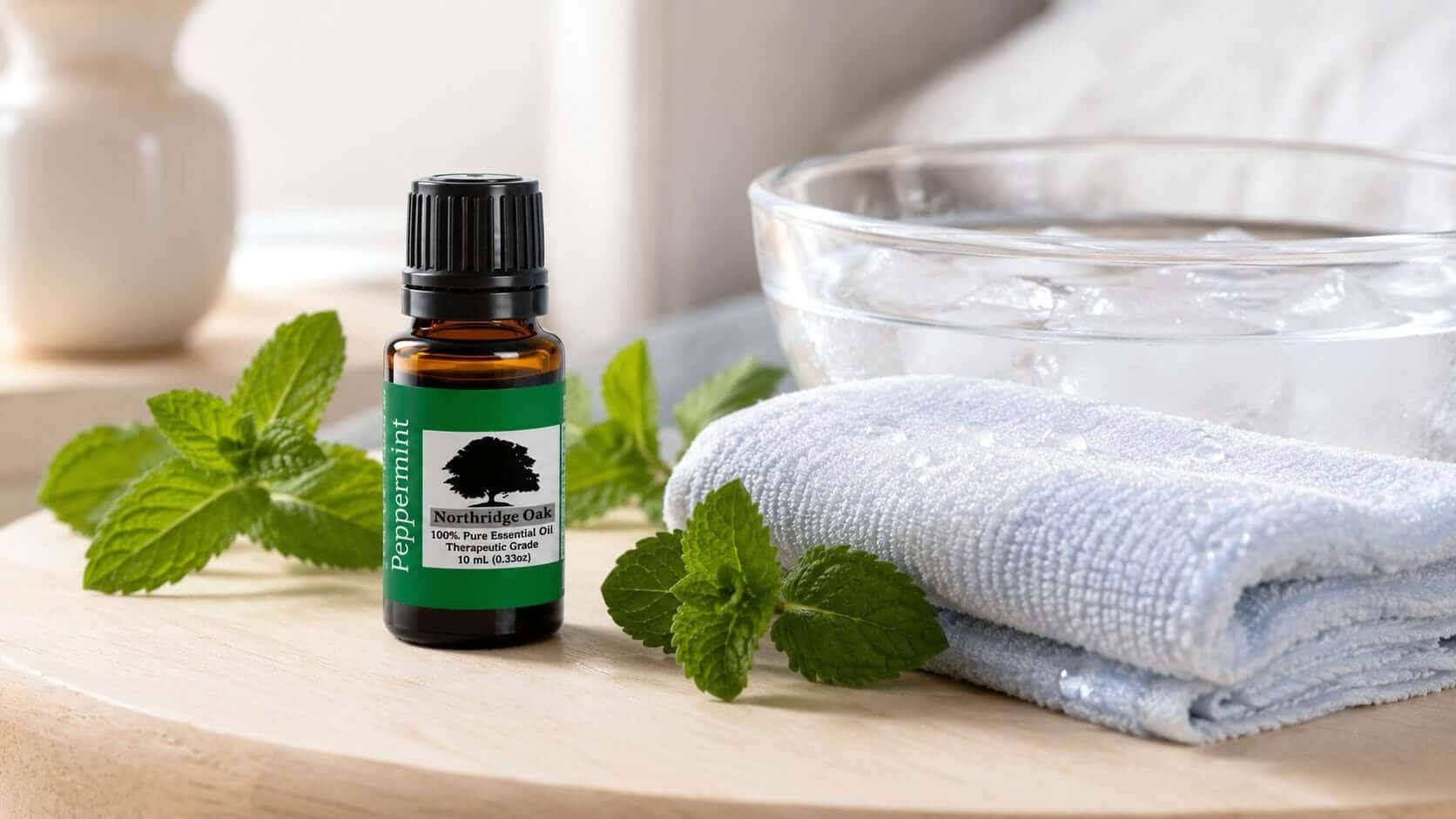
After applying the diluted roller to the temples, rest with a plain cool, damp cloth across the forehead or the back of the neck. Keep essential oil out of the water: oil and water do not mix evenly, and floating droplets can reach the eyes. A plain cloth gives you the cool physical sensation without that risk.
A 15-minute peppermint headache reset routine
This short routine combines peppermint with several practical steps that address common tension-headache patterns:
Minute 0–2: Check the basics. Drink a glass of water if you may be dehydrated. If you skipped a meal, have a small balanced snack.
Minute 2–4: Reduce stimulation. Lower the lights, silence notifications, and step away from your screen.
Minute 4–5: Apply peppermint. Use a very small amount of your patch-tested 0.5% or 1% roller on the temples, away from the eyes.
Minute 5–10: Release tension. Let your tongue rest, unclench your teeth, lower your shoulders, and take slow, comfortable breaths.
Minute 10–15: Rest and observe. Sit or lie in a quiet room. Notice whether the pressure, muscle tension, or overall intensity changes.
Keep a simple note of the date, possible triggers, what you tried, and what changed. Patterns involving sleep, posture, screen time, stress, meals, menstrual cycles, or caffeine can become clearer over several weeks.
How quickly might peppermint oil feel helpful?
In the controlled tension-headache study, the first measured improvement appeared at the 15-minute assessment. That does not create a universal countdown, but it gives you a reasonable time frame for a quiet trial of the routine.
The cooling sensation itself often appears sooner because menthol begins activating cold-sensitive receptors after topical application. Relief and cooling are not identical, so evaluate the whole experience: headache intensity, sense of pressure, shoulder tension, comfort, and your ability to resume normal activity.
Peppermint oil for migraines, sinus headaches, and other head pain
Searches for essential oils for headaches often group very different experiences together. Here is the most useful way to interpret the evidence:
Tension-type headaches: This is where topical peppermint has its most relevant controlled evidence.
Migraine: Some people appreciate peppermint's cool feeling or aroma, but the tension-headache study should not be presented as proof that peppermint treats migraine. Strong scents can also be unpleasant during migraine for some people.
Sinus pressure: Menthol can create a sensation of easier airflow, but that sensation does not necessarily mean nasal passages are physically more open or that an infection has been treated.
Neck and shoulder tension: A diluted peppermint blend may feel refreshing when massaged onto the shoulders or back of the neck, provided the skin is intact and the mixture is kept away from the face.
If your headache pattern is unfamiliar, severe, frequent, or changing, identifying the cause is more important than assigning it a label yourself.
How to choose a quality peppermint essential oil
Because essential oils are concentrated, sourcing and identity matter. Look for the botanical name Mentha piperita, clear usage guidance, lot-level traceability, and independent testing. The label should make clear that the bottle contains pure essential oil rather than a fragrance oil.
Northridge Oak Peppermint Essential Oil is 100% pure, undiluted Mentha piperita and third-party GC/MS tested. Its crisp, cooling aroma makes it a useful single oil for a temple roller, personal inhaler, diffuser blend, post-workout blend, or shower-steamer recipe.
Build your peppermint routine
Start with a fresh bottle of pure, third-party tested Mentha piperita, then dilute it to match the way you plan to use it.
Important safety for peppermint oil near the face
Dilute peppermint essential oil before skin application.
Patch test a new blend and stop using it if redness, burning, rash, or irritation develops.
Keep the blend well away from the eyes, eyelids, nostrils, mouth, and other mucous membranes.
If oil reaches the eye, flush with plenty of clean, lukewarm water and contact a poison-control center or medical professional for guidance.
Do not apply peppermint oil to the face of infants or young children. Inhaled menthol can cause serious effects in this age group.
Do not swallow essential oil. Keep bottles and rollers out of reach of children and pets.
Ask a qualified health professional for individualized guidance during pregnancy or breastfeeding, for children, or when managing a medical condition.
For everyday formulation help, bookmark the peppermint dilution guide before making topical recipes.
When a headache needs prompt medical attention
Essential oils are appropriate for a comfort routine, not for delaying evaluation of warning signs. Seek urgent medical care for a sudden “worst headache,” a headache after a significant head injury, or a headache accompanied by weakness, numbness, confusion, fainting, seizure, stiff neck, fever, vision loss, chest pain, or difficulty speaking.
Arrange timely professional care for a new or unusually severe headache, headaches that are becoming more frequent, a major change in your normal pattern, headaches during pregnancy or postpartum, or symptoms that repeatedly interfere with daily life. You can enjoy peppermint as a supportive sensory tool while also getting the evaluation you need.
What you have learned
Peppermint oil for headaches has a stronger research story than many people realize. The key is to match the claim to the evidence:
Controlled studies examined a defined 10% peppermint oil solution applied to the forehead and temples for tension-type headache.
The studied preparation reduced headache intensity compared with placebo, with measured improvement beginning at 15 minutes.
Menthol activates TRPM8 cold receptors, producing peppermint's familiar cooling sensation.
A gentle 0.5% to 1% roller offers a conservative way to explore peppermint at home, although it is not identical to the research formula.
Correct dilution, careful placement, patch testing, and quality sourcing make the experience more comfortable and dependable.
If your familiar tension headaches respond well to cooling rituals, a peppermint roller is a simple addition to keep in your self-care kit.
Continue your Peppermint Learning Center
Make peppermint one of the most useful oils in your collection with these practical guides:
Sources
Göbel H, Heinze A. Peppermint oil in the acute treatment of tension-type headache.
National Center for Complementary and Integrative Health: Peppermint Oil—Usefulness and Safety.
Essential oils are highly concentrated. Always follow appropriate usage and dilution guidance for each individual oil. Some oils require additional precautions, so familiarize yourself with an oil's safety information before use. Keep essential oils out of reach of children and pets.
These statements have not been evaluated by the Food and Drug Administration. This content is educational and is not medical advice or a substitute for diagnosis or treatment from a qualified professional.