Table of Contents
- Why people connect spearmint with facial hair
- The 30-day randomized controlled trial
- The earlier five-day study
- What these findings mean for someone with PCOS
- Can spearmint oil still belong in facial care?
- A gentle spearmint facial-oil recipe
- Spearmint, acne and the face
- A warm, evidence-aligned takeaway
- Continue learning about Spearmint Essential Oil
- Read the original spearmint studies
- Frequently Asked Questions
Spearmint and facial hair is one of the most searched—and most easily blurred—topics in the mint world. The encouraging news is that human studies do exist. The human studies focused on spearmint herbal tea, giving us valuable evidence about the plant while clearly identifying the preparation that produced the results.
That distinction makes the research more useful because it shows exactly how spearmint was prepared and studied. It makes it more useful. Once we separate the product in the study from the oil in your bottle, you can understand the hormone findings accurately, and still enjoy spearmint essential oil in a beautifully diluted aromatic skin-care routine.
Why people connect spearmint with facial hair
Hirsutism describes coarse, pigmented hair growth in a pattern associated with androgen activity. It can be part of polycystic ovary syndrome, though every person’s health picture is individual. Because spearmint tea has been studied for its effect on androgen measurements, online discussions often shorten “spearmint tea research” into “spearmint works for facial hair.”
The missing noun matters. Tea is a water-based preparation made from leaves and consumed in a defined amount. Essential oil is a concentrated volatile fraction created by distillation. Each preparation has its own chemical profile and route of use, so each deserves to be understood and enjoyed on its own terms.
The 30-day randomized controlled trial
A 2010 randomized trial enrolled 42 volunteers with hirsutism related to polycystic ovary syndrome. Participants drank spearmint tea or a placebo herbal tea twice daily for 30 days; 41 completed the study. Researchers measured hormone markers, asked participants about their experience and assessed hair growth with an objective scoring system.
Free and total testosterone decreased significantly in the spearmint-tea group, while luteinizing hormone and follicle-stimulating hormone increased. Participants’ own ratings of hirsutism improved. The authors observed meaningful hormonal changes and participant-reported improvement during the 30-day study, while noting that the longer natural hair-growth cycle may require a longer trial to register fully on the Ferriman–Gallwey score.
The earlier five-day study
An earlier clinical study also examined spearmint tea in women with hirsutism. It reported changes in free testosterone and related hormone measures over a short period. Together, the two trials offer a credible reason for continued research, especially longer studies that can observe a complete hair-growth cycle.
Together, these findings create a promising foundation for continued research into spearmint preparations, including future studies designed specifically for topical essential-oil formulas. For today’s routines, tea and topical essential oil each offer their own distinct way to experience the plant.
What these findings mean for someone with PCOS
The studies can be a useful item to bring to a healthcare appointment. PCOS can involve menstrual, metabolic, fertility, skin and hair concerns, so personalized care is valuable. A clinician can help interpret hormone symptoms, discuss established options and decide whether herbal tea fits safely alongside medications and individual health needs.
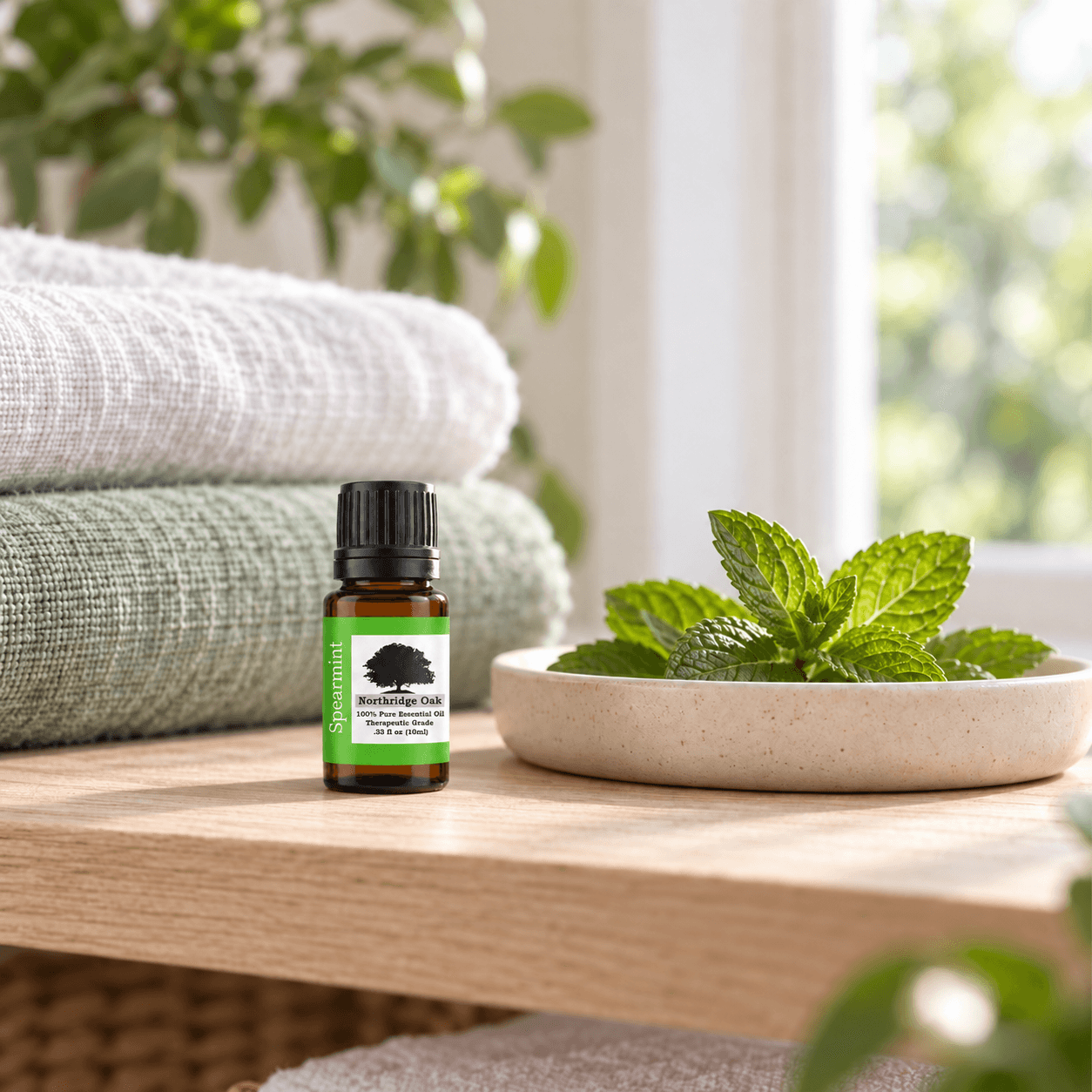
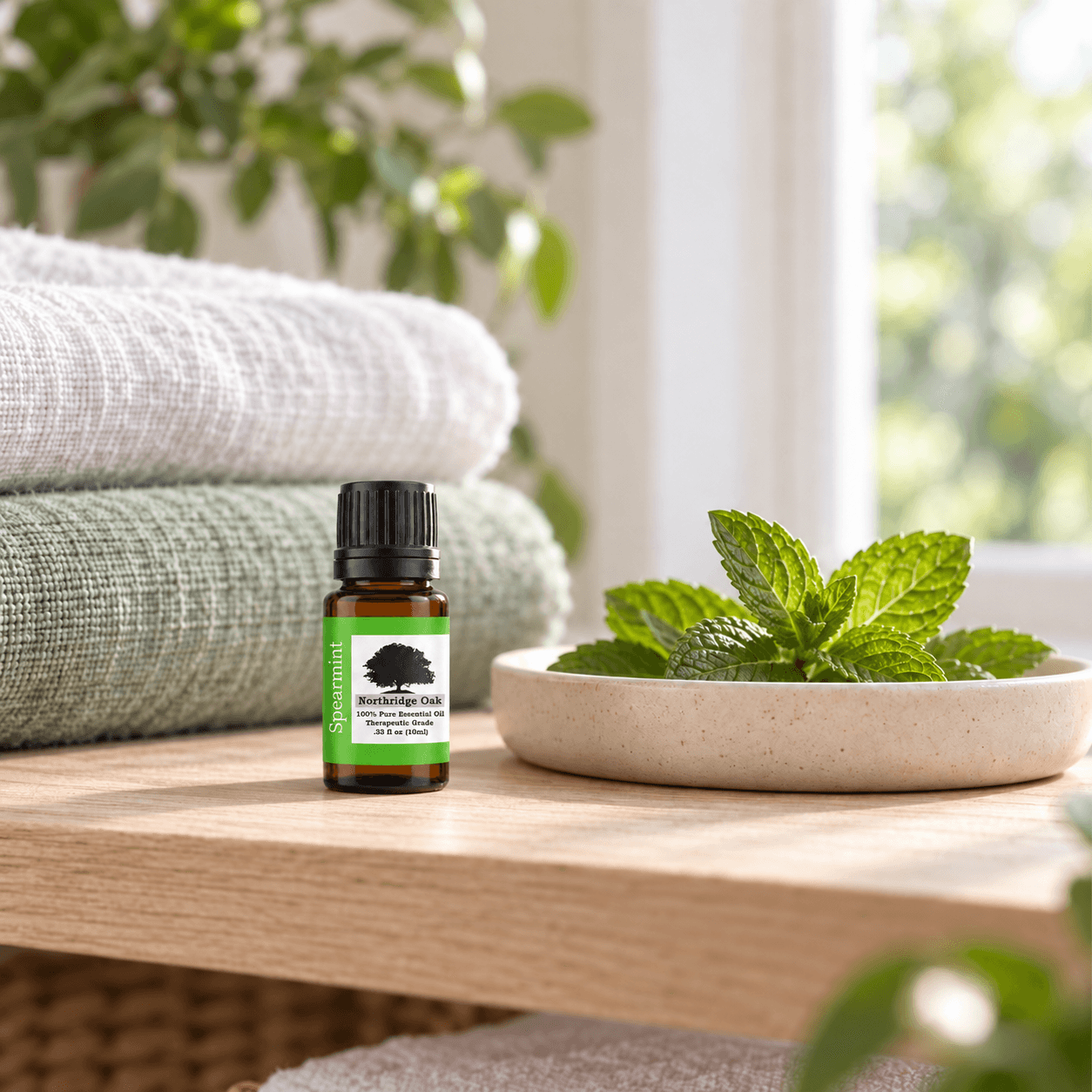
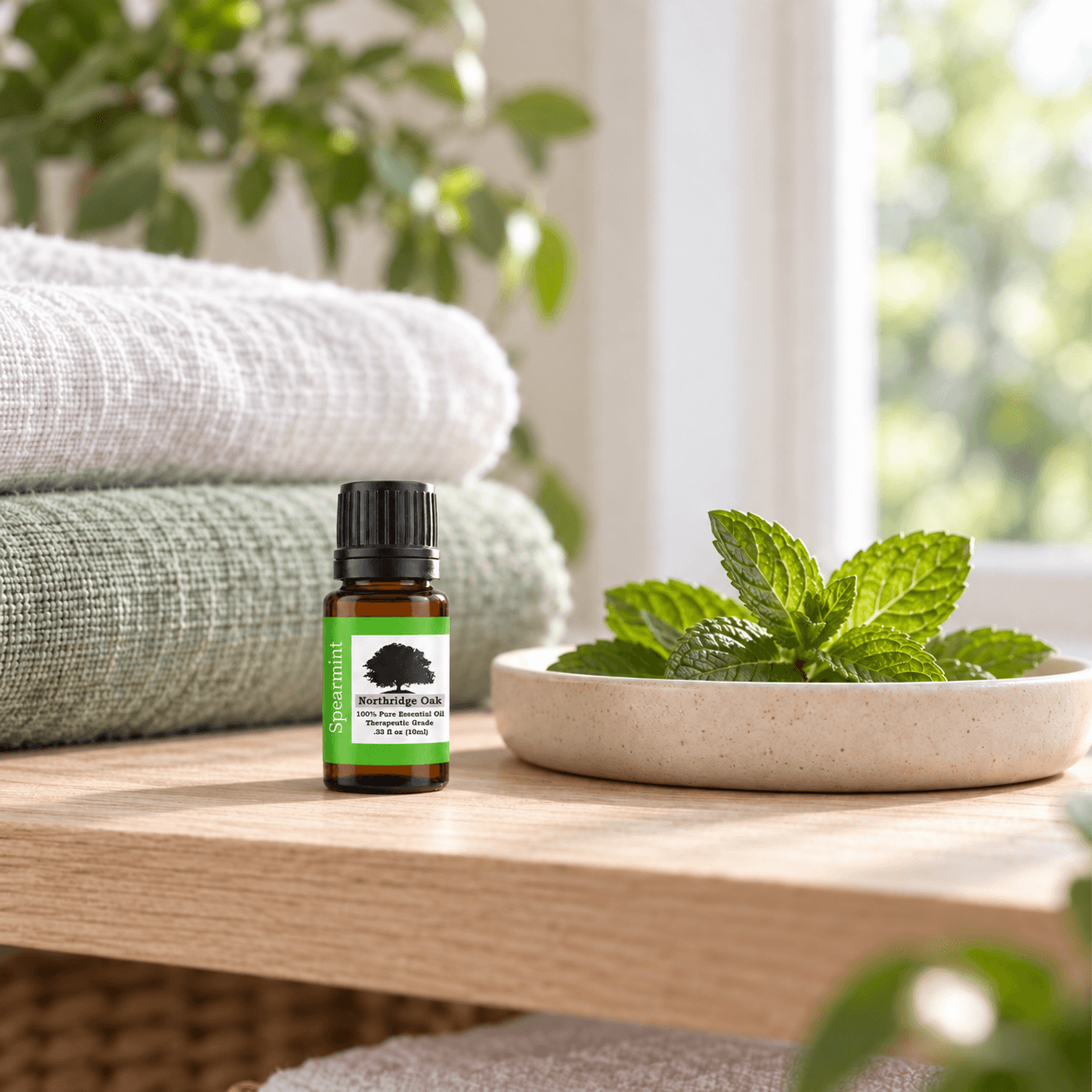
Spearmint tea and Spearmint Essential Oil are also sold for different purposes. Northridge Oak’s Spearmint Essential Oil is made for aromatic enjoyment and properly diluted topical use.
Can spearmint oil still belong in facial care?
Yes—as a low-level aromatic ingredient chosen for its sweet mint character and the enjoyment of a fresh routine. For an adult facial oil, begin around 0.25% to 0.5%. One drop in 2 teaspoons (10 mL) of jojoba or squalane is approximately a 0.5% dilution.
Patch test the finished blend and keep it away from eyes, lips and freshly shaved skin. The goal is a refined formula with a light, comfortable botanical aroma.
A gentle spearmint facial-oil recipe
Add 1 drop spearmint essential oil to 2 teaspoons jojoba oil in a clean amber bottle. Roll gently to combine. After a successful patch test, press one or two drops of the finished facial oil onto damp skin in the evening.
If you want a softer aromatic profile, make a larger batch: 1 drop spearmint in 4 teaspoons (20 mL) carrier creates approximately a 0.25% dilution. Label the bottle with ingredients and the date, and introduce it when the rest of your routine is stable.
Spearmint, acne and the face
A separate 2024 randomized trial evaluated a combined topical formula containing spearmint essential oil and Berberis integerrima root extract for mild to moderate acne. The combined botanical formula performed comparably to the study’s clindamycin group after four weeks, an encouraging result that supports further research into the contribution of each ingredient.
The Spearmint Oil for Skin and Acne guide explains that study in detail and includes a carefully diluted recipe.
A warm, evidence-aligned takeaway
Spearmint has earned genuine scientific interest, and the tea trials are more compelling when we describe them accurately. They found meaningful hormonal changes and encouraging participant-reported results, alongside an objective hair score that needed more time to show whether it would change.
If your interest is facial hair or PCOS, use the studies to support an informed healthcare conversation. If your interest is essential oil, enjoy its sweet green aroma in a gentle topical formula or diffuser blend. Both paths can be positive without pretending they are the same product.
Continue learning about Spearmint Essential Oil
Make this article part of a complete spearmint routine:
- Spearmint Oil Benefits and Uses: Research, Recipes and Safety
- What Does Spearmint Oil Smell Like? Aroma, Carvone and Pairings
- What Blends Well With Spearmint Oil?
- Spearmint Oil Diffuser Blends: 20 Fresh, Sweet Recipes
- Spearmint Oil for Skin and Acne: What Research Shows
- Spearmint Oil for Hair and Scalp: Benefits, Research and Recipes
- Spearmint Oil for Nausea and Digestive Aromatherapy
- Spearmint Oil for Oral Care and Fresh-Breath Products
- Spearmint Oil for Cleaning and Fresh Home Aromas
- Spearmint Oil Safety: Dilution, Children, Dogs and Cats
- Peppermint vs. Spearmint Essential Oil: What’s Different?
Read the original spearmint studies
The evidence comes from the 30-day randomized spearmint-tea trial and the earlier five-day study. Both identify tea as the tested preparation. Checking the intervention in the abstract is a simple way to separate an encouraging finding from the many ways it may be retold online.
These statements have not been evaluated by the Food and Drug Administration. Northridge Oak products are not intended to diagnose, treat, cure or prevent disease.