Table of Contents
- The First Impression: Bright Green Needles
- A Few Minutes Later: Wood and Resin
- Why Does Pine Smell So Fresh?
- Pine Versus Balsam Fir and Spruce
- How Different Oils Change the Aroma of Pine
- Three Ways to Experience the Scent
- Why Pure Pine May Smell Different From a Cleaner
- What You’ll Learn by Smelling Pine Slowly
- Continue Exploring Pine Essential Oil
- Frequently Asked Questions
Close your eyes and imagine crushing a few evergreen needles between your fingers on a cool morning. The first breath is bright and green. A moment later, you notice dry wood, warm resin, and the clean openness of the forest around you. That is the character of Pine Essential Oil—but the aroma has more depth than the familiar phrase “smells like a Christmas tree” suggests.
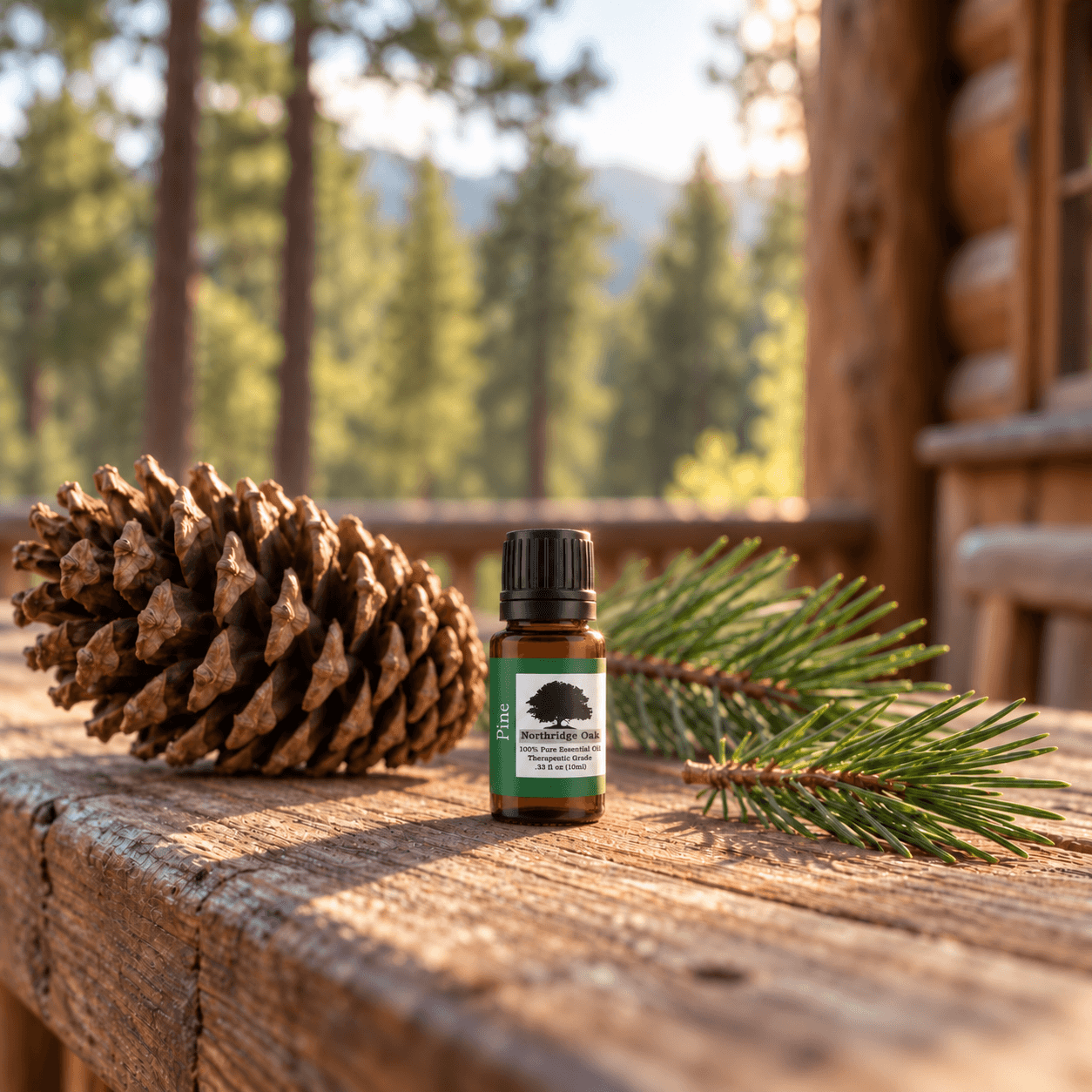
Northridge Oak Pine Essential Oil is distilled from Pinus sylvestris, or Scots pine. Its scent is crisp, needle-like, resinous, and gently woody, with a surprising brightness that can feel almost citrusy at the opening.
It is the aroma of a living evergreen—not a flat pine fragrance—and that distinction is where the pleasure begins.
The First Impression: Bright Green Needles
When you first open the bottle, the most noticeable quality is usually freshness. Pine seems to rise quickly from the bottle, bringing a brisk green note that feels clear and spacious. Many people immediately picture a forest path, freshly cut branches, or cool air moving through tall trees.
That sparkling quality makes pine feel naturally cheerful. It is why the oil blends so easily with Lemon, Grapefruit, and Bergamot. Those oils do not cover the pine; they catch its brightness and carry it a little farther.
A Few Minutes Later: Wood and Resin
Give pine time to unfold and the aroma becomes warmer. The green needles remain, but dry wood and resin begin to appear beneath them. This is the part of pine that pairs so beautifully with Cedarwood, Frankincense, and Balsam Fir.
The change is easiest to notice on a paper scent strip. Place one drop on the strip, smell it from several inches away, and return after five, fifteen, and forty-five minutes. At first, you may write “bright” or “sharp green.” Later, words such as “wood,” “sap,” “dry bark,” or “warm forest” may feel more accurate.
This small exercise makes pine much more interesting. Instead of asking only whether you like it, you begin noticing how it moves.
Why Does Pine Smell So Fresh?
Scots pine essential oil commonly contains alpha-pinene, beta-pinene, limonene, and other naturally occurring monoterpenes. Alpha-pinene is strongly associated with the recognizable aroma of pine; limonene can contribute brightness; and the complete scent comes from many compounds arriving together rather than one molecule working alone.
Researchers studying conifer essential oils have documented natural differences in their chemical profiles. Geography, plant material, weather, harvest, and distillation all influence the final oil. That is good news for anyone who enjoys natural aromas: genuine essential oil has subtle movement and character because it comes from a living plant. Explore the conifer chemistry study.
It is also why Northridge Oak uses third-party GC/MS testing. The report creates a chemical portrait of the batch and helps verify that the bottle contains the botanical oil named on its label.
Pine Versus Balsam Fir and Spruce
Evergreen oils belong to the same aromatic family, but they are not interchangeable.
Pine usually feels bright, dry, and needle-forward. Balsam fir is often softer, fuller, and a little sweeter. Spruce can feel deep green and rounded, sometimes with a subtle fruity character depending on the species.
If pine is a brisk walk beneath blue sky, balsam fir is the dense green tree beside the cabin. Blending them creates a more complete forest than either one alone. Try 3 drops pine with 2 drops balsam fir and 1 drop cedarwood, then notice how pine supplies the light while the other two oils add body and depth.
Our Balsam Fir vs. Pine vs. Spruce guide explores those differences more fully.
How Different Oils Change the Aroma of Pine
The easiest way to understand pine is to blend it in different directions.
With lemon, pine feels sunny, crisp, and freshly opened. With grapefruit, it becomes lively and modern. With blood orange, the forest gains a warm citrus glow.
With lavender, pine becomes softer and more peaceful. The floral note rounds the sharper green edges without taking away the outdoorsy character.
With rosemary, pine feels herbal and vivid, like green branches warmed by the sun. With eucalyptus, the blend becomes cool and airy.
With cedarwood, pine shifts toward timber, bark, and a quiet cabin. With frankincense, it becomes smooth, resinous, and contemplative.
The complete guide to what blends well with Pine Essential Oil provides formulas for each of these directions.
Three Ways to Experience the Scent
Sunlight Through the Trees
Diffuse 3 drops Pine, 2 drops lemon, and 1 drop grapefruit. The citrus catches pine’s bright opening and turns the blend into an aromatic version of morning light.
Quiet Woodland
Diffuse 3 drops pine, 2 drops Lavender, and 1 drop cedarwood. This blend keeps the forest character while making it softer and more restful.
Deep Evergreen
Diffuse 3 drops pine, 2 drops balsam fir, and 1 drop frankincense. It is layered, resinous, and wonderfully true to the feeling of a dense evergreen forest.
Why Pure Pine May Smell Different From a Cleaner
Many of us learned the word “pine” through household products designed to deliver an immediate, consistent fragrance. Pure essential oil is more nuanced. It has a bright opening, living green needles, dry wood, and resin that change as the oil evaporates.
That complexity is one of pine’s greatest strengths. It can make a room feel freshly cared for without belonging only to cleaning day. It can feel festive without being limited to December. It can be rugged, peaceful, sunny, or cozy depending on what you place beside it.
What You’ll Learn by Smelling Pine Slowly
Aroma becomes more enjoyable when you give yourself language for it. Ask whether the scent feels bright or dark, dry or sweet, cool or warm, airy or dense. Does it remind you of needles, bark, sap, lumber, mountain air, or holiday greenery?
There is no wrong memory. One person may picture hiking; another may remember woodworking, a family tree, or a childhood home. The memory is part of the aromatic experience, and it can help you choose the direction you want your blend to take.
Begin with a single drop on paper. Then try one of the 20 Pine diffuser blends. You may discover that pine does not simply smell like a forest—it lets you decide what kind of forest you want to visit.
Continue Exploring Pine Essential Oil
- Pine Essential Oil Benefits and Uses
- What Blends Well With Pine Essential Oil?
- Pine Essential Oil Diffuser Blends
- Pine Essential Oil for Christmas and Winter
- Pine Essential Oil Safety Guide
These statements have not been evaluated by the Food and Drug Administration. This information is educational and is not intended to diagnose, treat, cure, or prevent disease.