Table of Contents
- What is Vetiver Essential Oil?
- What is Vetiver Essential Oil good for?
- What human research says about Vetiver and sleep
- Vetiver for stress and grounding
- Vetiver for focus and ADHD: an evidence check
- Vetiver in perfume and cologne
- Vetiver for skin and cosmetics
- Vetiver and insects
- How to diffuse Vetiver
- How to use Vetiver topically
- What blends well with Vetiver?
- How to choose a quality Vetiver oil
- Vetiver Essential Oil safety
- Research referenced in this guide
- Continue learning about Vetiver Essential Oil
- Frequently Asked Questions
Vetiver essential oil benefits begin with something immediately noticeable: a deep, earthy aroma that can make a room, perfume or evening ritual feel grounded and complete. Steam-distilled from the roots of Chrysopogon zizanioides, Vetiver is valued in perfumery, aromatherapy and personal care for its exceptional depth, persistence and ability to connect brighter oils into a beautifully balanced blend.
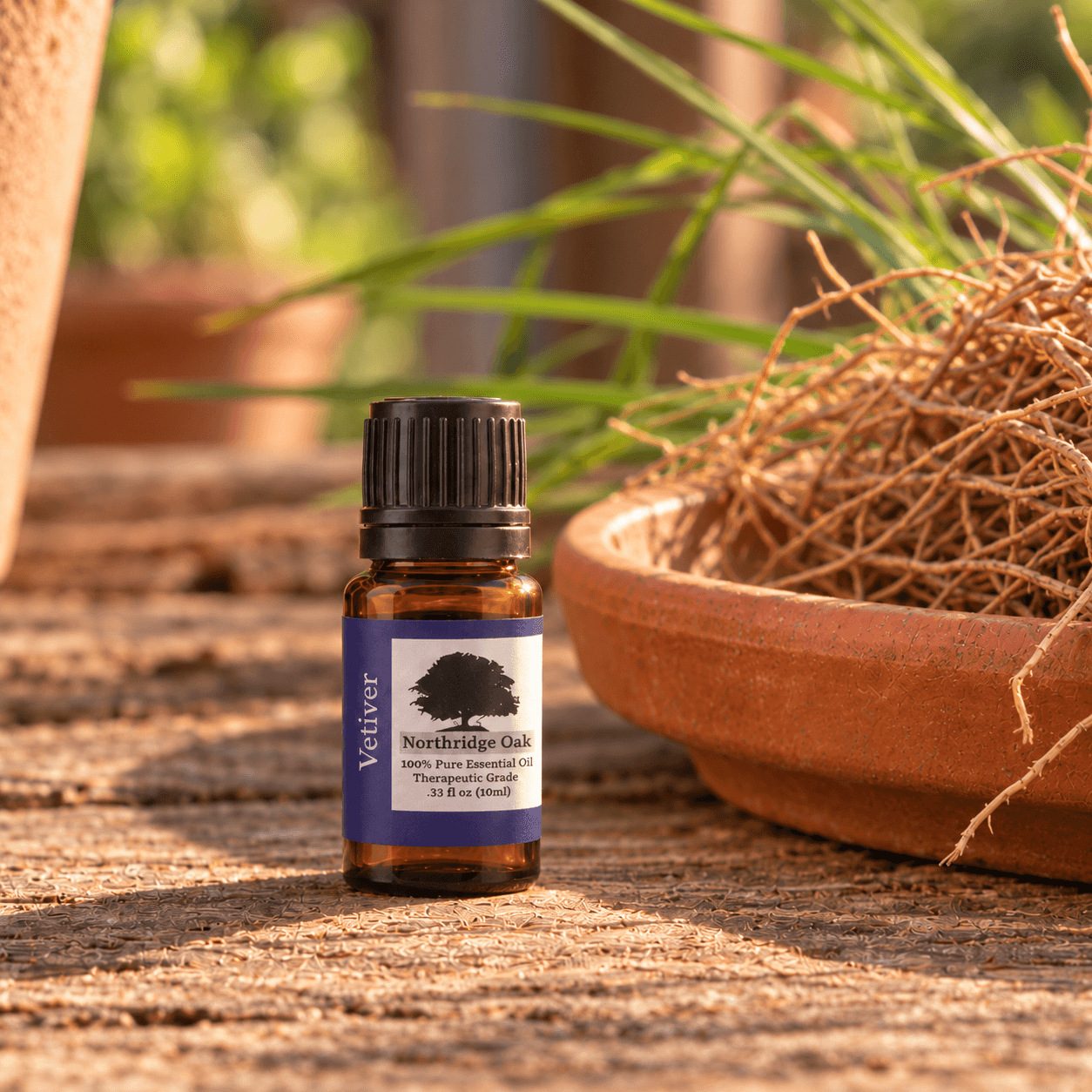
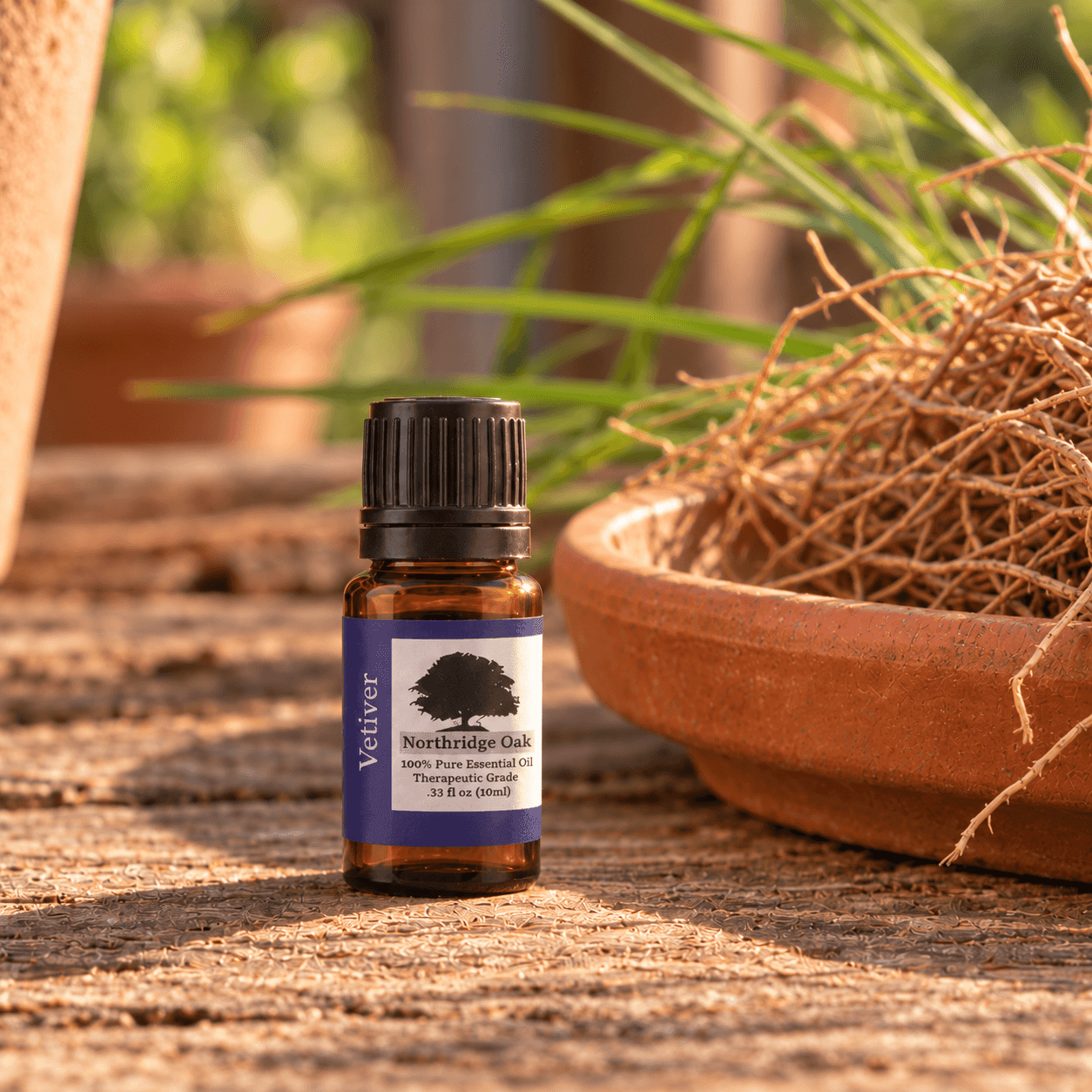
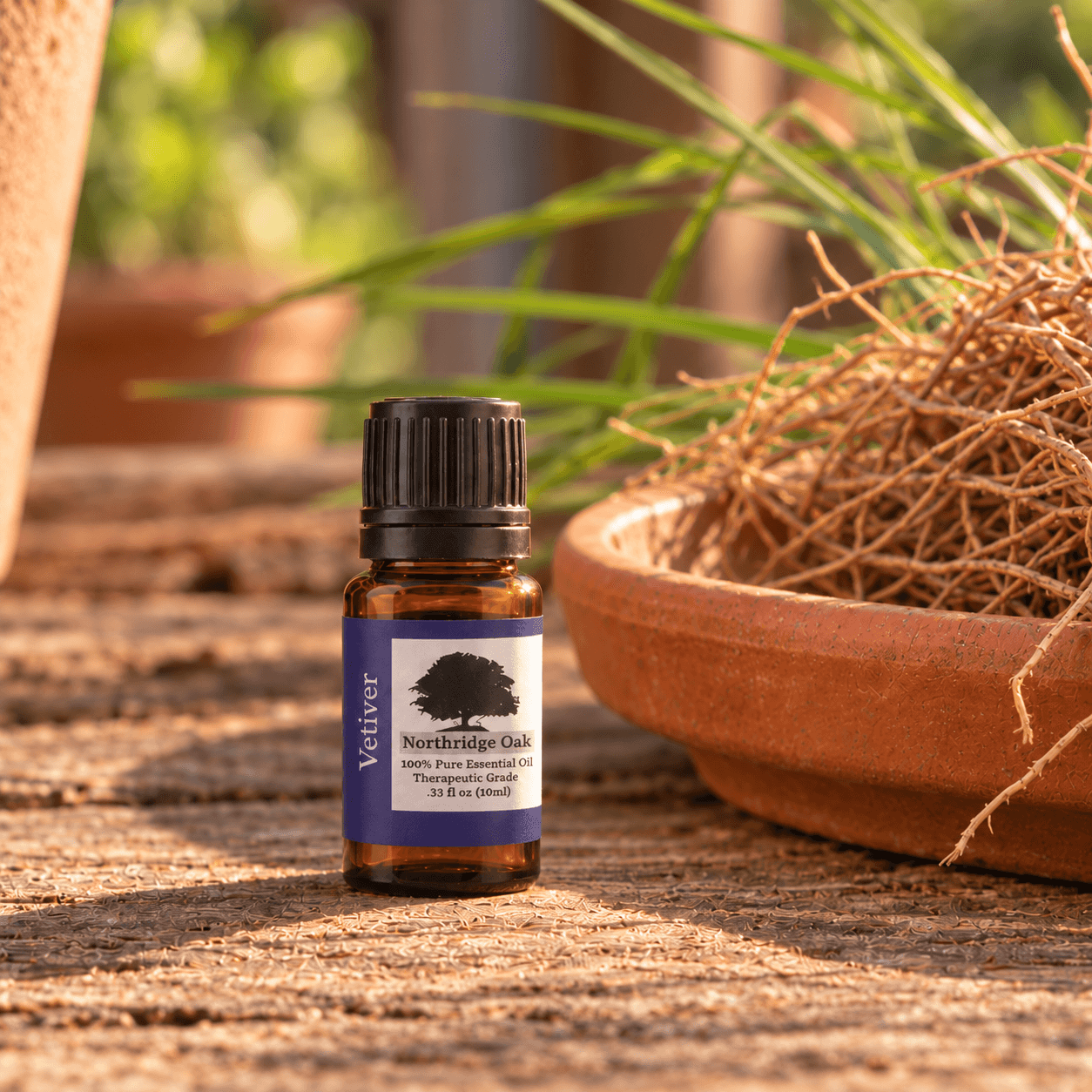
Bring that rich, root-deep character into your routine with Northridge Oak Vetiver Essential Oil, 100% pure, undiluted and third-party GC/MS tested.
Northridge Oak Vetiver Essential Oil comes from India and is 100% pure, undiluted and third-party GC/MS tested. Its naturally substantial texture and concentrated aroma mean that a single drop often provides all the character a recipe needs.
What is Vetiver Essential Oil?
Vetiver is a tall perennial grass with a dense network of aromatic roots. Those roots are harvested, cleaned, dried and steam-distilled to produce an amber-to-brown essential oil. Older references may use the botanical name Vetiveria zizanioides; the currently accepted name is Chrysopogon zizanioides. India is Vetiver’s historic home, while Haiti, Indonesia, Java and Réunion have also become important producing regions.
Root distillation gives Vetiver a personality unlike oils expressed from citrus peel or distilled from leaves and flowers. It is woody, smoky, dry, earthy and faintly sweet. Perfumers classify it as a base note because it develops slowly and remains after lighter materials have faded.
What is Vetiver Essential Oil good for?
Its best-supported everyday roles are aromatic. Vetiver anchors natural perfume, adds staying power to diffuser blends, gives massage oil an elegant scent and creates a recognizable cue for quiet routines. People commonly choose it for bedtime, meditation, reading, journaling and personal fragrance. These uses are practical because they rely on the oil’s established sensory qualities rather than asking one ingredient to make sweeping health promises.
Vetiver also attracts scientific interest. Researchers have examined sleep quality and cardiovascular measurements in people, sleep-wake activity and brain waves in animals, anxiety-like behavior in animal models, antimicrobial activity in laboratory systems, cosmetic applications and repellency against termites and other arthropods. Each study answers a narrow question, and the strongest guide connects the result only to the use actually tested.
What human research says about Vetiver and sleep
A 2025 study followed 67 participants assigned to Lavender, Vetiver or Orange Blossom aroma use for four to six weeks. Eighteen participants used Vetiver. Their average Pittsburgh Sleep Quality Index score changed from 7.92 to 6.08, while systolic blood pressure and heart rate also decreased modestly. The sample was small, yet the study provides genuine human evidence that makes Vetiver especially interesting for a consistent bedtime aroma routine.
The study gives readers a sound reason to explore Vetiver as part of a broader wind-down pattern that also includes comfortable light, temperature, timing and reduced evening stimulation.
Vetiver for stress and grounding
“Grounding” describes the sensory impression many people get from slow, earthy aromas. A 2015 animal inhalation study found an anxiety-like behavioral profile and changes in c-fos expression in a region of the amygdala after Vetiver exposure. That research supports continued study of the aroma-brain relationship. For daily use, the most responsible translation is simple: pair Vetiver with slow breathing, stretching or journaling and let the scent define a deliberate pause.
Vetiver for focus and ADHD: an evidence check
Google results frequently connect Vetiver with focus and ADHD, largely because of a small 2001 report involving children and a Test of Variables of Attention. The report is best understood as an early observation that invites confirmation through well-designed randomized trials. A separate 2016 animal EEG study found increased waking and brain-wave changes the researchers described as refreshing. That makes Vetiver interesting for study or planning rituals while leaving medical ADHD claims beyond the available evidence.
Vetiver in perfume and cologne
This is where Vetiver has its clearest professional history. Its complex aroma and tenacity have made it a major material in fine fragrance. It can form the base of dry citrus cologne, smoky woods, soft floral perfume or earthy resin blends. Start with one part Vetiver, two parts heart note and three parts citrus top note. For a 10 mL jojoba roller, try 1 drop Vetiver, 2 drops Cedarwood and 3 drops Bergamot FCF.
Vetiver for skin and cosmetics
A 2017 laboratory investigation tested three Réunion Vetiver oils in cosmetic assays. The researchers found no particularly convincing broad cosmetic activity beyond scent, while observing antimicrobial activity against several Gram-positive bacteria and one Candida glabrata strain. This makes an important distinction: Vetiver can be a beautiful aromatic ingredient in a properly diluted body oil, while laboratory antimicrobial findings remain a research lead rather than a home treatment claim.
Vetiver and insects
Vetiver has unusually direct pest-research history. In a 2001 comparison of eight essential oils against Formosan subterranean termites, Vetiver showed the strongest and longest-lasting repellency and reduced tunneling at low experimental concentrations. Later research has explored Vetiver constituents against other arthropods. These findings are scientifically interesting, though household termite infestations still call for professional inspection because structural protection requires validated application methods.
How to diffuse Vetiver
For a 100 mL ultrasonic diffuser, begin with 1 drop Vetiver, 2 drops Bergamot and 2 drops Lavender. Add water to the fill line, then add the oils. This five-drop recipe opens with bright citrus, moves through a soft floral heart and finishes with Vetiver’s earthy base. For daytime, replace Lavender with Grapefruit. For evening, replace Bergamot with Cedarwood.
How to use Vetiver topically
For an approximately 1% adult massage blend, combine 3 drops Vetiver and 3 drops Lavender in 1 fluid ounce of jojoba, sweet almond or fractionated coconut oil. Patch test the finished blend. A 10 mL personal aroma roller uses about 3 total essential-oil drops for approximately 1% dilution or 6 drops for approximately 2%.
What blends well with Vetiver?
Bergamot, Grapefruit, Blood Orange and Lemon brighten it. Lavender, Ylang Ylang and Geranium soften it. Cedarwood, Frankincense, Myrrh and Patchouli deepen it. Rosemary and Spearmint create a fresher, greener direction.
How to choose a quality Vetiver oil
Look for a clear botanical identity, root as the plant part, country of origin, dark-glass packaging and batch-level testing. Vetiver varies naturally with geography and distillation, so GC/MS analysis helps confirm identity while preserving the reality that authentic oils are not chemically identical. Northridge Oak bottles in small batches and uses third-party GC/MS testing so customers receive a clearly identified, undiluted oil.
Vetiver Essential Oil safety
Measure carefully, dilute topical recipes and patch test before broader application. Diffuse with comfortable airflow and begin with one drop. Keep the bottle secured from children and pets, and consult an appropriate professional for pregnancy, nursing, young children, medications or individual health considerations. Read the complete Essential Oil Safety Guide.
Research referenced in this guide
- Human sleep-quality and cardiovascular study
- Vetiver inhalation and anxiety-like behavior study
- Vetiver inhalation and EEG study
- Vetiver in cosmetics and antimicrobial testing
Continue learning about Vetiver Essential Oil
Choose the next guide that matches what you want to make or understand:
- What Does Vetiver Smell Like?
- What Blends Well With Vetiver Essential Oil?
- Vetiver Essential Oil Diffuser Blends
- Vetiver Essential Oil for Sleep
- Vetiver for Stress, Anxiety and Grounding
- Vetiver for Focus and ADHD: Examining the Evidence
- Vetiver Perfume and Cologne Recipes
- Vetiver Oil for Skin: Cosmetic Research
These statements have not been evaluated by the Food and Drug Administration. Northridge Oak products are not intended to diagnose, treat, cure or prevent disease.
Frequently Asked Questions
What is Vetiver Essential Oil best known for?
Its earthy aroma, perfumery value and ability to anchor citrus, floral, wood and resin blends.
What part of Vetiver produces the oil?
The essential oil is steam distilled from the aromatic roots of Chrysopogon zizanioides.
What is Vetiver commonly used for?
Popular uses include diffusion, natural perfume, properly diluted massage oil and bedtime or grounding rituals.
Is there human research on Vetiver?
Yes. A small human study examined sleep quality and cardiovascular measurements after four to six weeks of aroma use.
Why is Vetiver oil thick?
Its root-derived chemistry gives it a naturally substantial texture. Gentle hand warmth helps a drop move through the reducer.
What blends well with Vetiver?
Bergamot, Grapefruit, Lavender, Geranium, Cedarwood, Frankincense, Rosemary and Ylang Ylang are excellent partners.
Can Vetiver be used on skin?
Yes, in a properly diluted formula that has been patch tested.
Where does Northridge Oak Vetiver come from?
Northridge Oak Vetiver is sourced from India and third-party GC/MS tested.