Table of Contents
- Why Vetiver feels so natural at bedtime
- The 2025 human study: what researchers actually did
- What happened in the Vetiver group
- What the human study can tell us
- The 2016 sleep–wake and EEG study
- Why one study found alertness and another found better sleep
- How to try Vetiver as a bedtime cue
- Four measured Vetiver bedtime diffuser blends
- Make a personal bedtime inhaler
- Make a quiet-evening roller
- Build the rest of the evening around the aroma
- Who might enjoy Vetiver at night?
- Comfortable nighttime use
- Read the Vetiver sleep research
- Continue learning about Vetiver Essential Oil
- The encouraging takeaway
- Frequently Asked Questions
Vetiver Essential Oil for sleep is more than a beautiful bedtime tradition. A 2025 human study found that participants using Vetiver for four to six weeks reported meaningful improvement on a recognized sleep-quality questionnaire. That finding gives Vetiver something many essential oils lack: direct human research connected specifically with sleep.
Northridge Oak Vetiver Essential Oil has a deep, earthy aroma that feels naturally suited to the end of the day. Used thoughtfully, it can become the scent that tells your mind the lights are lower, the workday is finished and it is time to settle into a quieter rhythm.
Why Vetiver feels so natural at bedtime
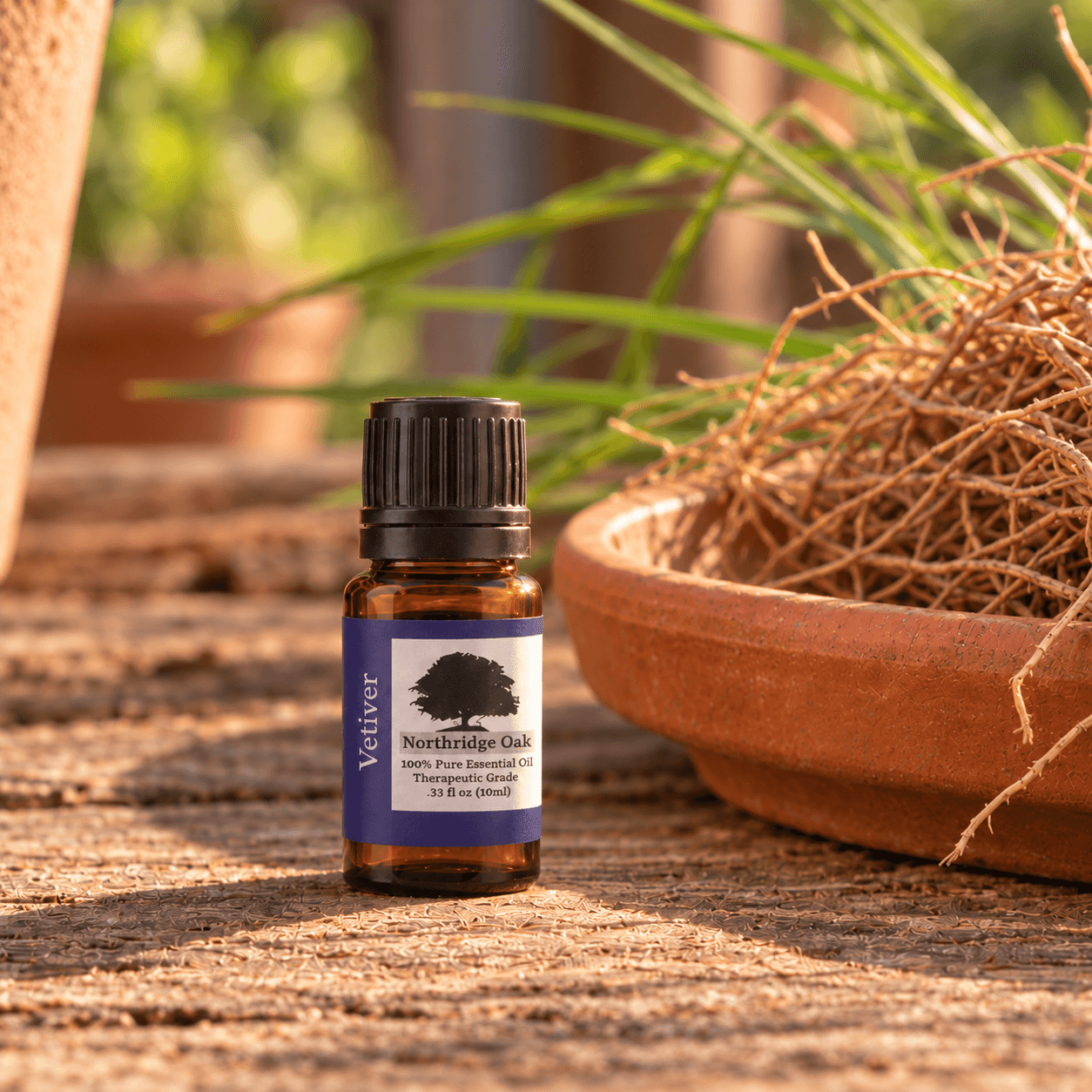
Vetiver is steam-distilled from the roots of Chrysopogon zizanioides. Unlike bright citrus oils that announce themselves quickly and fade, Vetiver is a slow, persistent base note. Its aroma is earthy, woody, smoky, dry and gently sweet as it develops.
That sensory profile can make a room feel quieter and more grounded. Just as a familiar cup, lamp or evening playlist can signal the transition toward rest, a consistent aroma can become part of the sequence that prepares you for bed. Vetiver’s staying power means only a small amount is needed.
The 2025 human study: what researchers actually did
Chang and colleagues studied three essential oils—Lavender, Vetiver and Orange Blossom—over a four-to-six-week period. A total of 67 people completed the project. Participants were randomly assigned to one of the three aroma groups: 21 used Lavender, 18 used Vetiver and 17 used Orange Blossom.
Before and after the intervention, researchers measured cardiovascular and autonomic-nervous-system parameters. Participants also completed the Pittsburgh Sleep Quality Index, usually called the PSQI. This widely used questionnaire looks at several parts of sleep, including perceived quality, time needed to fall asleep, sleep duration, disturbances and daytime functioning.
Lower PSQI scores indicate better reported sleep quality. That makes the before-and-after change easy to understand.
What happened in the Vetiver group
The Vetiver group’s average PSQI score improved from 7.92 to 6.08 after four to six weeks. The change was statistically significant, with a reported P value of .007. Improvement was even more pronounced among participants who began with PSQI scores of five or higher—people already reporting meaningful sleep difficulty.
The researchers also recorded modest cardiovascular changes. Average systolic blood pressure in the Vetiver group moved from 108.39 to 105.33 mm Hg, and average heart rate moved from 78.33 to 76 beats per minute. Both changes reached statistical significance within the study.
For someone considering Vetiver, this is encouraging evidence. Eighteen people is a small Vetiver group, yet the study followed real participants for several weeks and used an established sleep questionnaire rather than relying on a single night or an informal impression.
What the human study can tell us
The most reasonable conclusion is that consistent Vetiver aroma use may support perceived sleep quality as part of an evening routine. The study does not tell us that one drop produces instant sleep, and it was not designed to compare Vetiver with medical treatment. Its value lies in showing that a multiweek aroma practice corresponded with better sleep-quality scores in people.
That is also why consistency matters. Participants used the assigned oil for four to six weeks. A reader who tries Vetiver once and evaluates it after ten minutes is testing something very different from the routine studied.
The 2016 sleep–wake and EEG study
An earlier study by Cheaha and colleagues examined Vetiver inhalation in adult male Wistar rats. Researchers implanted electrodes and recorded sleep–wake patterns and electrical brain activity while the animals inhaled either water or commercial Vetiver oil at two experimental amounts: 20 or 200 microliters.
Vetiver inhalation increased total waking time and reduced slow-wave sleep in this animal model. It also changed several EEG frequency bands: alpha and beta-1 activity decreased in frontal and parietal regions, while frontal gamma activity increased. These changes began soon after exposure.
The authors described the result as a refreshing or alertness-related effect. At first glance, that sounds different from the 2025 human sleep finding—and that contrast is scientifically useful.
Why one study found alertness and another found better sleep
The studies asked different questions. The 2016 experiment measured immediate brain and sleep–wake changes in rats during controlled exposure to comparatively large experimental amounts. The 2025 study followed people using an aroma over several weeks and measured their overall perceived sleep quality.
A scent can also play different roles depending on amount, timing and context. A strong exposure during the active period may feel stimulating, while a low, familiar amount paired with a wind-down routine may become a comforting environmental cue. Lavender can feel relaxing to many people yet fresh and clarifying to others; Vetiver’s experience may be similarly dose- and context-sensitive.
The useful takeaway is not that one study cancels the other. Together they show that Vetiver can influence arousal-related systems and that application details matter.
How to try Vetiver as a bedtime cue
Begin gently. Vetiver is thick and aromatically powerful, so one drop can be enough in a small bedroom blend. Introduce the scent 30 to 60 minutes before bed while you dim lights, put away work and choose a quiet activity. Turn the diffuser off before sleep if that fits your equipment instructions and personal preference.
Repeat the same routine for several weeks before deciding whether it belongs in your evening. You are looking for a pleasant pattern: Do you enjoy entering the room? Does the aroma help the evening feel distinct from the day? Does your routine become easier to repeat?
Four measured Vetiver bedtime diffuser blends
These recipes are designed for a 100 mL diffuser. Follow your diffuser manufacturer’s directions and reduce the total when scenting a smaller space.
Deep Quiet: 1 drop Vetiver, 3 drops Lavender and 1 drop Frankincense. Lavender softens the rooty base while Frankincense adds a gentle resinous lift.
Soft Earth: 1 drop Vetiver, 2 drops Lavender and 2 drops Bergamot FCF. This is an approachable first blend for someone who finds Vetiver intense from the bottle.
Night Woods: 1 drop Vetiver, 2 drops Cedarwood and 2 drops Lavender. The result is dry, calm and woodsy.
Velvet Evening: 1 drop Vetiver, 1 drop Ylang Ylang, 2 drops Lavender and 1 drop Bergamot FCF. Ylang Ylang rounds the blend with a soft floral sweetness.
Make a personal bedtime inhaler
Add 3 drops Vetiver, 7 drops Lavender and 5 drops Bergamot FCF to the cotton wick of a blank personal inhaler. Assemble and label it. Take two or three gentle breaths from a comfortable distance while reading or journaling before bed.
A personal inhaler keeps the aroma contained and makes the routine easy to repeat when traveling. It also lets another person or pet leave the scent environment completely.
Make a quiet-evening roller
Add 1 drop Vetiver, 2 drops Lavender and 1 drop Frankincense to a 10 mL roller bottle. Fill with jojoba or fractionated coconut oil, close and roll gently. This creates approximately a 2% dilution.
After patch testing, apply lightly to adult wrists or forearms during the evening routine. The recipe is a personal fragrance and sensory cue; the massage motion and familiar sequence are part of the experience.
Build the rest of the evening around the aroma
Vetiver works best as one part of a coherent transition. Lower the room lights, reduce stimulating screen use, set a comfortable temperature and choose a predictable bedtime. Pair the first breath of Vetiver with one small action you can repeat—closing the laptop, preparing tomorrow’s clothes or opening a book.
Over time, that sequence can become easier to recognize. The aroma marks the beginning; the rest of the routine supports the conditions in which sleep can arrive naturally.
Who might enjoy Vetiver at night?
Vetiver is especially appealing to people who prefer woods, roots, earth and smoke over sweet floral aromas. It is also useful for someone who enjoys Lavender but wants a blend with more depth and staying power. Because only one drop is usually needed, a 10 mL bottle can support a long season of evening blends.
If Vetiver feels too dense by itself, pair it with Lavender or Bergamot FCF. If you love its darker side, combine it with Cedarwood and Frankincense. The best bedtime aroma is one you genuinely look forward to using.
Comfortable nighttime use
Keep diffusion gentle, provide airflow and follow the equipment instructions. Store essential oils securely away from children and pets. A personal inhaler is often the simplest option in a shared household because each person can choose whether to participate.
Persistent insomnia, loud snoring, gasping during sleep, unusual daytime sleepiness or a sudden change in sleep deserves professional attention. Vetiver can remain a pleasant part of a supportive routine while health concerns receive appropriate care. Review the complete Essential Oil Safety Guide.
Read the Vetiver sleep research
- Chang et al. (2025): Vetiver and Orange Blossom, cardiovascular measures and sleep quality
- Cheaha et al. (2016): Vetiver inhalation, sleep–wake patterns and EEG activity
- University of Pittsburgh: About the Pittsburgh Sleep Quality Index
Continue learning about Vetiver Essential Oil
Make this article part of a complete Vetiver routine:
- Vetiver Essential Oil: Benefits, Uses, Research and Safety
- What Does Vetiver Smell Like?
- What Blends Well With Vetiver Essential Oil?
- Vetiver Essential Oil Diffuser Blends
- Vetiver for Stress, Anxiety and Grounding
- Vetiver Perfume and Cologne Recipes
- Indian, Haitian and Java Vetiver
- Vetiver Essential Oil Safety
The encouraging takeaway
The best reason to try Vetiver at bedtime is the combination of evidence and experience. A 2025 human study found improved sleep-quality scores after four to six weeks, while earlier EEG research reminds us that amount and context shape the response. That makes a gentle, consistent routine the most sensible way to explore the oil.
Vetiver will not smell like a typical “sleep oil.” It is deeper, earthier and more mysterious—and that may be exactly its appeal. One drop can give the bedroom a sense of warmth and stillness that feels unmistakably separate from the day.
These statements have not been evaluated by the Food and Drug Administration. Northridge Oak products are not intended to diagnose, treat, cure or prevent disease.