Table of Contents
- Why Aroma Can Become a Relaxation Cue
- What the Human Patchouli Study Found
- An Evening Patchouli Diffuser Blend
- A Bright After-Work Transition
- A Patchouli Pulse-Point Aroma
- Patchouli and a Five-Minute Pause
- Can Patchouli Help You Sleep?
- How to Keep the Aroma Soft
- What We’re Learning About Patchouli and Relaxation
- Continue Exploring Patchouli Essential Oil
- Create a Ritual That Feels Like Yours
- Frequently Asked Questions
Patchouli essential oil for stress, relaxation and sleep routines offers an earthy aroma that many people find grounding. It does not need to be dramatic to be useful. One drop in a balanced diffuser blend can mark the end of the workday, accompany slow breathing or make a familiar bedtime routine feel more intentional.
There is also a small human study with encouraging results. Understanding what the researchers found—and how to translate it honestly—can help you enjoy Patchouli with both optimism and perspective.
Why Aroma Can Become a Relaxation Cue
Our sense of smell is closely tied to memory and emotion. When you pair the same aroma with a calm activity, the scent can become part of the routine’s meaning. Patchouli’s deep, persistent character makes it especially suited to this kind of repetition because it does not disappear as quickly as a bright citrus top note.
Choose a simple cue: turn off work notifications, dim a lamp, begin a few gentle stretches and diffuse the same Patchouli blend. The routine—not a single ingredient—creates the supportive setting.
What the Human Patchouli Study Found
In a randomized controlled trial, fifty emergency nurses inhaled either a 5% Patchouli preparation in sweet almond oil or the carrier alone on two occasions. The Patchouli group reported significantly lower stress and greater compassion satisfaction than the control group. Relative to baseline, compassion fatigue also decreased within the Patchouli group. Read the study abstract on PubMed.
This is a positive result worth talking about: Patchouli was used briefly in a demanding real-world profession, and the researchers measured encouraging self-reported outcomes. The study was small, short and focused on emergency nurses, so it does not prove Patchouli treats anxiety, burnout or a sleep disorder. It does support trying a pleasant Patchouli aroma as one modest part of a relaxation routine.
An Evening Patchouli Diffuser Blend
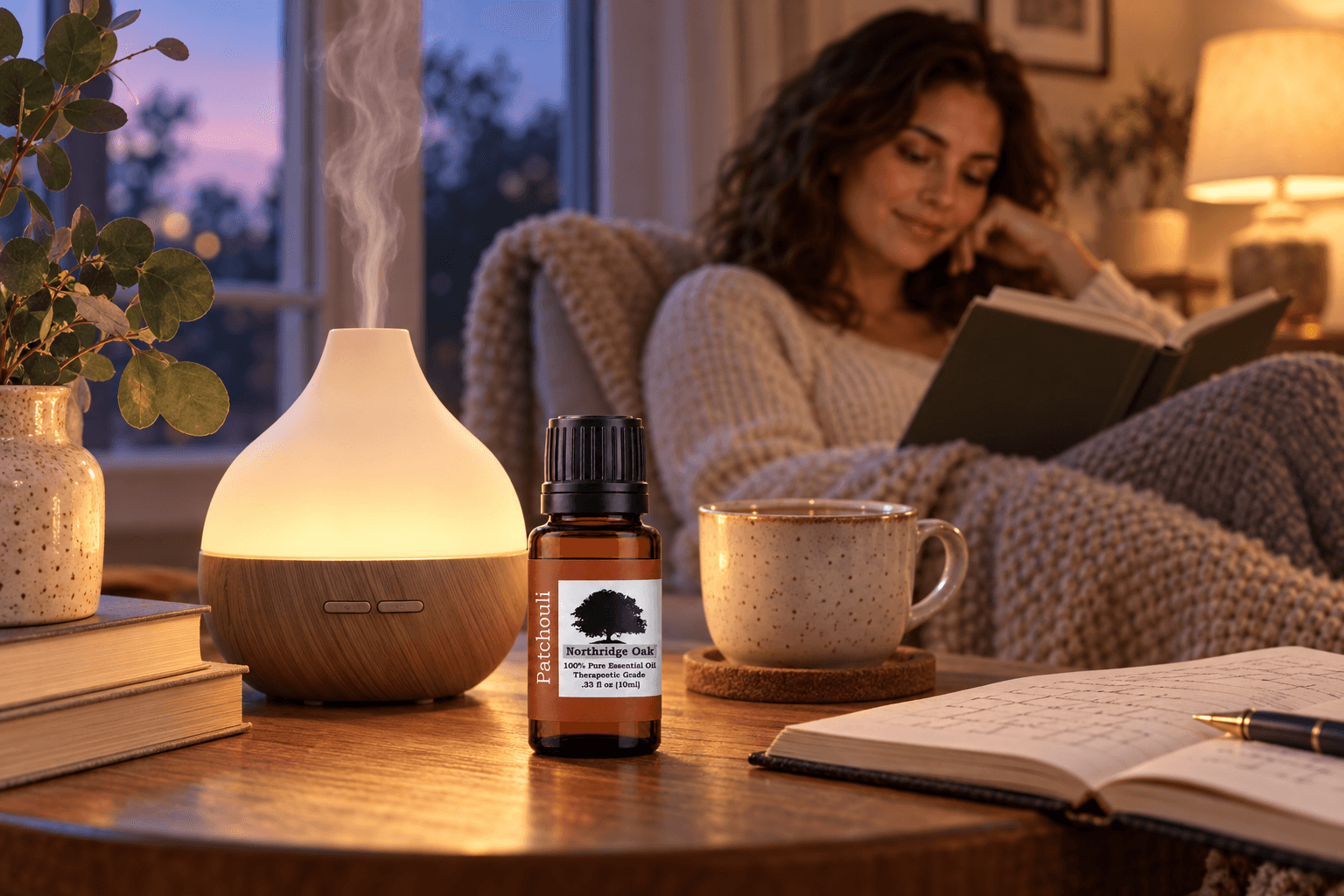
Add three drops Lavender, two drops Frankincense and one drop Patchouli to your diffuser, adjusting the total to the device instructions. Lavender provides a familiar soft heart, Frankincense adds resinous clarity and Patchouli forms the warm base.
Diffuse intermittently in a ventilated room while reading, journaling or preparing for bed. Turn the diffuser off before sleep unless the manufacturer and your household safety plan specifically support another approach.
A Bright After-Work Transition
Relaxation does not always need to smell sleepy. Three drops Sweet Orange, two drops Bergamot and one drop Patchouli create a bright-but-grounded blend that can help distinguish “work time” from “home time.” Use it while putting away your bag, changing clothes or preparing dinner.
This kind of transition ritual can be especially appealing when work and home occupy the same space. The aroma gives the brain a sensory change of scene.
A Patchouli Pulse-Point Aroma
For a 10 mL roller, combine one drop Patchouli, two drops Lavender and one drop Sweet Orange, then fill with jojoba. Apply sparingly to a small area after patch testing. Check the topical guidance for the specific citrus oil you choose, including any phototoxicity considerations.
The benefit of a personal aroma is portability. You can roll a tiny amount onto the wrist before a quiet break and bring the scent closer without filling a whole room.
Patchouli and a Five-Minute Pause
Set a timer for five minutes. Sit comfortably, soften your gaze and take normal, unforced breaths while noticing the aroma in the room. When attention wanders, return to one sensory detail: the earthy base, the bright citrus top or the feeling of your feet on the floor.
This is not a test of perfect calm. It is simply practice at pausing. Patchouli’s slow dry-down suits that patient, non-demanding approach.
Can Patchouli Help You Sleep?
Patchouli can be part of a bedtime atmosphere, especially when its aroma becomes associated with a consistent wind-down routine. Current evidence does not establish it as a treatment for insomnia. Think of it as a sensory companion to habits such as a regular schedule, lower evening light and a quiet room.
If sleep difficulty is frequent, severe or affecting daytime life, a health professional can help. Your Patchouli ritual can remain a pleasant complement to that guidance.
How to Keep the Aroma Soft
Patchouli is potent. Start with one drop, choose lighter partners and allow fresh air. If the room feels saturated, turn off the diffuser and ventilate. A soft background aroma is usually more relaxing than an intense one.
People share spaces differently. Ask others whether they enjoy the blend and make sure children and pets can leave the area. Courtesy is part of good aromatic practice.
What We’re Learning About Patchouli and Relaxation
The emergency-nurse trial gives us an encouraging human finding: short Patchouli inhalation was associated with lower reported stress and higher compassion satisfaction in that study. Its limitations keep the conclusion modest, but they do not erase the positive result.
The practical invitation is simple. Pair a low-intensity Patchouli aroma with a routine that already supports you. Notice whether you enjoy the experience and whether the cue helps you shift pace. That is a worthwhile experiment without asking the oil to carry more than it can.
Continue Exploring Patchouli Essential Oil
Patchouli is one of those oils that becomes more interesting the more you explore it. Continue through the Northridge Oak Patchouli Learning Center to discover encouraging research, inviting aroma combinations and practical ways to bring this warm, earthy botanical into your everyday routine.
- Start with the complete Patchouli Essential Oil benefits, uses, research, recipes and safety guide.
- Create a warm, welcoming atmosphere with 20 Patchouli Essential Oil diffuser blends.
- Discover what blends well with Patchouli Essential Oil and how different pairings reveal its softer side.
- Learn how Patchouli can become a lasting base note in a natural perfume or personal aroma blend.
- Bring Patchouli into thoughtful self-care with guides for skin, hair and scalp, and massage and body oils.
- Create a peaceful aromatic routine with Patchouli for relaxation and sleep.
- Use Patchouli confidently with the Patchouli Essential Oil safety guide and the Complete Essential Oil Safety Guide.
- Shop Northridge Oak Patchouli Essential Oil.
Create a Ritual That Feels Like Yours
Maybe your Patchouli moment is an after-work citrus blend, a quiet diffuser beside a book or a softly scented roller before journaling. Choose the version you will actually enjoy repeating. Familiarity, intention and a beautiful aroma can turn five ordinary minutes into a welcome daily pause.
These statements have not been evaluated by the Food and Drug Administration. Northridge Oak products are not intended to diagnose, treat, cure or prevent disease.