Table of Contents
- Why Patchouli Appears in Skin Care
- What a Patchouli Skin Study Found
- How to Dilute Patchouli for Skin
- Patchouli Body Oil Recipe
- Simple Patchouli Hand and Cuticle Oil
- A Gentle Patchouli Facial-Oil Approach
- Patchouli for Bath and Body
- How to Patch Test
- What We’re Learning About Patchouli and Skin
- Continue Exploring Patchouli Essential Oil
- Create a Ritual You’ll Enjoy
- Frequently Asked Questions
Patchouli essential oil for skin can turn a simple care routine into a warm, woodsy moment you look forward to. Its lasting aroma fits beautifully in body oils, hand balms and carefully diluted facial blends, while early research gives scientists interesting reasons to keep studying Patchouli in cosmetic applications.
The best home approach is gentle and realistic: use a modest dilution, patch test, choose a carrier that suits your skin and enjoy Patchouli as part of a supportive cosmetic ritual.
Why Patchouli Appears in Skin Care
Patchouli has a rich base-note aroma, so even a small amount can make an unscented oil feel finished and luxurious. It blends especially well with Lavender, Geranium and Frankincense, all familiar choices for personal-care aromas. Jojoba creates a light, stable base; fractionated coconut oil feels silky; and richer oils can suit massage or dry-feeling body areas.
Skin is individual. A formula that feels wonderful on one person may not suit another, which is why conservative dilution and a small patch test are part of the pleasure, not an obstacle to it. They let you get to know a blend before using more broadly.
What a Patchouli Skin Study Found
A 2014 study examined topical Patchouli oil in a mouse model of UV-related photoaging. Compared with UV exposure alone, the treated groups showed less wrinkle formation, better measured elasticity and increased collagen content. Those are positive, intriguing findings that support continued cosmetic research. You can read the published abstract on PubMed.
The study was performed in mice under controlled experimental conditions, so it does not prove that a homemade Patchouli blend prevents human photoaging. It also does not replace sunscreen, shade or dermatologist-recommended care. Its value is as a promising preclinical signal: researchers observed measurable skin-related changes worth exploring further.
How to Dilute Patchouli for Skin
For everyday adult body care, many people choose a low dilution such as 1%, which is approximately one drop of essential oil in one teaspoon (5 mL) of carrier. For a 30 mL bottle, about six total essential-oil drops creates roughly a 1% blend. Facial products generally call for even more restraint.
Drop size varies, and every formula includes the safety considerations of all oils used. If you are pregnant, nursing, managing a skin condition or using medication, ask a qualified professional for personalized guidance. Avoid eyes, lips and other sensitive areas.
Patchouli Body Oil Recipe
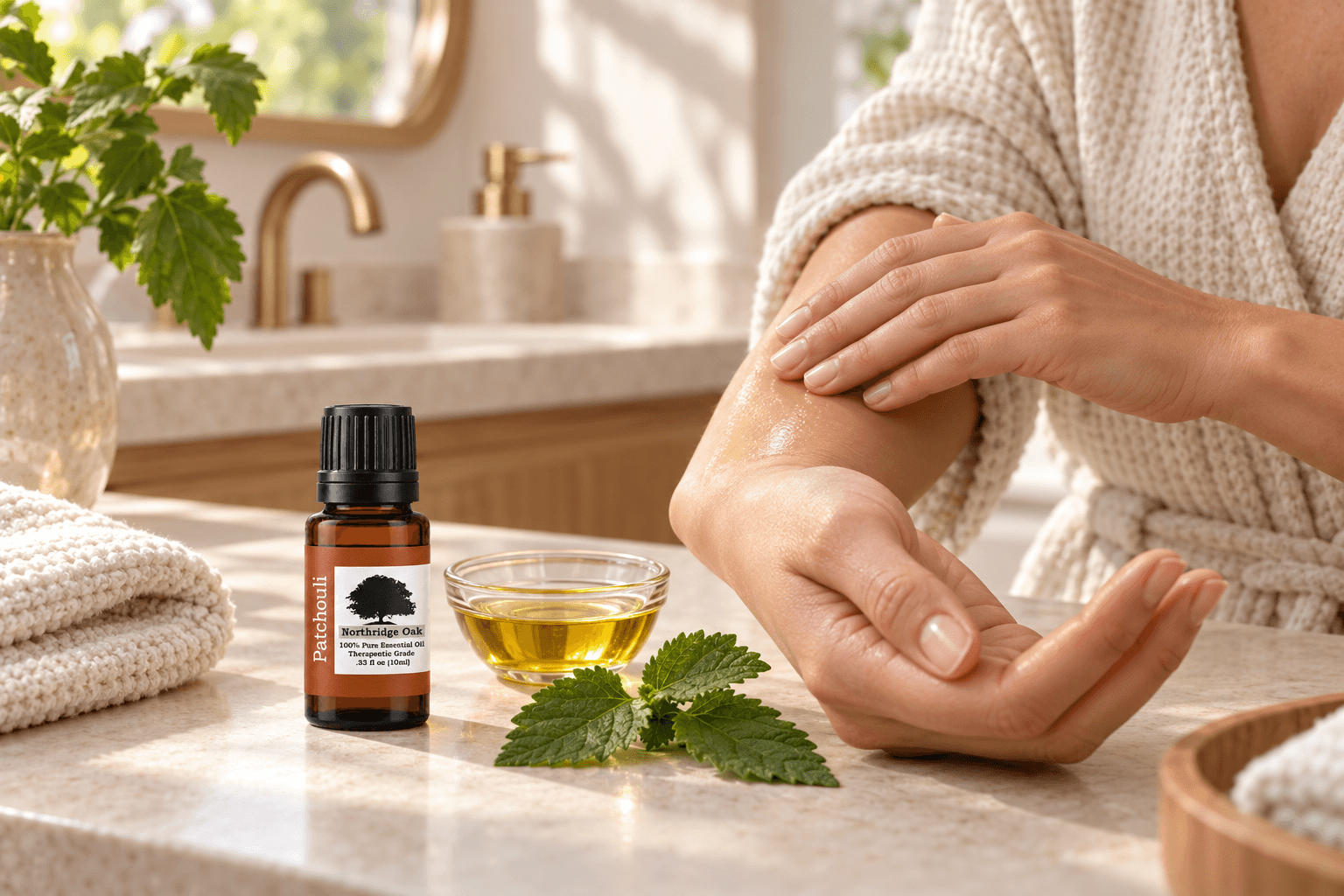
For a 30 mL bottle, add three drops Patchouli, two drops Lavender and one drop Frankincense, then fill with jojoba or fractionated coconut oil. Close, roll gently and label it with the ingredients and date. Massage a small amount onto arms or legs after bathing, when skin is still slightly damp.
The blend smells softly earthy and calm. Patchouli provides lasting depth, Lavender keeps it familiar and Frankincense adds a resinous brightness. If you prefer a citrus accent, choose a skin-safe citrus and review its phototoxicity guidance before sun exposure.
Simple Patchouli Hand and Cuticle Oil
Add one drop Patchouli and one drop Lavender to 10 mL jojoba oil. Apply a tiny amount around nails and massage it in. The goal is a pleasant, portable ritual: soft aroma, a few quiet breaths and the emollient feel of the carrier oil.
Because hands are washed frequently, this little routine is easy to repeat as needed. Keep the bottle away from heat and light, and avoid touching the dropper to skin so the contents stay clean.
A Gentle Patchouli Facial-Oil Approach
Facial skin deserves special care. Instead of improvising a strong blend, use a very low concentration and a carrier you already tolerate. For 30 mL jojoba, one or two total drops of Patchouli creates a restrained aromatic formula. Patch test along the jaw or inner arm and wait before broader use.
Keep expectations cosmetic: a facial oil can provide slip, reduce the sensation of dryness and make a routine more enjoyable. Patchouli’s aroma may help you slow down and apply it thoughtfully, which is a lovely benefit on its own.
Patchouli for Bath and Body
Essential oil does not disperse evenly in bathwater. Do not drip Patchouli directly into the tub. Use a professionally formulated bath product or a suitable dispersing base made for that purpose. A simpler option is to apply a properly diluted body oil after the bath, where the amount is measurable and the aroma stays close.
For massage, Patchouli pairs beautifully with Cedarwood, Lavender and Sweet Orange. Visit our Patchouli massage and body-oil guide for formulas designed around glide, dilution and scent balance.
How to Patch Test
Apply a small amount of the finished diluted product to a limited area of clean skin, then observe it before using more broadly. If discomfort or irritation develops, wash the area and stop using the blend. A patch test cannot predict every reaction, but it is a sensible introduction to a new formula.
Use clean tools, label homemade blends and make modest quantities. Fresh, simple formulas are easier to understand and easier to adjust.
What We’re Learning About Patchouli and Skin
Patchouli’s cosmetic story combines tradition, sensory appeal and emerging research. The mouse photoaging study found encouraging changes in wrinkles, elasticity and collagen, giving researchers a reason to investigate further. For home users, the most responsible translation is not a medical promise; it is an invitation to enjoy a beautifully diluted oil while protecting skin with established practices.
Choose one carrier, one simple formula and one area of use. That calm approach makes it easier to notice how the texture, aroma and routine feel for you.
Continue Exploring Patchouli Essential Oil
Patchouli is one of those oils that becomes more interesting the more you explore it. Continue through the Northridge Oak Patchouli Learning Center to discover encouraging research, inviting aroma combinations and practical ways to bring this warm, earthy botanical into your everyday routine.
- Start with the complete Patchouli Essential Oil benefits, uses, research, recipes and safety guide.
- Create a warm, welcoming atmosphere with 20 Patchouli Essential Oil diffuser blends.
- Discover what blends well with Patchouli Essential Oil and how different pairings reveal its softer side.
- Learn how Patchouli can become a lasting base note in a natural perfume or personal aroma blend.
- Bring Patchouli into thoughtful self-care with guides for skin, hair and scalp, and massage and body oils.
- Create a peaceful aromatic routine with Patchouli for relaxation and sleep.
- Use Patchouli confidently with the Patchouli Essential Oil safety guide and the Complete Essential Oil Safety Guide.
- Shop Northridge Oak Patchouli Essential Oil.
Create a Ritual You’ll Enjoy
A body oil after a shower or a tiny cuticle blend beside the sink can make Patchouli feel immediately useful. Begin gently, let the aroma warm on the skin and appreciate the routine for what it is: a thoughtful moment of care with a deep, distinctive botanical scent.
These statements have not been evaluated by the Food and Drug Administration. Northridge Oak products are not intended to diagnose, treat, cure or prevent disease.