Table of Contents
- Why Perfumers Love Patchouli
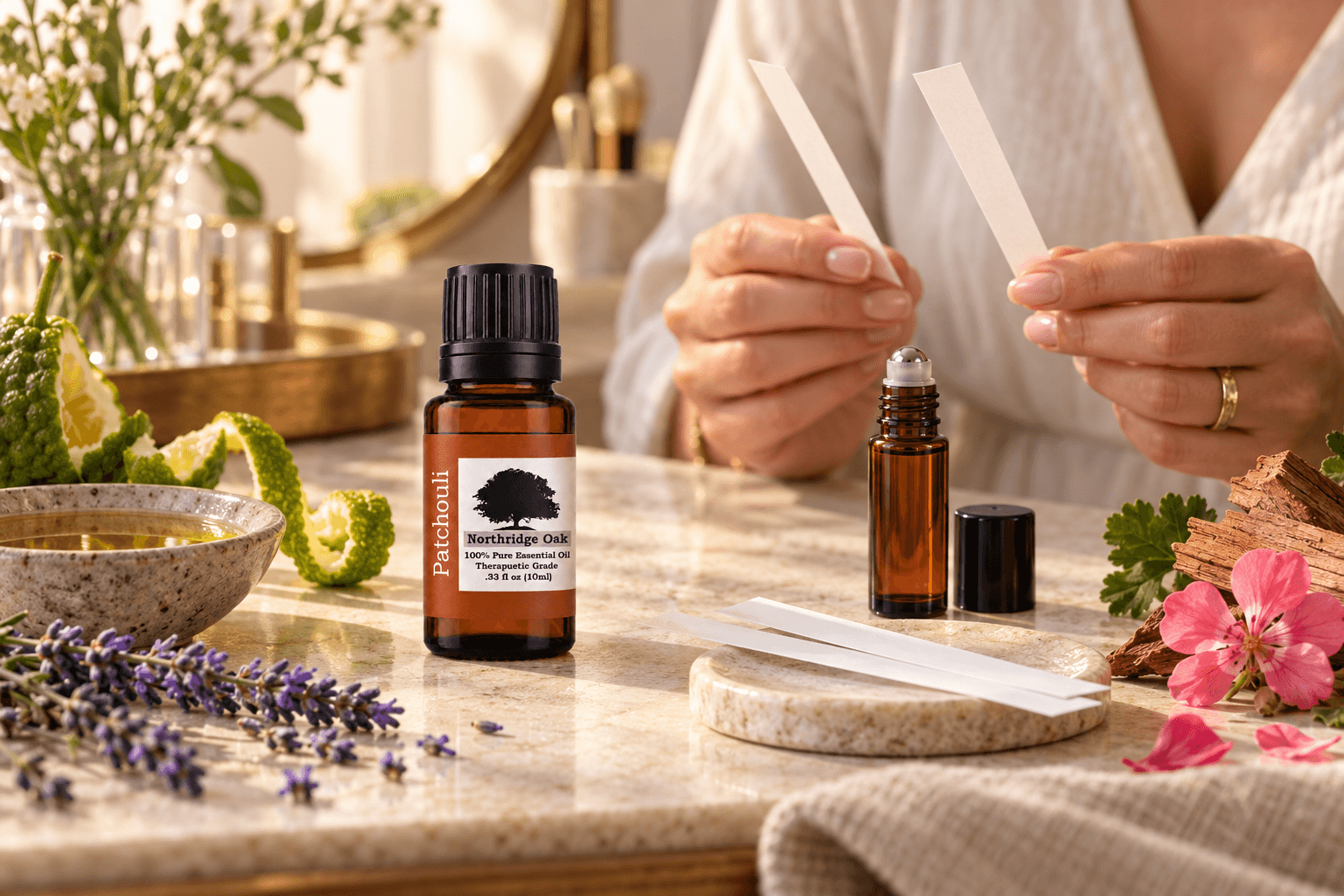
- Start With Scent Strips
- A Simple Perfume Structure
- Bright Patchouli Roller
- Soft Floral Patchouli Perfume
- Woodland Patchouli Perfume
- Let the Perfume Rest
- How Natural Perfume Feels Different
- Personalize One Element at a Time
- Patch Testing and Storage
- Choosing a Quality Patchouli
- What We’re Learning About Patchouli Perfume
- Continue Exploring Patchouli Essential Oil
- Wear the Version You Love
- A Small Perfume Practice Session
- Build a Tiny Scent Wardrobe
- Frequently Asked Questions
Patchouli essential oil natural perfume is a classic for good reason. It lasts, deepens lighter aromas and can make a simple three-oil formula smell thoughtfully composed. Used with restraint, Patchouli is the warm base that helps citrus sparkle, florals feel plush and woods linger gracefully.
You need only scent strips, a notebook and a few familiar oils to create something personal and beautifully wearable.
Why Perfumers Love Patchouli
Top notes make the first impression, heart notes shape the character, and base notes form the lasting foundation. Patchouli is a base note: it evaporates slowly and remains after brighter materials soften. That persistence lets it bridge sparkling Bergamot to Lavender or Geranium to Cedarwood. It develops from green and earthy toward woody, balsamic sweetness. Our guide to what Patchouli smells like follows the full dry-down.
Start With Scent Strips
Place one drop of each oil on separate strips. Fan them together and move the Patchouli strip farther away if it dominates. Try Sweet Orange, Lavender and Patchouli first. Smell immediately, after fifteen minutes and after an hour. Citrus changes quickly while Patchouli becomes central.
This exercise saves ingredients and teaches proportion. Write down three words at each interval. The formula you enjoy after an hour is often more important than the first impression.
A Simple Perfume Structure
A friendly ratio is four parts top note, two parts heart note and one part Patchouli. Make a tiny trial on blotters before diluting for skin. Our Patchouli blending guide offers more partners.
Record every drop and let the materials integrate before adjusting. Natural perfume rewards patience.
Bright Patchouli Roller
In a 10 mL roller, add two drops Sweet Orange, one drop Bergamot, one drop Lavender and one drop Patchouli, then fill with jojoba. Citrus leads and Patchouli provides a lasting finish. Review citrus phototoxicity guidance and patch test.
Soft Floral Patchouli Perfume
Use two drops Lavender, one drop Geranium, one drop Sweet Orange and one drop Patchouli in 10 mL jojoba. It is green-floral, warm and approachable. For richness, test Ylang Ylang on a strip; both Ylang Ylang and Patchouli are powerful, so tiny proportions feel elegant.
Woodland Patchouli Perfume
Add two drops Cedarwood, one drop Frankincense, one drop Bergamot and one drop Patchouli to 10 mL jojoba. Bergamot lights the opening while woods remain close to skin. For a greener variation, try Pine on a blotter.
Let the Perfume Rest
A fresh blend may smell separated. Close and label it, then rest it in a cool, dark place for a day or two. Smell again before changing anything. If Patchouli dominates, add carrier or revise the next small batch with less base note.
How Natural Perfume Feels Different
An oil perfume sits close to the body rather than creating a large cloud. It evolves with skin warmth and may need reapplication sooner than conventional fragrance. That intimacy is appealing: you notice it when you move your wrist, and Patchouli gives those moments continuity.
Personalize One Element at a Time
For brightness, compare Grapefruit with Bergamot. For softness, increase Lavender. For a drier finish, compare Cedarwood with Frankincense. Change one element at a time so you understand what improved the aroma. Patchouli supports each direction without requiring a crowded formula.
Patch Testing and Storage
Patch test the diluted perfume, avoid sensitive areas and stop if irritation occurs. Label ingredients and date. Store tightly closed away from heat and light. Ask a qualified professional for personal guidance during pregnancy, nursing, medical conditions or medication use.
Choosing a Quality Patchouli
Look for Pogostemon cablin, a stated origin, clear purity information and independent testing. Northridge Oak is family-owned in Pea Ridge, Arkansas. We bottle in small batches and use third-party GC/MS testing. Our oil is undiluted, with no fillers or added fragrance, so you can control every perfume proportion yourself.
What We’re Learning About Patchouli Perfume
Patchouli is not one fixed earthy smell. Proportion, partners and time make it bright, floral, woodsy, resinous or softly sweet. The creative skill is restraint: let one drop provide structure, then let top and heart notes speak.
Your first formula need not be perfect. Three or four oils, careful notes and a day of rest reveal what kind of Patchouli perfume feels like yours.
Continue Exploring Patchouli Essential Oil
Patchouli is one of those oils that becomes more interesting the more you explore it. Continue through the Northridge Oak Patchouli Learning Center to discover encouraging research, inviting aroma combinations and practical ways to bring this warm, earthy botanical into your everyday routine.
- Start with the complete Patchouli Essential Oil benefits, uses, research, recipes and safety guide.
- Create a warm, welcoming atmosphere with 20 Patchouli Essential Oil diffuser blends.
- Discover what blends well with Patchouli Essential Oil and how different pairings reveal its softer side.
- Learn how Patchouli can become a lasting base note in a natural perfume or personal aroma blend.
- Bring Patchouli into thoughtful self-care with guides for skin, hair and scalp, and massage and body oils.
- Create a peaceful aromatic routine with Patchouli for relaxation and sleep.
- Use Patchouli confidently with the Patchouli Essential Oil safety guide and the Complete Essential Oil Safety Guide.
- Shop Northridge Oak Patchouli Essential Oil.
Wear the Version You Love
If you like sunny scents, begin with citrus. If you love gardens, choose Lavender and Geranium. If woods feel like home, reach for Cedarwood and Frankincense. Explore Northridge Oak’s 100% Pure Patchouli Essential Oil and let one thoughtful drop give your perfume warmth and staying power.
A Small Perfume Practice Session
Set aside twenty quiet minutes and choose one citrus, one floral or herb, and Patchouli. Label three scent strips, add one drop to each and smell them individually. Then fan them together. Move the citrus closer for sparkle, the heart note closer for softness, or Patchouli farther away for a lighter base. This playful exercise turns proportion into something you can smell immediately.
Next, create two blotter variations. In the first, imagine a sunny perfume with four parts citrus, two parts Lavender and one part Patchouli. In the second, replace half the citrus impression with Cedarwood. Revisit both after an hour. You will notice that a small structural change can move the scent from bright and casual to dry and polished.
Build a Tiny Scent Wardrobe
Once you enjoy one formula, keep its Patchouli foundation and change only the top note. Sweet Orange feels friendly, Grapefruit lively and Bergamot refined. On another day, keep the top and base but change the heart from Lavender to Geranium. This creates a family of related perfumes without starting from zero.
Name each trial. A memorable name helps you recall the mood, and the accompanying notes preserve the exact formula. Natural perfume becomes much more enjoyable when each experiment feels like a small creative project rather than a search for instant perfection.
These statements have not been evaluated by the Food and Drug Administration. Northridge Oak products are not intended to diagnose, treat, cure or prevent disease.