Table of Contents
- What “grounding” actually means
- Why aroma can change the feeling of a moment
- The 2015 Vetiver anxiety study
- What makes the animal study interesting
- What the research means for everyday use
- The registered human Vetiver trial
- A 2025 human study adds another encouraging clue
- Stress, anxiety and grounding are related—but different
- A 90-second Vetiver reset
- Make a portable grounding inhaler
- Three Vetiver grounding diffuser blends
- A grounding roller for adult pulse points
- Choose the right partner for the moment
- Create an aroma anchor instead of diffusing at random
- Comfortable, responsible use
- Read the Vetiver stress research
- Continue learning about Vetiver Essential Oil
- The encouraging takeaway
- Frequently Asked Questions
Vetiver Essential Oil for stress, anxiety and grounding begins with an unmistakable sensory experience. Its aroma is deep, earthy and steady—the scent of roots, dry wood and warm soil. For many people, that character makes Vetiver a natural companion for slow breathing, journaling, meditation or the few quiet minutes that separate a demanding day from a peaceful evening.
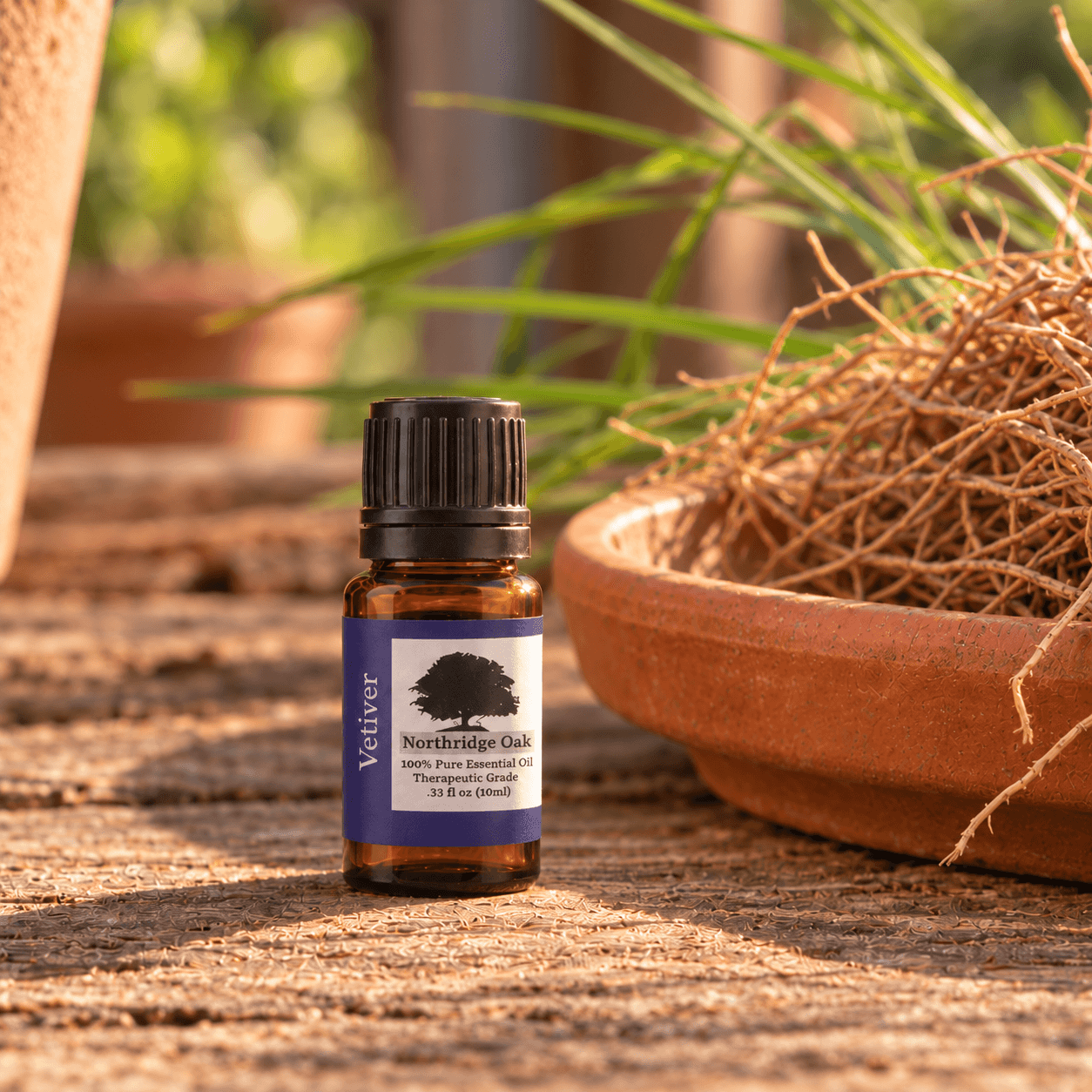
Northridge Oak Vetiver Essential Oil is 100% pure, undiluted and third-party GC/MS tested. Its strength is part of its beauty: one drop can anchor a diffuser blend, deepen a personal inhaler and give a simple pause a scent you can recognize and return to.
What “grounding” actually means
Grounding is a sensory description rather than a medical diagnosis. It refers to feeling more present, steady and connected with the immediate moment. The term fits Vetiver because the aroma is low, slow and substantial. It draws attention toward breath, body and surroundings instead of competing for attention with a sharp burst of fragrance.
That experience can be valuable during an ordinary stressful day. Smell Vetiver while placing both feet on the floor, relaxing the shoulders and lengthening the exhale. The oil becomes a marker for the practice. With repetition, the aroma and the action begin to belong together.
Why aroma can change the feeling of a moment
Odor information reaches brain regions involved in memory, emotion and learned associations. That is why a familiar smell can change the atmosphere of a room before you have consciously named it. Aroma also gives the mind something immediate and concrete to notice.
Vetiver is especially suited to this role because it does not disappear quickly. Its heavier aromatic compounds evaporate gradually, so the scent can remain present through a breathing exercise, a chapter of a book or an evening journaling session. This lasting quality makes it easier to build a repeatable ritual around the oil.
The 2015 Vetiver anxiety study
Saiyudthong and colleagues published a study titled Anxiety-like behaviour and c-fos expression in rats that inhaled Vetiver essential oil. The researchers exposed rats to Vetiver aroma and evaluated anxiety-related behavior using established animal testing methods.
They also measured c-fos expression. Researchers use c-fos as a marker of neuronal activation: when activity changes in a brain region, c-fos can help show which neural circuits participated. The team focused on the central amygdaloid nucleus, a region involved in processing emotionally significant and threat-related information.
The Vetiver-exposed animals displayed an anxiety-related behavioral profile comparable in direction to the diazepam comparison group, and the researchers observed changes in c-fos expression in the central amygdala. The findings suggested that inhaled Vetiver influenced both behavior and neural activity within this animal model.
What makes the animal study interesting
The study went beyond asking whether an observer thought an animal looked calmer. It combined a behavioral test with a biological marker in a relevant brain region. That gives the research more depth and offers a plausible starting point for investigating how Vetiver aroma interacts with emotion-related neural pathways.
Animal research is designed to identify signals and mechanisms that can guide later work. The study therefore supports continued human investigation and gives readers a research-based reason to explore Vetiver as part of a calming sensory routine.
What the research means for everyday use
A home diffuser uses different amounts, timing and surroundings from a laboratory animal protocol. The practical translation is beautifully simple: Vetiver can be paired with a calming action and enjoyed for the atmosphere it creates.
This could mean three slow breaths before opening your email, a Vetiver inhaler during the transition home from work, or a diffuser blend while stretching at the end of the day. The oil is most useful when it supports a clear habit rather than becoming one more thing to remember.
The registered human Vetiver trial
ClinicalTrials.gov lists a study sponsored by Chung Shan Medical University titled Study on the Efficacy of Vetiver Essential Oil Aroma on Depression/Anxiety People. The planned study was designed to evaluate Vetiver aroma in people experiencing depression or anxiety.
A trial registration is valuable because it records the intended research question and design. Publicly available study results are what allow readers to evaluate enrollment, completion, outcome measures and statistical findings. At the time of this review, the registry documented the project but did not provide results that could be interpreted as clinical evidence.
This is an important part of an honest research story: human investigators considered Vetiver promising enough to study formally, and the published outcome data will determine what the trial ultimately adds.
A 2025 human study adds another encouraging clue
A separate 2025 study followed 67 participants assigned to Lavender, Vetiver or Orange Blossom for four to six weeks. Eighteen participants used Vetiver. Although sleep quality was the central focus, the researchers also measured cardiovascular and autonomic parameters.
In the Vetiver group, average systolic blood pressure changed from 108.39 to 105.33 mm Hg, and average heart rate changed from 78.33 to 76 beats per minute. Both within-group changes were statistically significant. Participants also reported improved sleep-quality scores.
This study was small and was not a clinical anxiety-treatment trial, yet it adds direct human evidence that a sustained Vetiver aroma routine can coincide with measurable physiological changes and better reported sleep. That makes it especially relevant to a discussion of evening stress and settling down.
Stress, anxiety and grounding are related—but different
Everyday stress is the pressure or activation that can follow a deadline, crowded schedule, difficult conversation or long list of responsibilities.
Grounding is a practical way of returning attention to the present through the senses, breath or body.
Anxiety can describe a passing emotional experience, but persistent or disruptive anxiety can also be part of a health condition that deserves professional support.
Vetiver fits comfortably into the first two categories as an aroma for a pause, breathing practice or evening transition. Someone receiving care for anxiety can still enjoy the scent as a complementary personal ritual alongside the support that works for them.
A 90-second Vetiver reset
Place one drop of Vetiver on the wick of a personal inhaler. Sit or stand with both feet supported. Take a gentle breath from the inhaler, then inhale naturally through the nose for a count of four and exhale for a count of six. Repeat five times.
During each exhale, notice one physical detail: the weight of your feet, the support beneath you, the temperature of the air or the sound of the room. The longer exhale, sensory attention and distinctive aroma work together to create a clear stopping point in the day.
Make a portable grounding inhaler
Add 5 drops Vetiver, 6 drops Bergamot FCF and 4 drops Lavender to a blank inhaler wick. Assemble the inhaler and label it.
Bergamot gives the opening brightness, Lavender softens the center and Vetiver provides the steady base. Use it during a scheduled break, before a journal entry or as part of the transition between work and home.
Three Vetiver grounding diffuser blends
These recipes suit a 100 mL diffuser. Begin with the listed amount and follow the diffuser manufacturer’s directions.
Clear the Day: 1 drop Vetiver, 3 drops Bergamot FCF and 2 drops Lavender. This blend feels bright at first, then becomes soft and earthy.
Quiet Forest: 1 drop Vetiver, 2 drops Cedarwood, 2 drops Frankincense and 1 drop Bergamot FCF. It is dry, resinous and spacious.
Gentle Balance: 1 drop Vetiver, 2 drops Lavender, 1 drop Geranium and 2 drops Bergamot FCF. Geranium gives the blend a polished green-floral center.
A grounding roller for adult pulse points
Add 1 drop Vetiver, 2 drops Bergamot FCF and 1 drop Frankincense to a 10 mL roller bottle. Fill with jojoba or fractionated coconut oil, close and roll gently. This is approximately a 2% dilution.
After patch testing, apply lightly to adult wrists or forearms. Pause long enough to notice the aroma’s opening, middle and dry-down. Vetiver often becomes smoother and softer after several minutes on warm skin.
Choose the right partner for the moment
Pair Vetiver with Bergamot or Grapefruit when you want grounded energy without heaviness. Choose Lavender or Ylang Ylang for a softer evening blend. Use Cedarwood or Frankincense when you want a quiet forest-like atmosphere. Add Geranium when you want the blend to feel botanical and refined.
Keeping Vetiver to one drop lets the partner oil shape the mood while the root note provides continuity underneath.
Create an aroma anchor instead of diffusing at random
Choose one moment that already exists in your day: closing the office door, arriving home, beginning a stretch or opening a journal. Use the same Vetiver blend only during that moment for two weeks.
This gives the scent a clear meaning. Rather than becoming background fragrance, it marks a transition you want to remember. The practice is easy to evaluate because you can ask whether that specific moment now feels more deliberate and enjoyable.
Comfortable, responsible use
Vetiver is potent, so begin with one drop in a diffuser blend and provide fresh airflow. Store concentrated oils securely away from children and pets. Patch test topical blends and keep them away from eyes and sensitive tissues.
For persistent anxiety, panic, depression or distress that interferes with daily life, professional support can provide evaluation and a broader range of effective tools. Vetiver can remain a pleasant sensory companion within that plan. Read the full Essential Oil Safety Guide.
Read the Vetiver stress research
- Saiyudthong et al. (2015): Anxiety-like behavior and c-fos expression after Vetiver inhalation
- ClinicalTrials.gov: Registered Vetiver aroma study in people with depression or anxiety
- Chang et al. (2025): Vetiver, heart rate, blood pressure and sleep quality
Continue learning about Vetiver Essential Oil
Make this article part of a complete Vetiver routine:
- Vetiver Essential Oil: Benefits, Uses, Research and Safety
- What Does Vetiver Smell Like?
- What Blends Well With Vetiver Essential Oil?
- Vetiver Essential Oil Diffuser Blends
- Vetiver Essential Oil for Sleep
- Vetiver for Focus and ADHD: Examining the Evidence
- Vetiver Perfume and Cologne Recipes
- Vetiver Essential Oil Safety
The encouraging takeaway
Vetiver has a genuine research story: an animal inhalation study found changes in anxiety-related behavior and activity within the central amygdala, a registered human trial shows formal interest in the oil, and a 2025 study documented modest physiological changes during a multiweek Vetiver routine.
Its everyday appeal is even easier to experience. One drop can make a blend feel steady, warm and complete. Pair it with a slow exhale, a quiet room or a familiar transition, and Vetiver becomes more than a scent—it becomes a practical invitation to pause.
These statements have not been evaluated by the Food and Drug Administration. Northridge Oak products are not intended to diagnose, treat, cure or prevent disease.