Table of Contents
- Why Vetiver appears in cosmetics
- The most important Vetiver cosmetic study
- Six cosmetic questions the researchers tested
- What those assays found
- Where the research became especially interesting
- What the antimicrobial findings mean for a reader
- Why Vetiver feels so luxurious in body oil
- Choose a carrier oil for the experience you want
- Recipe: Everyday Vetiver body oil
- Recipe: Polished Botanical body oil
- Recipe: Woodland massage oil
- Recipe: Close-to-the-skin Vetiver perfume roller
- Body care or facial care?
- Dilution and patch testing
- How to read Vetiver skin claims with confidence
- Read the cosmetic research
- Continue learning about Vetiver Essential Oil
- The most useful takeaway
- Frequently Asked Questions
Vetiver oil for skin earns its place in body care for a reason that is both simple and genuinely appealing: it can turn an ordinary carrier oil into a deeply aromatic ritual. Its earthy, woody fragrance settles close to the skin, softens as it warms and lingers far longer than most citrus or herbal oils. Cosmetic researchers have also tested Vetiver for antioxidant, enzyme-inhibiting and antimicrobial activity, giving us a useful scientific picture of what this root oil contributes—and where its greatest strengths truly lie.
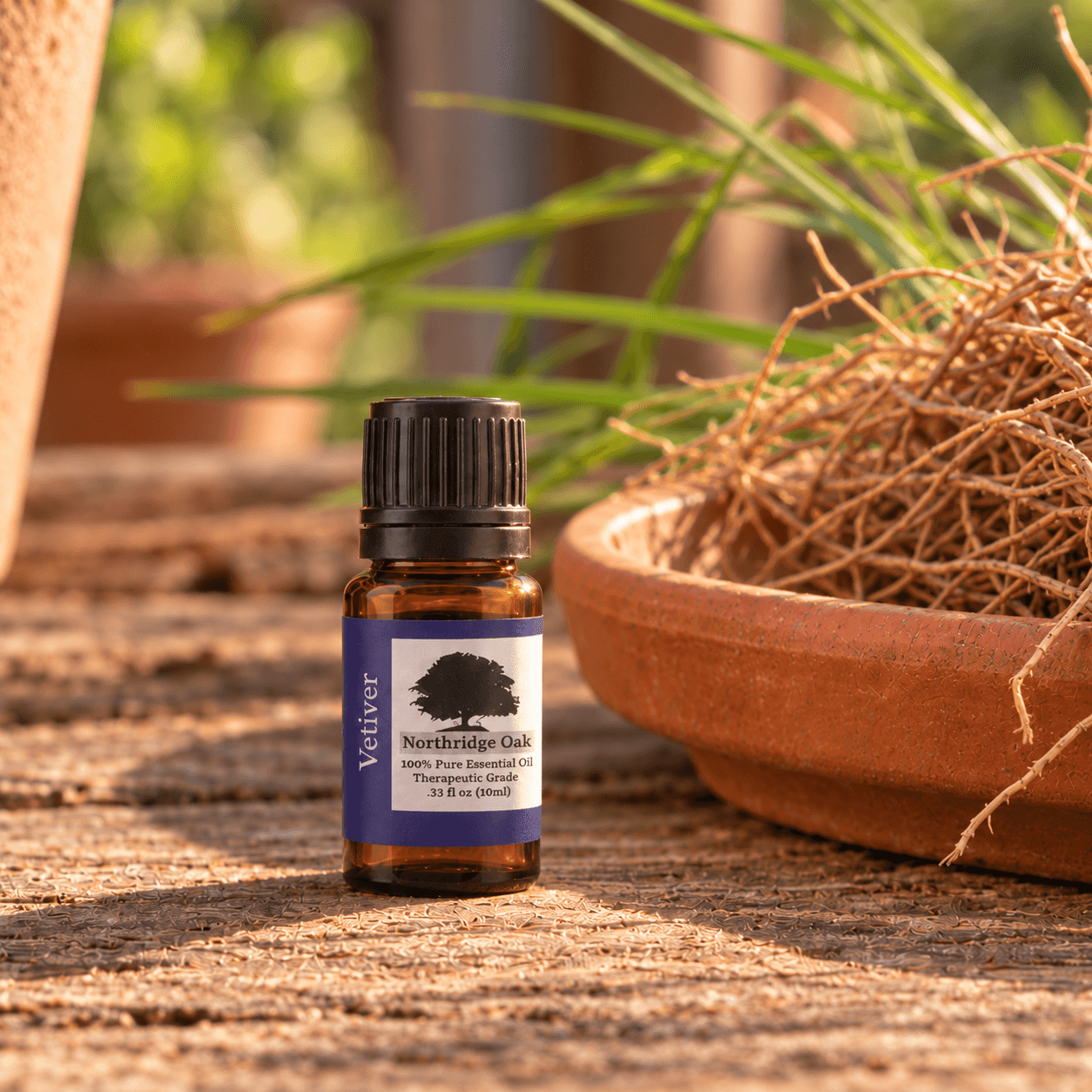
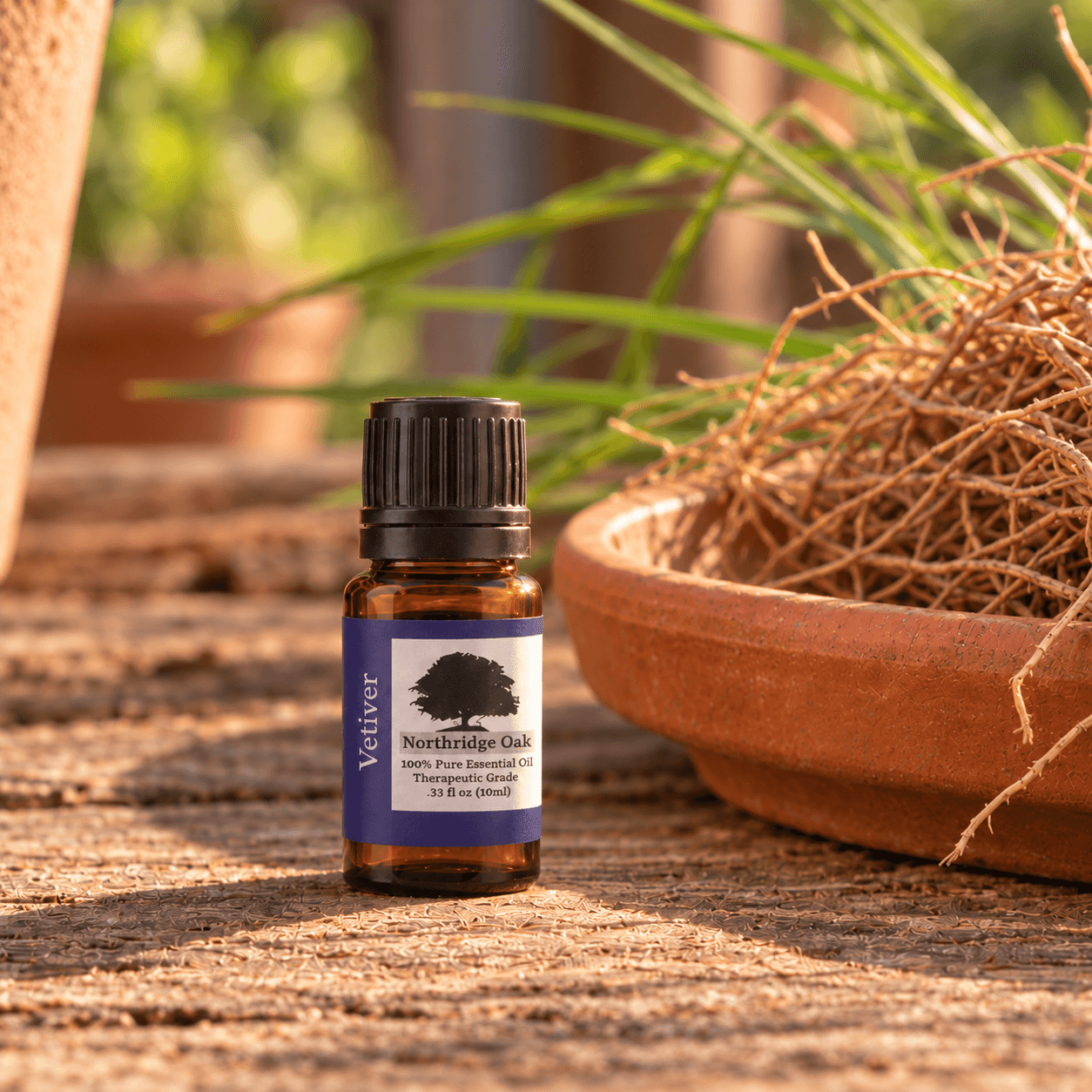
Northridge Oak Vetiver Essential Oil is 100% pure, undiluted and third-party GC/MS tested. Because Vetiver is concentrated and wonderfully tenacious, a few carefully measured drops are enough to give body oil, massage oil or a personal fragrance a sophisticated aroma that develops beautifully over time.
Why Vetiver appears in cosmetics
Vetiver, Chrysopogon zizanioides, is a tall grass whose aromatic treasure lies underground. Steam distillation of its dried roots produces a thick amber oil with earthy, woody, smoky, dry and subtly sweet notes. That unusual fragrance has made Vetiver a celebrated material in perfumery, soaps, deodorants and personal-care products.
Perfumers call Vetiver a base note. It evaporates slowly, helps lighter aromas feel more complete and remains detectable long after citrus top notes have softened. On skin, that slow dry-down is part of the pleasure: what begins as intensely rooty can become smooth, warm and quietly elegant.
Traditional aromatherapy sources have also associated Vetiver with dry, mature, sensitive or blemish-prone skin. Those traditions inspired modern researchers to ask a valuable question: beyond its fragrance, does Vetiver demonstrate measurable cosmetic activity in laboratory assays?
The most important Vetiver cosmetic study
In 2017, Burger and colleagues published Vetiver Essential Oil in Cosmetics: What Is New? in the journal Medicines. Rather than repeating traditional claims, the team examined three commercial Vetiver oils from Réunion Island using chemical analysis, professional olfactory evaluation, cosmetic bioassays and antimicrobial testing.
The three oils were analyzed with gas chromatography and mass spectrometry so the researchers could compare their chemical profiles. A trained perfumer also evaluated the samples at a 10% dilution in ethanol. For the biological testing, the oils were prepared at a final concentration of 100 micrograms per milliliter in the cosmetic assay wells.
This design matters because it evaluated several commonly promoted skin-care ideas side by side. It also allowed the researchers to distinguish Vetiver’s fragrance value from its activity in specific laboratory models.
Six cosmetic questions the researchers tested
The study explored six different pathways that frequently appear in cosmetic-product claims:
- Antioxidant activity: measured with a DPPH free-radical-scavenging assay.
- Tyrosinase inhibition: used to explore potential effects on the enzyme involved in melanin production.
- Lipoxygenase inhibition: examined as an in-vitro marker connected with inflammatory chemistry.
- Elastase inhibition: tested because elastase breaks down elastin, one of the proteins associated with skin resilience.
- Collagenase inhibition: studied because collagenase breaks down collagen.
- Hyaluronidase inhibition: evaluated because this enzyme degrades hyaluronic acid.
Those are meaningful screening tools for cosmetic research. They do not recreate living human skin, but they can identify materials worth developing and testing further.
What those assays found
The three Vetiver samples did not distinguish themselves as powerful new antioxidant, brightening, anti-inflammatory or anti-aging actives in these particular assays. The researchers’ conclusion was refreshingly clear: Vetiver’s established cosmetic value remained its remarkable scent.
That conclusion is useful rather than disappointing. It tells formulators and readers exactly where Vetiver shines. A properly diluted Vetiver body oil can smell luxurious, create a memorable personal ritual and add depth to other botanical aromas. The carrier oil supplies most of the softness, glide and emollient feel, while Vetiver supplies the aromatic personality.
It also protects the reader from expecting one ingredient to perform every role in a skin-care routine. A thoughtfully formulated moisturizer can handle hydration and barrier support; Vetiver can make that routine feel special, grounded and enjoyable.
Where the research became especially interesting
The same researchers tested the Vetiver oils against 20 bacterial strains and two Candida species using a microbroth dilution method. This test places the material in direct contact with microorganisms in controlled laboratory wells and measures the concentration required to inhibit visible growth.
The Vetiver samples showed notable activity against several Gram-positive bacterial strains and particularly strong activity against one Candida glabrata strain. The authors concluded that antimicrobial activity could offer added value alongside Vetiver’s fragrance in future cosmetic development.
This is the study’s most promising biological finding. It gives cosmetic chemists a legitimate reason to keep investigating Vetiver in professionally formulated products. It also demonstrates why the oil deserves more than a generic “good for skin” description: its actual laboratory profile is more specific and more interesting.
What the antimicrobial findings mean for a reader
A laboratory antimicrobial result is an early step in product development. Skin is a living ecosystem with its own barrier, moisture, oils and resident microbiome. A finished cosmetic also needs the right concentration, ingredient compatibility, stability and—when water is present—a complete preservation system.
For a simple home body oil, the most satisfying evidence-led approach is to enjoy Vetiver as a fragrant ingredient while recognizing its promising laboratory story. That gives the oil a credible purpose without asking a homemade blend to behave like a clinical or preserved cosmetic product.
Why Vetiver feels so luxurious in body oil
Vetiver’s aroma unfolds slowly. Straight from the bottle, it can feel powerful, smoky and rooty. At a low dilution in jojoba, fractionated coconut oil or apricot kernel oil, the scent opens up. Dry woods, warm earth and a restrained sweetness become easier to notice.
Body warmth then helps the blend develop over several hours. Lavender makes Vetiver softer, Bergamot makes it brighter, Geranium creates a polished botanical heart, and Cedarwood emphasizes its dry woodland character. This ability to change and blend is why Vetiver can make a very simple body oil smell remarkably refined.
Choose a carrier oil for the experience you want
Golden jojoba oil feels elegant and leaves a light protective layer. It is an excellent choice for a personal body oil or perfume-style application.
Fractionated coconut oil has a light texture and nearly neutral aroma, allowing Vetiver and its blending partners to remain the focus.
Sweet almond oil offers comfortable glide for massage. Its slightly richer feel works especially well on arms, legs, hands and feet.
Apricot kernel oil feels soft and silky, making it a lovely choice for an after-bath body oil.
Recipe: Everyday Vetiver body oil
Add 3 drops Vetiver and 3 drops Lavender Essential Oil to a clean 1-fluid-ounce bottle. Fill with jojoba or fractionated coconut oil, cap and roll gently to combine. This creates approximately a 1% total essential-oil dilution.
After a patch test, smooth a small amount over damp arms or legs after bathing. Lavender softens Vetiver’s earthy character while the carrier oil gives skin a comfortable, conditioned feel.
Recipe: Polished Botanical body oil
Add 2 drops Vetiver, 2 drops Geranium Essential Oil and 2 drops Bergamot FCF Essential Oil to 1 fluid ounce of jojoba or apricot kernel oil.
This approximately 1% blend begins bright and green, moves through a soft floral center and settles into a smooth Vetiver base. Bergamot FCF is the preferred choice for a leave-on formula because its relevant phototoxic furocoumarins have been removed.
Recipe: Woodland massage oil
Add 3 drops Vetiver, 2 drops Cedarwood Essential Oil and 1 drop Frankincense Essential Oil to 1 fluid ounce of sweet almond or fractionated coconut oil.
Warm a teaspoon between the palms and use it for a slow hand, foot or shoulder massage. The carrier provides glide, while the woody-resinous aroma turns an ordinary massage into a calming sensory ritual.
Recipe: Close-to-the-skin Vetiver perfume roller
Add 1 drop Vetiver, 2 drops Bergamot FCF and 1 drop Lavender to a 10 mL roller bottle. Fill with jojoba oil, close and roll gently. Let the blend rest for 24 to 48 hours before evaluating it.
This formula creates a personal fragrance at approximately 2% dilution. Apply lightly to adult pulse points after patch testing. Vetiver provides the lasting base, Bergamot creates a sparkling opening and Lavender connects the two.
Body care or facial care?
Vetiver is especially easy to enjoy in body oils, massage oils and perfume rollers, where its fragrance has room to develop. Facial skin is often more reactive and may already be exposed to cleansers, exfoliants, retinoids or other active ingredients. Someone drawn to Vetiver’s aroma can keep a facial routine simple and enjoy the oil on the body instead.
If a professionally formulated facial product contains Vetiver, follow its directions. The formulator has selected the concentration and evaluated how the complete ingredient system behaves together.
Dilution and patch testing
For adult body care, a 1% dilution is an inviting place to begin. In a 1-fluid-ounce bottle of carrier oil, that equals about six total drops of essential oil. A 10 mL personal-fragrance roller commonly uses approximately four total drops for a 2% dilution.
Patch test the finished blend on a small area of the inner forearm and observe it for 24 hours. Use clean, dry containers, label each formula with its ingredients and preparation date, and store it away from direct light and heat. Read the complete Essential Oil Safety Guide for broader topical guidance.
How to read Vetiver skin claims with confidence
A strong article should tell you whether a claim comes from traditional use, a laboratory assay, a finished-product study or a human clinical trial. For Vetiver, the clearest modern cosmetic study used laboratory assays rather than people applying the oil to their skin.
The evidence supports a confident description of Vetiver as an exceptional natural fragrance material with selected antimicrobial activity in vitro. Claims about erasing scars, clearing acne, reversing wrinkles or balancing skin oil would require direct human evidence. Keeping that distinction clear makes the oil’s genuine qualities easier to trust.
Read the cosmetic research
- Burger et al. (2017): Vetiver Essential Oil in Cosmetics: What Is New?
- Journal DOI and publication record
Continue learning about Vetiver Essential Oil
Make this article part of a complete Vetiver routine:
- Vetiver Essential Oil: Benefits, Uses, Research and Safety
- What Does Vetiver Smell Like?
- What Blends Well With Vetiver Essential Oil?
- Vetiver Essential Oil Diffuser Blends
- Vetiver Perfume and Cologne Recipes
- Indian, Haitian and Java Vetiver: What Is the Difference?
- Vetiver Essential Oil Safety: Dilution, Children and Pets
- Does Vetiver Oil Repel Insects and Termites?
The most useful takeaway
Vetiver does not need an exaggerated list of skin promises to be worth trying. Its authentic strength is more personal and immediate: it can make a simple body oil smell rich, earthy and beautifully composed. Cosmetic research adds an intriguing antimicrobial finding and gives formulators a reason to continue studying the oil.
Choose Vetiver when you want body care to feel less ordinary—when you want the warmth of massage, the softness of a good carrier oil and an aroma that settles into the skin with quiet depth. A single drop can completely change the character of a blend, which is exactly why Vetiver has remained so valuable to perfumers and cosmetic makers.
These statements have not been evaluated by the Food and Drug Administration. Northridge Oak products are not intended to diagnose, treat, cure or prevent disease.
Frequently Asked Questions
Does research prove Vetiver treats acne?
No. Laboratory antimicrobial findings do not establish acne treatment in people.
What did the cosmetic study conclude?
It found limited broad cosmetic activity beyond scent, plus antimicrobial activity against selected laboratory strains.
Can Vetiver still be used in body oil?
Yes. Properly diluted Vetiver gives body oil a sophisticated natural fragrance.
Which carrier oil works well with Vetiver?
Jojoba, fractionated coconut, sweet almond and apricot kernel offer different textures.
What is a 1% body-oil dilution?
Use about 6 total essential-oil drops in one fluid ounce of carrier oil.
How do I patch test?
Apply a small amount of the finished diluted blend to the inner forearm and observe it over the next day.
Is laboratory antimicrobial activity the same as skin treatment?
No. Clinical use requires appropriate formulation, delivery and human testing.
What is Vetiver’s strongest cosmetic role?
Its established strength is fragrance in perfume, soap and personal-care products.