Table of Contents
- Best Essential Oils to Blend with Ginger
- Citrus Oils That Blend with Ginger
- Wood Oils That Blend with Ginger
- Herbal and Mint Oils That Blend with Ginger
- Evergreen Oils That Blend with Ginger
- Floral Oils That Blend with Ginger
- Earthy Oils That Blend with Ginger
- Spice Oils That Blend with Ginger
- Ginger Root Essential Oil for Custom Blends
- Three Simple Ginger Blending Ratios
- Diffuser and Topical Safety
- How to Fine-Tune a Ginger Blend
- Continue Exploring
- Frequently Asked Questions
What blends well with Ginger Essential Oil? Citrus oils, woods, gentle florals, fresh herbs, evergreens and selected spices all pair beautifully with ginger’s warm, earthy spark. The most reliable blends give ginger a supporting role—usually one part ginger to two or three parts of a softer companion.
Ginger Root Essential Oil smells dry, spicy, fresh and slightly woody. It can connect a bright top note to a deeper base, add warmth without making a blend sugary, and give familiar citrus combinations a more distinctive center. This guide organizes pairings by aroma family and shows how to balance them.
Best Essential Oils to Blend with Ginger
- Citrus: Blood Orange, Lemon, Sweet Orange, Bergamot and Grapefruit
- Woods: Cedarwood, Sandalwood and Ho Wood
- Herbs: Rosemary, Spearmint and Basil
- Evergreens: Balsam Fir, Pine and Spruce
- Florals: Lavender and Geranium
- Earthy notes: Patchouli, Vetiver and Frankincense
- Spices: Cinnamon Leaf, Cardamom and Black Pepper
Two or three companion oils usually create the clearest formula, making it easy to notice how citrus, woods, herbs or florals change Ginger’s character.
Citrus Oils That Blend with Ginger
Citrus is the easiest place to start. Blood Orange makes ginger rounder and friendlier; Lemon highlights its fresh side; Grapefruit keeps it dry and airy; Bergamot adds a refined floral-citrus note. For a five-drop diffuser test, try three drops citrus, one drop ginger and one drop wood.
Ginger and Blood Orange create an especially useful everyday pairing. Read our Blood Orange Essential Oil guide or try more recipes in Blood Orange diffuser blends. For a sharper profile, consult what blends well with Lemon Essential Oil.
Easy Citrus Formula
- 3 drops Blood Orange Essential Oil
- 1 drop Ginger Root Essential Oil
- 1 drop Cedarwood Essential Oil
Orange opens the blend, ginger warms the middle and cedarwood lengthens the finish.
Wood Oils That Blend with Ginger
Cedarwood is ginger’s dependable grounding partner. It softens the fresh-root edge without smothering it. Sandalwood gives a smoother, creamier base, while Ho Wood can bridge toward floral notes. Woods are useful when a citrus-ginger blend feels fleeting or overly bright.
Try two parts cedarwood, one part ginger and two parts citrus on scent strips before putting the formula in a diffuser. Scent strips make one-drop changes easier to compare and keep experimentation separate from skin use.
Herbal and Mint Oils That Blend with Ginger
Rosemary makes ginger feel brisk and purposeful. Basil reinforces its green-spicy side, while Spearmint provides a soft, sweet freshness. Mint can dominate quickly, so begin with equal parts ginger and Spearmint or use mint as the smallest portion.
These pairings create bright, purposeful daytime room aromas. Begin with Ginger as the warm center, then adjust the strongest companion one drop at a time.
Evergreen Oils That Blend with Ginger
Balsam Fir, spruce and pine give ginger a clean forest setting. The combination feels seasonal without relying on sweet fragrance. Add citrus for sparkle or cedarwood for a drier, cabin-like base.
Forest Ginger Formula
- 2 drops Balsam Fir Essential Oil
- 2 drops Lemon Essential Oil
- 1 drop Ginger Root Essential Oil
This proportion keeps the fir recognizable and the ginger supportive. Use less total oil in small rooms and allow fresh air to circulate.
Floral Oils That Blend with Ginger
Lavender turns ginger into a softer, more rounded aroma. Geranium adds green-rose complexity and can make ginger feel unexpectedly polished. These pairings are useful in personal inhalers or body oils when properly formulated, but topical products require attention to the total essential-oil concentration.
If skin care is your goal, use the conservative guidance in ginger oil for skin and compare it with our Geranium skin guide.
Earthy Oils That Blend with Ginger
Patchouli and Vetiver make ginger feel darker and more meditative. Frankincense adds a dry resinous bridge. Use earthy oils sparingly: a single drop can reshape a blend. Citrus is an effective counterweight if the result becomes too dense.
Patchouli is especially helpful in longer-lasting diffuser blends and massage aromas. Explore its character in Patchouli Essential Oil benefits and uses and Patchouli diffuser blends.
Spice Oils That Blend with Ginger
Cinnamon Leaf, cardamom and black pepper can intensify Ginger’s warmth. Use one spice as a small accent so every note remains distinct and the finished blend feels polished.
For a balanced seasonal room scent, try three drops Blood Orange, one drop Ginger Root and one drop Cinnamon Leaf. See Cinnamon Leaf diffuser blends for more ideas, and remember that aromatic use does not mean culinary use.
Ginger Root Essential Oil for Custom Blends
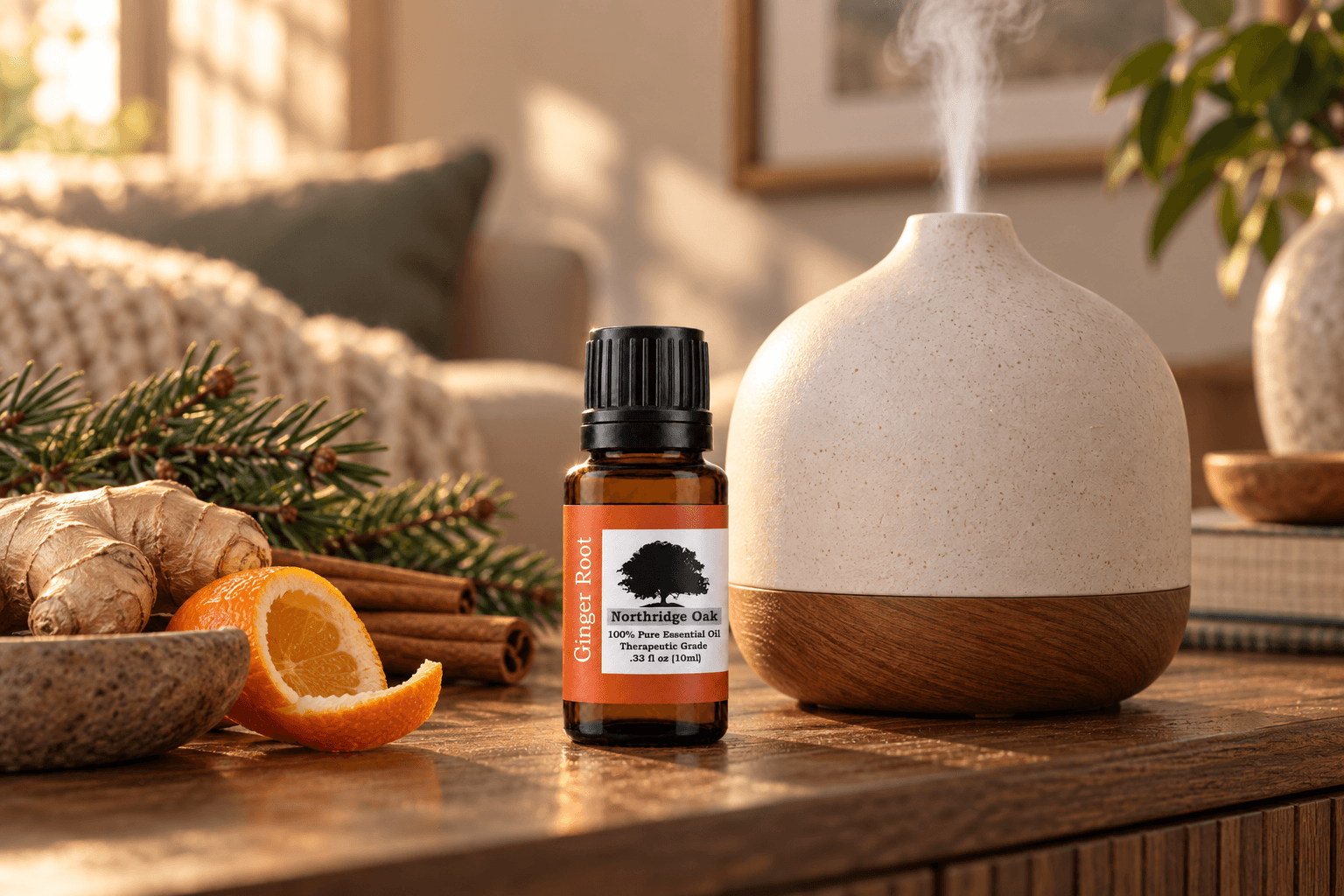
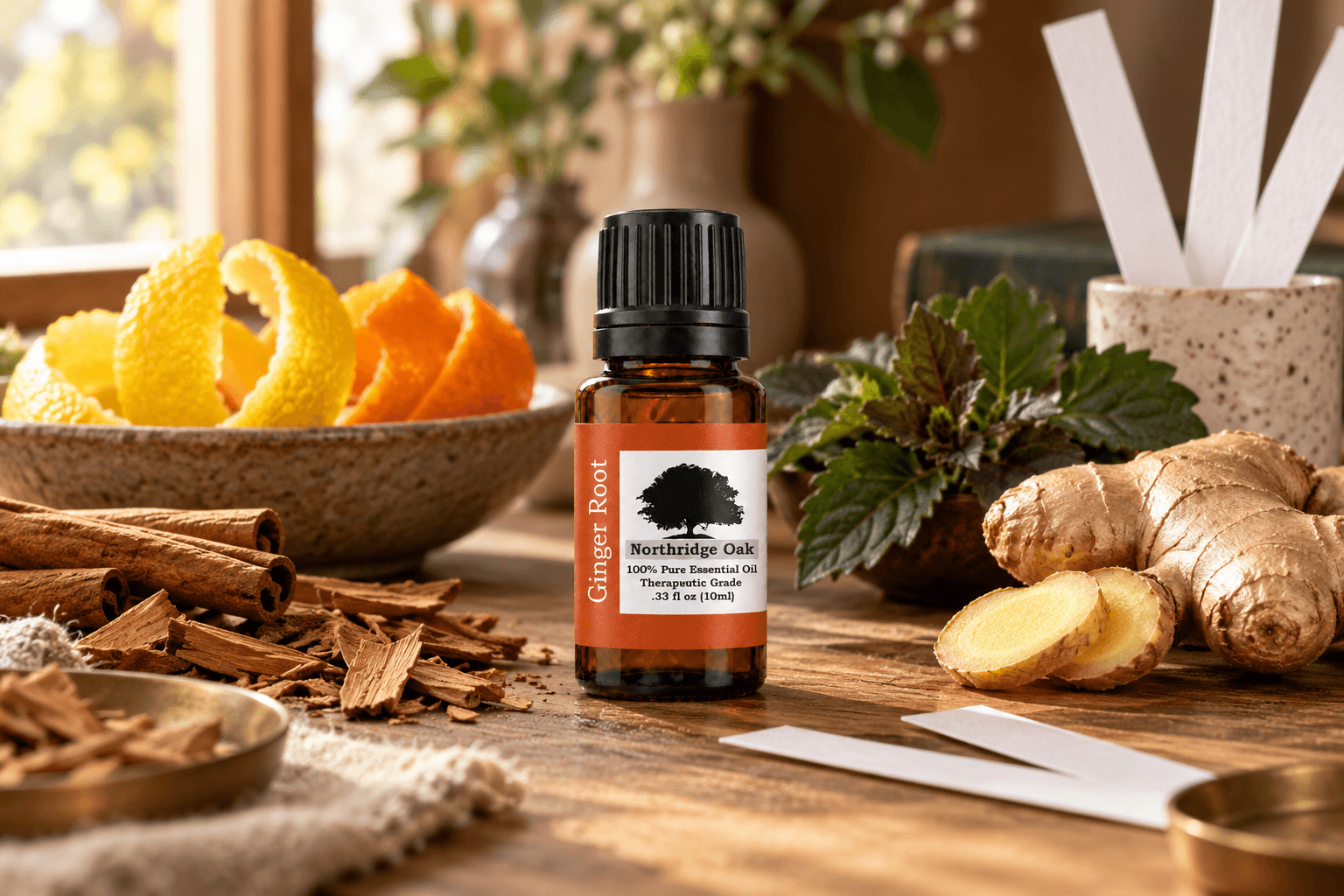
Northridge Oak’s 100% Pure Ginger Root Essential Oil is undiluted and GC/MS tested. Its single-ingredient format makes it easy to build repeatable formulas, because you control the carrier and every companion oil.
Start on paper scent strips. Place one drop of each oil on separate strips, fan them together and smell from a comfortable distance. Remove or add strips to explore proportion before committing drops to a diffuser or carrier. Write down the final ratio, date and intended use.
Three Simple Ginger Blending Ratios
Bright
Use three parts citrus, one part ginger and one part herb or wood. This emphasizes fresh energy and keeps spice light.
Cozy
Use two parts citrus, one part ginger and two parts wood or evergreen. This creates a balanced room aroma with a lasting base.
Grounded
Use two parts wood, one part ginger, one part citrus and a trace of patchouli or vetiver. Keep the earthy accent smaller than the ginger.
Diffuser and Topical Safety
For a diffuser, follow the unit’s instructions, use ventilation and begin with a low total drop count. Do not add carrier oil or infused ginger oil to a water diffuser. Our ginger diffuser blends provide ready-to-use recipes.
For topical blends, calculate dilution using the total number of essential-oil drops, not just ginger. A conservative adult body blend can begin around 1%, or roughly six total drops per ounce of carrier oil. Use less for the face or sensitive skin, patch test and avoid eyes. Review the complete essential oil safety guide.
How to Fine-Tune a Ginger Blend
If ginger disappears, reduce the strongest companion rather than immediately adding more ginger. If a blend is sharp, add a soft citrus or wood. If it is muddy, remove one base note. If it is too sweet, add lemon, fir or cedarwood. Make one change at a time so you know what worked.
Continue Exploring
Start with Ginger Root Essential Oil benefits and everyday uses, then move into ginger massage blends. For another pairing-focused guide, visit what blends well with Eucalyptus Essential Oil.
These statements have not been evaluated by the Food and Drug Administration. This product and the information in this article are not intended to diagnose, treat, cure or prevent any disease. Essential oils are highly concentrated. Dilute before topical use, patch test first, and keep out of reach of children and pets. Consult a qualified healthcare professional before use during pregnancy or nursing, with young children, while taking medication or when managing a medical condition.