Table of Contents
- Best Essential Oils to Blend with Marjoram
- Lavender and Marjoram
- Citrus Oils That Blend with Marjoram
- Wood and Resin Oils That Blend with Marjoram
- Herbal Oils That Blend with Marjoram
- Eucalyptus and Mint Oils with Marjoram
- Evergreen Oils That Blend with Marjoram
- Marjoram Essential Oil for Custom Blending
- Three Reliable Marjoram Blend Structures
- How to Test a Blend on Scent Strips
- Diffuser and Topical Safety
- Common Blending Problems
- Continue Exploring
- Make a Small Master Blend Carefully
- Building a Blend from Top, Middle and Base Notes
- Pairings to Approach Carefully
- Frequently Asked Questions
What blends well with Marjoram Essential Oil? Lavender, Bergamot, Cedarwood, Eucalyptus, Rosemary, Clary Sage, Sweet Orange, Frankincense and gentle mint oils are strong starting partners. Marjoram’s warm green center can soften sharp notes and make bright-to-deep transitions feel more natural.
The easiest rule is to use Marjoram as one part of a three- or four-part blend. Its aroma is moderate, but herb-on-herb formulas can become dense quickly. Test small ratios on paper scent strips before making a diffuser or body product.
Best Essential Oils to Blend with Marjoram
- Soft floral: Lavender, Geranium
- Citrus: Bergamot, Lemon, Sweet Orange, Blood Orange
- Woods and resins: Cedarwood, Frankincense
- Fresh herbs: Rosemary, Basil, Clary Sage
- Cool greens: Eucalyptus, Spearmint
- Evergreens: Balsam Fir, Pine, Spruce
A good pairing list is an aroma map, not permission to combine everything. Two or three companions usually make a cleaner formula than eight.
Lavender and Marjoram
Lavender is Marjoram’s most forgiving partner. It softens the peppery-green edge while preserving the herbaceous identity. Begin with two or three parts Lavender to one part Marjoram for a diffuser or scent-strip test.
This pairing suits an evening routine because Lavender softens Marjoram’s herbal center and creates an easy, comforting aroma. Read Marjoram Essential Oil for sleep and Lavender benefits and uses.
Citrus Oils That Blend with Marjoram
Bergamot gives marjoram lift and elegance. Lemon makes it brighter and cleaner. Sweet Orange rounds its green edges; Blood Orange creates a fuller, softer citrus base. Citrus is the quickest fix when an herbal blend feels too dense.
Simple Herbal Citrus Ratio
- 2 parts Bergamot
- 1 part Marjoram
- 1 part Cedarwood
For topical products, check whether a specific citrus oil is phototoxic and follow its label. Diffuser formulas do not automatically become skin recipes. Explore Blood Orange Essential Oil.
Wood and Resin Oils That Blend with Marjoram
Cedarwood anchors marjoram and extends its dry finish. Frankincense adds spacious resinous depth. These partners are especially useful when Lavender or citrus disappears too quickly in a diffuser blend.
Try two parts Cedarwood, one part Marjoram and two parts orange. For a deeper formula, replace one orange part with Frankincense. Keep the recipe simple enough to remember and record it.
Herbal Oils That Blend with Marjoram
Rosemary makes marjoram brisker, Basil emphasizes its culinary-herbal association and Clary Sage adds softness. Because similar notes can stack, begin with equal parts only on scent strips. In a diffuser, add citrus or wood to create contrast.
Each oil has its own aromatic chemistry and blending personality. Compare Marjoram with stronger Origanum-family aromas in Marjoram vs. Oregano Essential Oil.
Eucalyptus and Mint Oils with Marjoram
Eucalyptus makes Marjoram feel open and fresh, while Spearmint adds a soft, cool lift. Use either as the smallest portion so Marjoram remains easy to notice.
For more pairing logic, visit what blends well with Eucalyptus Essential Oil.
Evergreen Oils That Blend with Marjoram
Balsam Fir, Pine and Spruce reinforce marjoram’s green character and give it a forest setting. Bergamot or Sweet Orange keeps the result from becoming too shadowy. This combination works well in cooler months without relying on cinnamon or clove.
Marjoram Essential Oil for Custom Blending
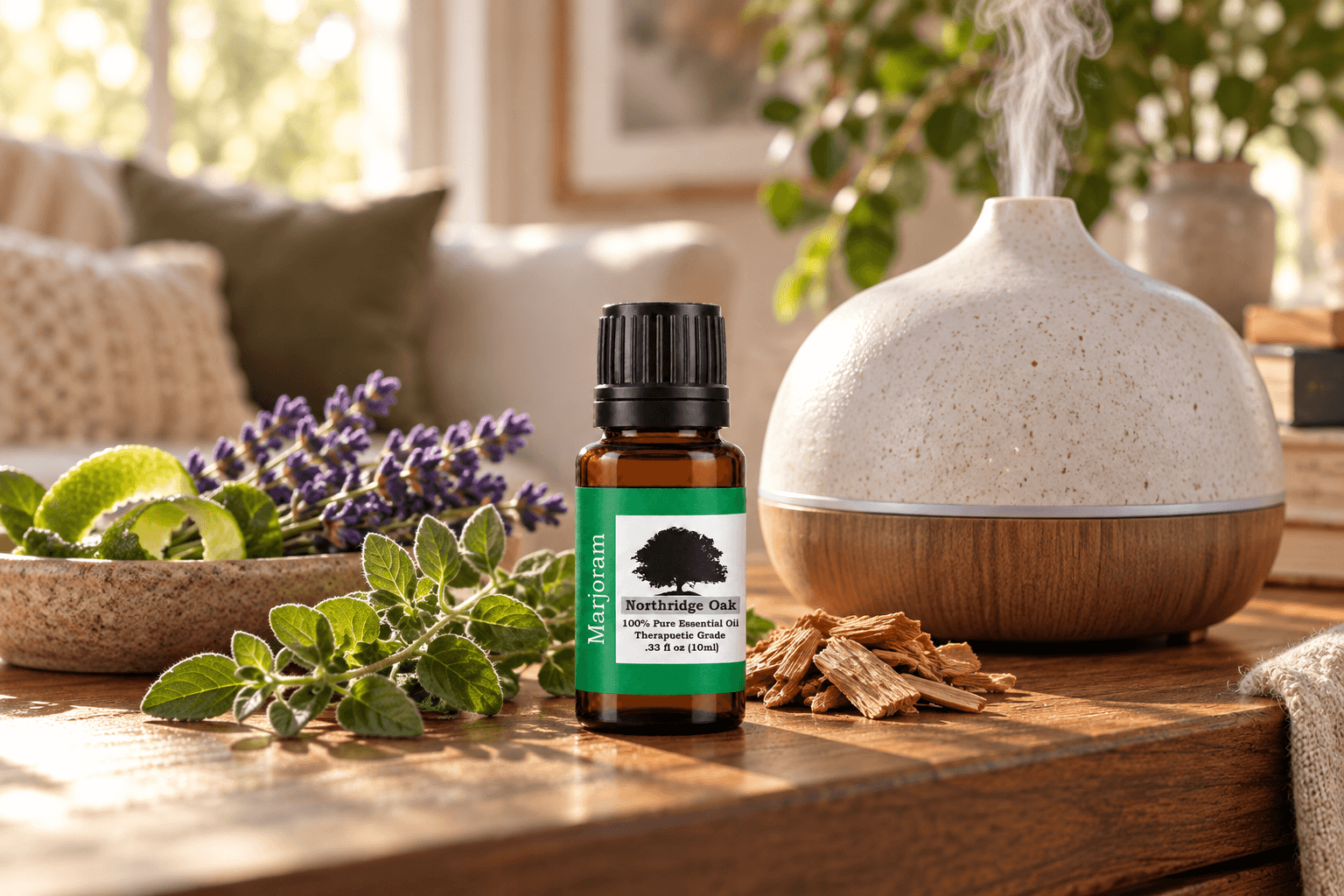
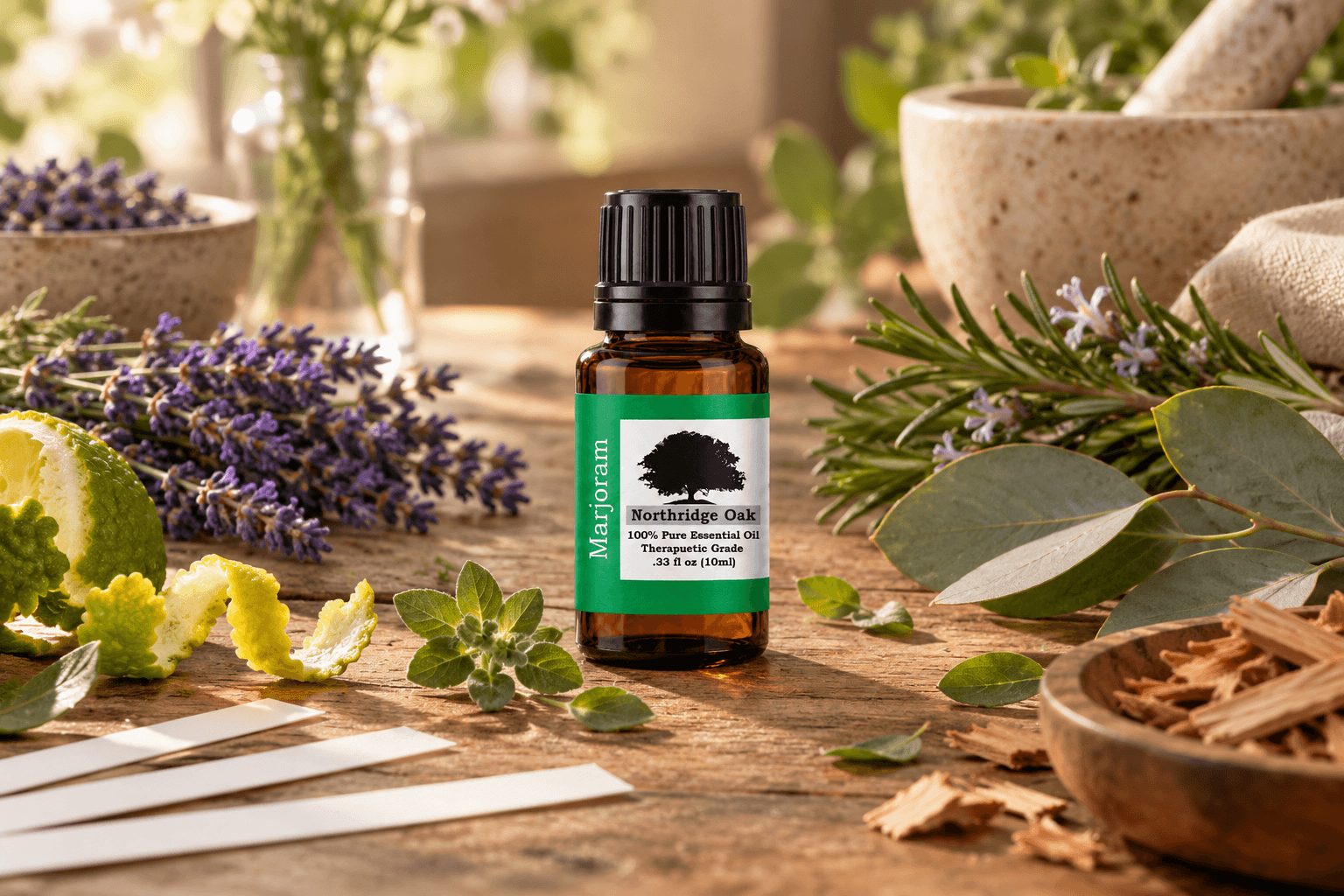
Northridge Oak Marjoram Essential Oil is 100% pure, undiluted, third-party GC/MS tested and botanically identified as Origanum majorana. A single-ingredient oil makes it easier to control the exact ratio.
Three Reliable Marjoram Blend Structures
Bright
Use two parts citrus, one part Marjoram and one part Rosemary or Eucalyptus. This keeps the green note lively.
Soft
Use three parts Lavender, one part Marjoram and one part Cedarwood. This balances a gentle floral middle with a dry base.
Grounded
Use two parts Cedarwood, one part Marjoram, one part Frankincense and one part orange. The citrus prevents heaviness.
How to Test a Blend on Scent Strips
Put one drop of each oil on separate strips. Fan them together from a comfortable distance. To simulate two parts Lavender, use two Lavender strips rather than repeatedly adding oil to one. Remove, add and record until the balance feels right.
Wait several minutes and smell again. Bright notes fade first, so a blend that opens beautifully may become too woody later. Retesting helps you understand the full arc.
Diffuser and Topical Safety
For a diffuser, follow device directions, begin low and ventilate. For skin, calculate dilution from all essential-oil drops combined. Six total drops per ounce of carrier is an approximate 1% adult body blend. Patch test and avoid eyes or broken skin.
Read Marjoram for skin, Marjoram massage oil and the complete safety guide.
Common Blending Problems
If the formula smells medicinal, reduce Eucalyptus, Rosemary or mint. If it smells flat, add Bergamot or Lemon. If it is too sharp, add Lavender or Cedarwood. If every note disappears into one muddy aroma, remove an oil rather than adding more.
Continue Exploring
Try finished recipes in Marjoram diffuser blends, learn the oil in Marjoram benefits and uses, or compare another herbal pairing system in what blends well with Ginger Essential Oil.
Make a Small Master Blend Carefully
After a ratio works on scent strips, combine a modest master blend in a labeled amber bottle for diffuser use. Write the oils, parts and date on the label. Use the finished blend in drops according to diffuser capacity; a master blend is still undiluted essential oil.
Keep it separate from topical products and never assume a diffuser master blend is skin-safe. If the aroma changes significantly or becomes harsh, replace it rather than masking it with fresh oil. Store it upright and out of reach.
These statements have not been evaluated by the Food and Drug Administration. This product and the information in this article are not intended to diagnose, treat, cure or prevent any disease. Essential oils are highly concentrated. Dilute before topical use, patch test first, and keep out of reach of children and pets. Consult a qualified healthcare professional before use during pregnancy or nursing, with young children, while taking medication or when managing a medical condition.
Building a Blend from Top, Middle and Base Notes
A practical blend often includes a bright opening, a central character and a lasting base. Bergamot or Lemon can provide the opening, Marjoram can occupy the herbal middle and Cedarwood or Frankincense can supply the base. These labels are useful guides rather than rigid scientific categories, but they prevent every oil from competing in the same space.
Start with a 2:1:1 ratio: two parts bright note, one part Marjoram and one part base. Smell immediately, again after ten minutes and once more after an hour on scent strips. The blend may become woodier as citrus fades.
Pairings to Approach Carefully
Powerful spice oils such as Cinnamon or Clove can reshape Marjoram quickly. Beginners often get the clearest, most balanced results from Lavender, citrus and woods, then add stronger accents one drop at a time.