Table of Contents
- Why Cinnamon Leaf Changes a Blend So Quickly
- Citrus Partners
- Spices
- Evergreens and Woods
- Resins and Earth
- Eight Dependable Blends
- Why Choose Northridge Oak Cinnamon Leaf?
- Learning About Essential Oils: Build Around a Warm Accent
- A Simple Way to Experience Cinnamon Leaf
- Continue Learning About Cinnamon Leaf Essential Oil
- Thoughtful Use
- Frequently Asked Questions
The pleasure of blending Cinnamon Leaf begins when you stop asking only which oils “go with it” and start asking what you want the finished room to feel like. Its warm, dry, green and clove-like character can be brightened, softened, deepened or made more spacious depending on the partner you choose. This guide explains why the best pairings work and gives you measured blends you can actually recreate.
Why Cinnamon Leaf Changes a Blend So Quickly
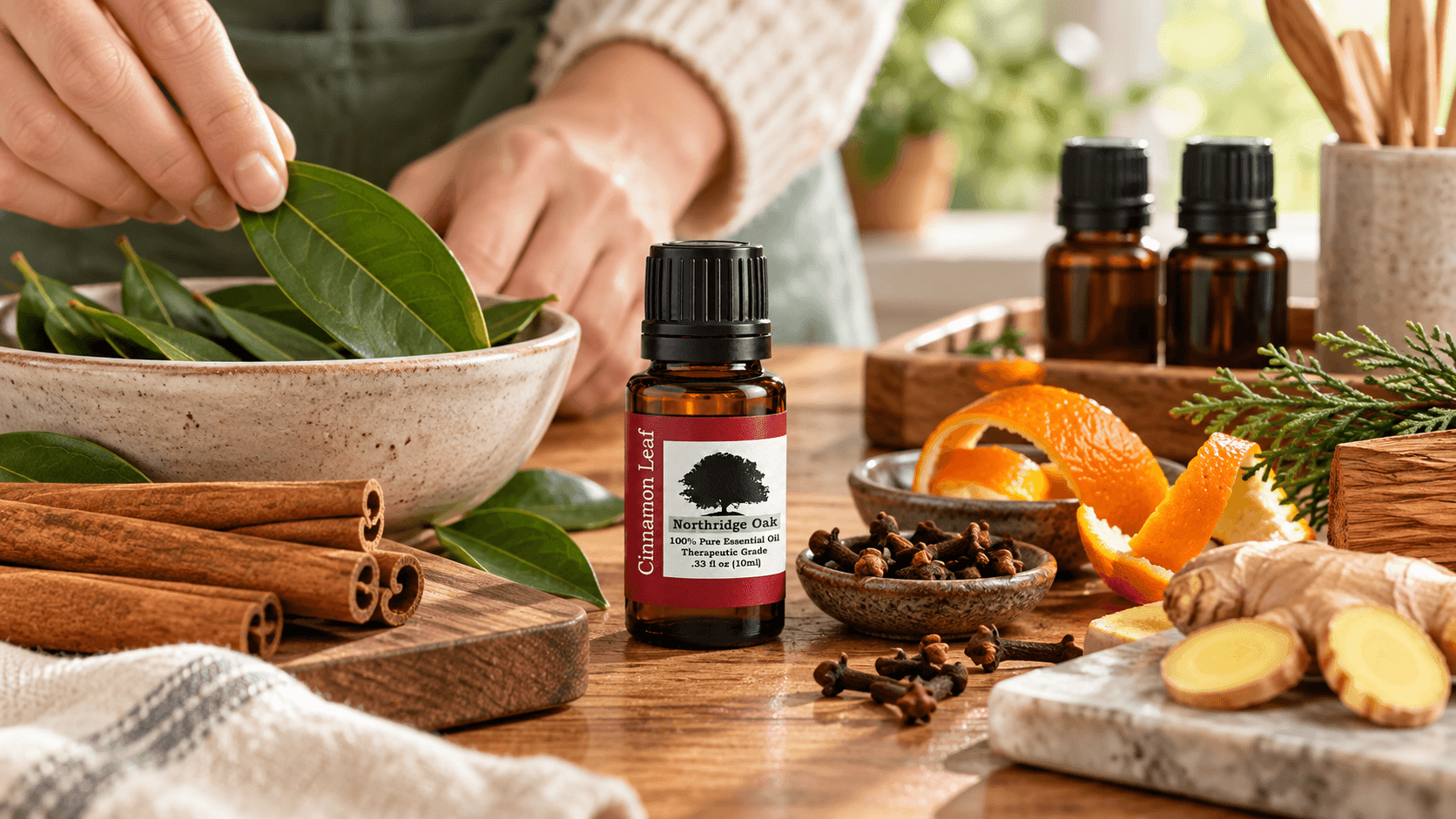
Its eugenol-rich aroma is persistent and immediately recognizable. Let brighter partners carry more of the formula while Cinnamon Leaf supplies the warm center. Begin with one part Cinnamon Leaf to three or four parts citrus or evergreen.
Citrus Partners
Blood Orange creates the classic warm-orange direction. Lemon feels cleaner and brighter. Grapefruit keeps the spice dry, while Bergamot gives it a polished perfume quality.
Spices
Clove deepens the shared eugenol character. Ginger Root adds lively warmth. Use both as accents and let citrus or woods provide space around them.
Evergreens and Woods
Balsam Fir creates a bright holiday forest. Cedarwood gives dry structure and makes Cinnamon Leaf feel more refined. These are ideal when a recipe feels sweet and needs definition.
Resins and Earth
Frankincense adds balsamic space, while Patchouli creates a deeper earthy finish. Start with a small Patchouli amount so the warm leaf note remains clear.
Eight Dependable Blends
- 1 Cinnamon Leaf, 3 Blood Orange, 2 Balsam Fir
- 1 Cinnamon Leaf, 3 Bergamot, 2 Cedarwood
- 1 Cinnamon Leaf, 3 Lemon, 1 Frankincense
- 1 Cinnamon Leaf, 3 Grapefruit, 1 Cedarwood
- 1 Cinnamon Leaf, 3 Blood Orange, 1 Ginger Root
- 1 Cinnamon Leaf, 2 Balsam Fir, 2 Frankincense
- 1 Cinnamon Leaf, 3 Bergamot, 1 Patchouli
- 1 Cinnamon Leaf, 2 Blood Orange, 1 Clove, 2 Cedarwood
Choose a citrus top note, one drop Cinnamon Leaf as the heart accent and a wood or resin as the base. For six drops, a 3:1:2 ratio creates brightness, spice and structure. Let the formula diffuse for several minutes before adjusting.
Grapefruit and Cedarwood suit spring; Lemon and Frankincense create a lighter summer direction; Blood Orange and Ginger define fall; Balsam Fir and Frankincense create winter warmth.
Evaluate ratios on paper before calculating any topical formula. Cinnamon Leaf remains strong at low concentration, so one part can be enough to shape several parts of citrus and wood.
Compare Blood Orange against Bergamot to hear the difference between cozy and polished. Compare Balsam Fir against Cedarwood to hear fresh forest versus dry timber. Compare Frankincense against Patchouli to hear spacious resin versus deep earth.
Use citrus to create space, Cinnamon Leaf to supply the warm heart and wood or resin to shape the finish. A 3:1:2 ratio is a dependable six-drop structure. For a lighter result, use four citrus, one Cinnamon Leaf and one base.
Blood Orange makes Cinnamon Leaf cozy. Bergamot makes it elegant. Lemon makes it clean-smelling. Grapefruit makes it dry. Balsam Fir makes it festive. Cedarwood makes it tailored. Frankincense makes it spacious. Choose the word that matches your goal, then begin with that two-oil relationship.
Clove and Ginger can enrich Cinnamon Leaf, yet all three are expressive. Let Blood Orange, Lemon or Balsam Fir hold most of the formula. Try three Blood Orange, one Cinnamon Leaf, one Ginger and one Cedarwood for layered warmth with clear structure.
When a formula feels heavy, add citrus. When it feels thin, add Cedarwood or Frankincense. When it feels sweet, one Cinnamon Leaf drop may provide dry definition. Let the diffuser run briefly before making the next change.
A diffuser ratio can inspire perfume or soap, but each method needs its own concentration calculation. Preserve the aromatic proportion on paper, then formulate for the specific finished product with suitable guidance.
Save Grapefruit–Cedarwood for spring, Lemon–Frankincense for summer, Blood Orange–Ginger for fall and Balsam Fir–Frankincense for winter. Cinnamon Leaf connects the collection while every season remains distinct.
Choose one formula, write it down before diffusing and keep the total light enough to notice every ingredient. Cinnamon Leaf is expressive at one drop, so consistency matters more than complexity. Record the diffuser capacity, room, time and first impression.
Return to the room after a brief break. Citrus usually greets you first, Cinnamon Leaf supplies the warm heart and woods or resins remain through the drydown. This simple observation turns a pleasant blend into practical blending knowledge.
Close the bottle promptly, use clean tools and store it upright away from heat and sunlight. Fresh Cinnamon Leaf should smell layered: green leaf, warm clove-like spice and dry wood. Thoughtful storage preserves that progression from the first recipe to the last.
Why Choose Northridge Oak Cinnamon Leaf?
Northridge Oak Cinnamon Leaf Essential Oil is 100% pure, undiluted leaf oil, bottled in small batches and third-party GC/MS tested. Its warm spice, dry leaf and clove-like character brings depth to diffusers, natural fragrance and thoughtfully formulated home or personal-care projects.
Start with one pure Cinnamon Leaf drop and let familiar citrus or woods reveal the side you enjoy most.
Try Northridge Oak Cinnamon Leaf Essential Oil
Learning About Essential Oils: Build Around a Warm Accent
Write the botanical identity, exact drops, method, date and first impression in a blending notebook. Cinnamon Leaf is powerful enough that a one-drop adjustment can change the whole composition. Smell immediately and again after fifteen minutes to notice how citrus brightness settles around the warm eugenol-rich heart.
Build from two oils before adding a third. Simple formulas reveal whether the blend needs more brightness, softer floral character or deeper wood structure. This measured approach makes successful recipes repeatable.
A Simple Way to Experience Cinnamon Leaf
You do not need a complicated project to decide whether this oil is for you. Begin with the aroma itself. Place one drop on a paper scent strip or cotton pad, set it several inches away and notice the first impression. Return after 15 minutes, then again after an hour. Cinnamon Leaf often reveals more character as the sharpest opening settles, and this slower test makes it easier to notice the warm, dry, green and clove-like details that disappear when you smell directly from the bottle.
Try a three-strip test before filling the diffuser: one strip with Cinnamon Leaf, one with your chosen partner and a third with both oils placed close together. Smell the trio at the beginning and again after 15 minutes. This quickly tells you whether the partner brightens, softens or grounds Cinnamon Leaf, and it gives you a reason for the ratio instead of leaving you to follow a list blindly.
If that sounds like the kind of ritual you would enjoy, Northridge Oak Cinnamon Leaf Essential Oil is 100% pure and undiluted, bottled in small batches and third-party GC/MS tested. It gives you a clearly identified single oil and a dependable place to begin.
Continue Learning About Cinnamon Leaf Essential Oil
Make this article part of a complete Cinnamon Leaf routine:
- Cinnamon Leaf Essential Oil Benefits, Uses & Safety Guide
- Cinnamon Leaf Essential Oil Diffuser Blends: 20 Recipes
- What Does Cinnamon Leaf Essential Oil Smell Like?
- Cinnamon Leaf vs. Cinnamon Bark Essential Oil
- Cinnamon Leaf Essential Oil for Cleaning & Home Aromas
Thoughtful Use
Use light amounts in diffusion with fresh airflow. For topical formulation, follow conservative eugenol-aware guidance, calculate the complete concentration and patch test the finished blend. Seek individualized guidance for pregnancy, nursing, young children, pets, medications or significant health considerations.
Read the essential-oil safety guide and beginner’s guide.
These statements have not been evaluated by the Food and Drug Administration. Northridge Oak products are not intended to diagnose, treat, cure or prevent disease.