Table of Contents
- Why Clary Sage Works in Personal Care
- Simple Clary Sage Body Oil
- Bright Hand Oil
- Soft Massage Blend
- Pre-Shampoo Scalp Oil
- Beard-Oil Direction
- Learning About Essential Oils: Compare the Blend on Paper and Skin
- A Simple Way to Experience Clary Sage
- Continue Learning About Clary Sage Essential Oil
- Thoughtful Use
- Frequently Asked Questions
Hair and scalp care feels more meaningful when the routine is pleasant enough to repeat. Clary Sage contributes a softly herbal, slightly sweet and tea-like scent that turns a simple pre-wash oil or scalp massage into a deliberate pause in the day. This guide gives you complete, measured recipes, clear directions and honest research context so you can try it with confidence rather than guesswork.
Why Clary Sage Works in Personal Care
It acts as an aromatic heart note, connecting bright citrus with woods and resins. A small amount can make an unscented carrier feel intentional and can give beard or scalp oils a polished green-floral character.
Simple Clary Sage Body Oil
Add one drop Clary Sage to one teaspoon of a suitable carrier for approximately one percent. Mix thoroughly and patch test. Apply a small amount to intact skin and notice how the aroma develops with body warmth.
Bright Hand Oil
Combine one drop Clary Sage and one drop Bergamot in two teaspoons of carrier. The citrus opens brightly while Clary Sage supplies a warm floral-herbal heart. If using a cold-pressed phototoxic citrus instead, follow that oil’s sun-exposure guidance; Northridge Oak Bergamot is FCF.
Soft Massage Blend
Combine two drops Clary Sage, two Lavender and one Frankincense in five teaspoons of carrier. The result is an approximate one-percent total concentration with floral softness and resinous depth.
Pre-Shampoo Scalp Oil
Add one drop Clary Sage and one drop Rosemary to two teaspoons of carrier. Apply a modest amount before shampooing, massage gently and keep the blend away from the eyes. This is an aromatic grooming recipe, not a hair-growth treatment.
Beard-Oil Direction
Pair two parts Clary Sage with one part Cedarwood and one part Bergamot, then dilute the total essential-oil blend appropriately. Clary Sage keeps the woods from feeling heavy and gives the formula a distinctive herbal finish.
Use Bergamot as the top note, Clary Sage as the heart and Cedarwood or Vetiver as the base. Begin on scent strips with a 3:2:1 ratio. Let the formula rest before adapting it to a properly diluted personal fragrance.
A light carrier suits hands, beard and scalp routines; a richer carrier can feel luxurious for massage or body oil. The carrier changes spread, absorption and aroma, so record it along with the essential-oil ratio.
Researchers have studied Clary Sage oil against microorganisms and explored its effects on cell membranes in laboratory settings. This helps explain scientific interest in future formulations. At home, a body oil is best appreciated for its aroma, texture and the enjoyable ritual it creates.
Clary Sage becomes smoother as the ingredients integrate. Smell the blend immediately and again the next day before changing it. A rested formula often needs fewer adjustments than a freshly mixed one.
A scalp oil needs easy distribution and rinsing. A beard oil benefits from a close-wearing aroma and comfortable texture. A hand or body oil can be lighter or richer depending on season. Prepare small, clearly labeled batches for each purpose rather than using one mixture everywhere.
For perfume studies, compare three directions on paper: Bergamot–Clary Sage–Cedarwood for polish, Lavender–Clary Sage–Geranium for softness, and Clary Sage–Frankincense–Patchouli for earthy warmth. Rest each strip before choosing one for topical formulation.
Match the carrier and aroma to the application. A light scalp oil spreads easily, a beard oil benefits from a refined close-wearing scent, and a richer body oil can make massage feel luxurious. Prepare small batches and let each formula rest overnight.
For perfume, choose polished Bergamot–Clary Sage–Cedarwood, soft Lavender–Clary Sage–Geranium or earthy Clary Sage–Frankincense–Patchouli. Work on paper first, then formulate the favorite at a suitable topical concentration.
One or two drops can turn an unscented carrier into a sophisticated herbal-floral experience. Northridge Oak’s pure, small-batch Salvia sclarea lets the natural tea warmth remain the centerpiece.
Use the same Clary Sage pairing across separate, properly formulated products. Bergamot and Cedarwood can inspire a beard oil, body oil and natural perfume, each calculated for its own application. The shared aroma creates a polished collection while the carrier and concentration remain purpose-specific.
Smell a freshly mixed batch, close it securely and return the next day. Clary Sage often becomes smoother as the ingredients settle together. Waiting before adjusting can preserve balance and prevent the brightest note from becoming too dominant.
Polished beard oil: Clary Sage, Bergamot and Cedarwood. Soft body oil: Clary Sage, Lavender and Frankincense. Herbal scalp oil: Clary Sage and Rosemary. Natural perfume: Bergamot, Clary Sage and Vetiver.
Calculate the total concentration for the application and choose a carrier whose texture fits the routine. Evaluate spread, absorption, closeness of the aroma and its thirty-minute drydown. A formula earns its place when it smells beautiful and feels pleasant to use.
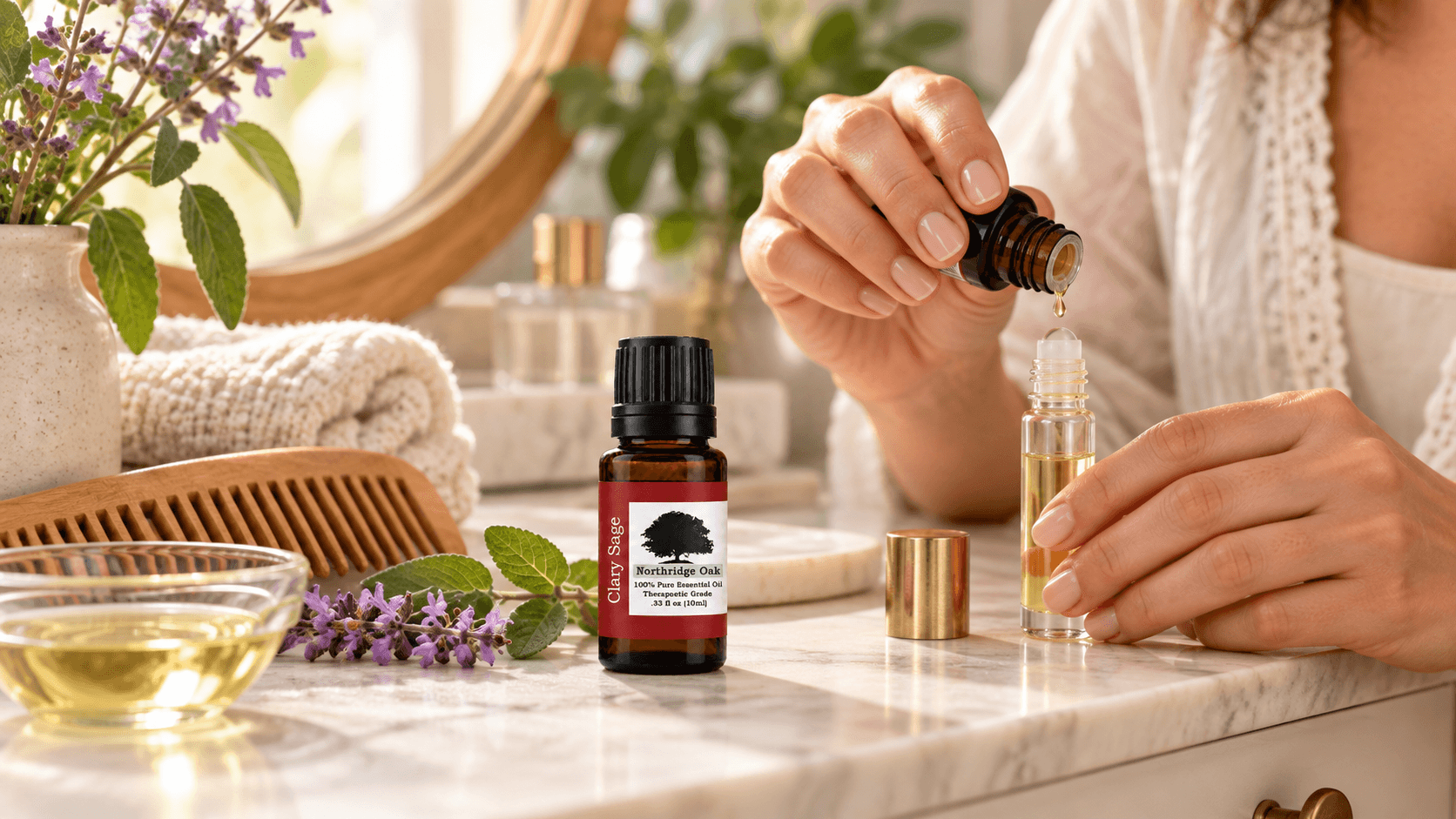
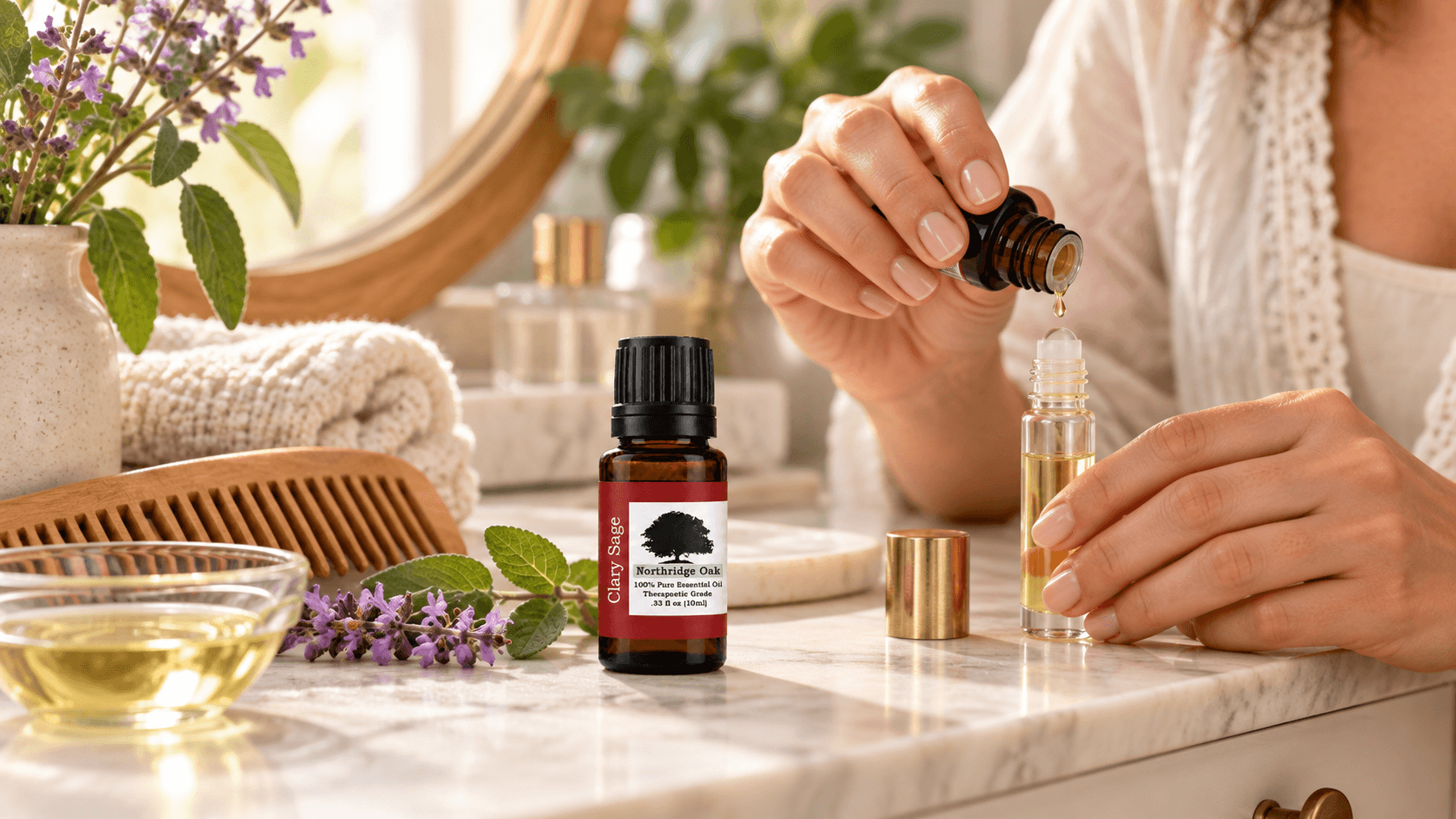
Northridge Oak Clary Sage Essential Oil is 100% pure, undiluted Salvia sclarea from France. It is bottled in small batches and third-party GC/MS tested, with no fillers or synthetic fragrance. Its soft herbaceous aroma, gentle floral sweetness and tea-like warmth make it especially rewarding in diffusion, natural perfumery and properly diluted personal-care recipes.
Use pure Clary Sage to give body, beard, scalp and natural-perfume formulas a sophisticated herbal-floral heart.
Try Northridge Oak Clary Sage Essential Oil
Learning About Essential Oils: Compare the Blend on Paper and Skin
Write the botanical name, total drops, method, date and first impression in a blending notebook. Smell the formula immediately and again after fifteen minutes. Clary Sage often becomes rounder and more tea-like as the brightest notes settle. Recording that development teaches you more than judging the bottle from one quick sniff.
Change one element at a time. A one-drop adjustment can move Clary Sage toward citrus brightness, floral softness, herbal clarity or woody depth. This measured approach makes successful recipes repeatable and helps you recognize exactly what each oil contributes.
A Simple Way to Experience Clary Sage
You do not need a complicated project to decide whether this oil is for you. Begin with the aroma itself. Place one drop on a paper scent strip or cotton pad, set it several inches away and notice the first impression. Return after 15 minutes, then again after an hour. Clary Sage often reveals more character as the sharpest opening settles, and this slower test makes it easier to notice the softly herbal, slightly sweet and tea-like details that disappear when you smell directly from the bottle.
For a first hair ritual, make only the small measured batch in this guide and use it before one wash day. Part the hair, apply sparingly to the scalp, massage gently and follow the stated timing. Notice the aroma, texture and ease of washing out—not just the ingredient list. A routine earns its place when you enjoy using it and can repeat it consistently.
If that sounds like the kind of ritual you would enjoy, Northridge Oak Clary Sage Essential Oil is 100% pure and undiluted, bottled in small batches and third-party GC/MS tested. It gives you a clearly identified single oil and a dependable place to begin.
Continue Learning About Clary Sage Essential Oil
Make this article part of a complete Clary Sage routine:
- Clary Sage Essential Oil Benefits, Uses & Safety Guide
- Clary Sage Essential Oil for Relaxation: What Research Found
- What Blends Well With Clary Sage Essential Oil?
- Clary Sage Essential Oil for Sleep: Evening Blends & Rituals
- Clary Sage Essential Oil Diffuser Blends: 20 Recipes
Thoughtful Use
For topical recipes, calculate the total essential-oil concentration, dilute in a suitable carrier and patch test the completed blend. Diffuse intermittently with fresh airflow and allow everyone in the room a scent-free option. Seek individualized guidance during pregnancy or nursing, for young children, around pets, with medications or significant health considerations.
Read the complete essential-oil safety guide and beginner’s guide.
These statements have not been evaluated by the Food and Drug Administration. Northridge Oak products are not intended to diagnose, treat, cure or prevent disease.