Table of Contents
- What is actually in Blood Orange essential oil?
- Limonene: abundant, aromatic, and easy to oversimplify
- What human aroma research suggests
- Why the oil smells bright and fades quickly
- Oxidation is the practical chemistry that matters most
- Does “antimicrobial in the lab” make it a disinfectant?
- Phototoxicity: species and extraction matter
- How to read research without losing the joy
- Continue learning about blood orange essential oil
The chemistry of Blood Orange Essential Oil helps explain why it smells bright, evaporates quickly, blends so naturally with woods and herbs, and deserves careful storage. Research can make the bottle more interesting and more useful—but only when laboratory findings, human aroma studies, and everyday use are kept in their proper lanes.
What is actually in Blood Orange essential oil?
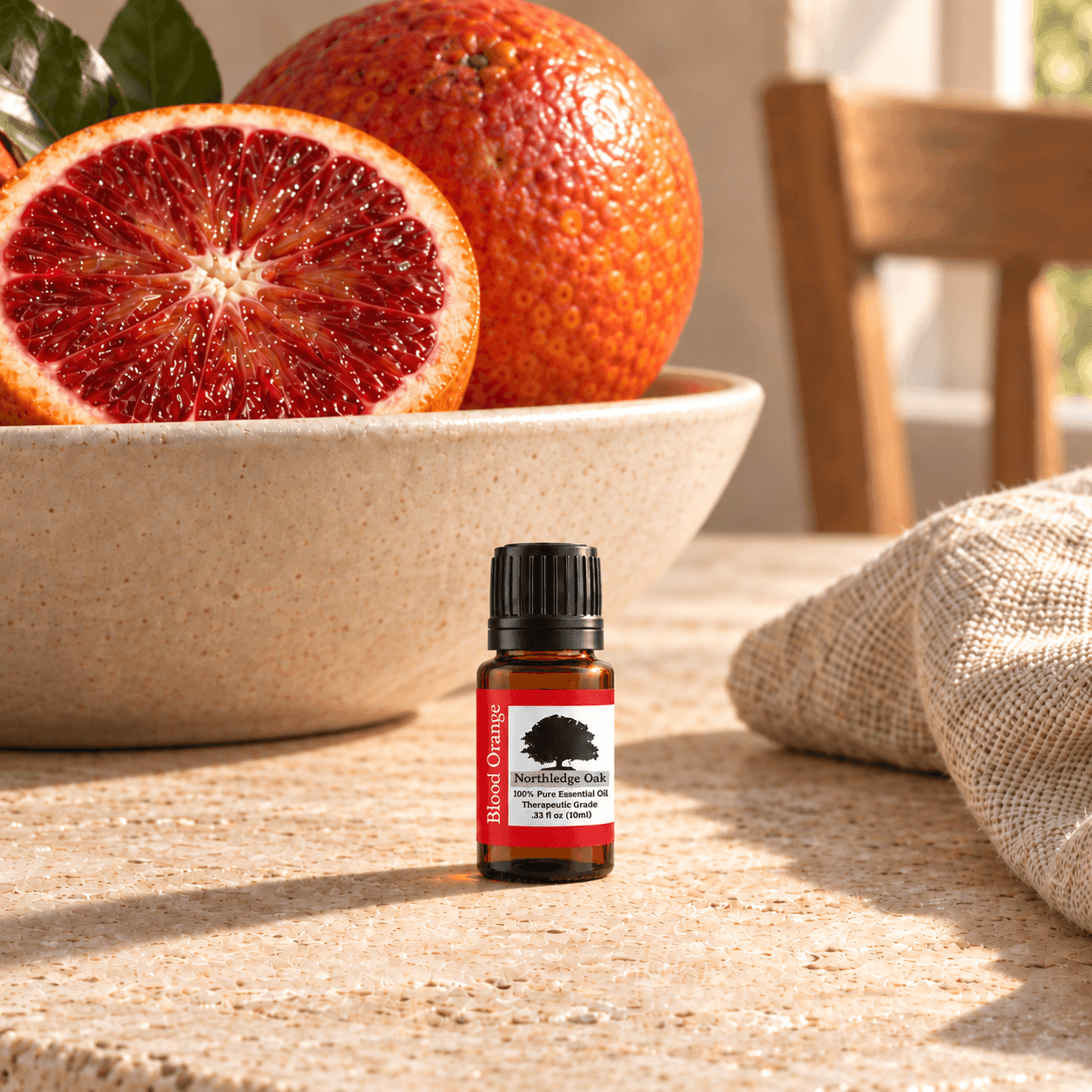
Blood Orange is a cultivar group within Citrus sinensis. The peel oil is commonly produced by expression, a mechanical process that releases volatile compounds from the rind. Limonene is typically the dominant constituent, often accompanied by smaller amounts of compounds such as myrcene, alpha-pinene, linalool, decanal, and other aldehydes or terpenes. Exact percentages vary by cultivar, origin, maturity, climate, processing, and storage.
Those smaller constituents matter. Limonene provides much of the recognizable citrus lift, but trace and minor compounds help distinguish a nuanced natural oil from a single isolated aroma chemical. This is also why a gas chromatography/mass spectrometry report is a fingerprint of a batch, not a universal formula for every Blood Orange oil.
Limonene: abundant, aromatic, and easy to oversimplify
Limonene is a volatile terpene found in many citrus peels. Researchers study it in isolated form and as part of complex essential oils. Laboratory work has explored antioxidant, antimicrobial, anti-inflammatory, and other biological activities. Those experiments can identify mechanisms worth studying, but a result in a test tube does not establish that diffusing or applying Blood Orange oil will prevent or treat disease.
Dose and route matter enormously. Cells in a dish can be exposed to concentrations that bear little resemblance to a few diffuser drops in a room. An isolated constituent may also behave differently from a whole essential oil. Responsible interpretation begins with the question: Was this a cell study, an animal study, a controlled human trial, or simply chemical analysis?
What human aroma research suggests
Small human studies involving orange aroma have reported changes in situational anxiety, mood ratings, or stress-related measures in settings such as dental care. These studies are relevant because Blood Orange belongs to the same species, Citrus sinensis, and shares much of the familiar orange aroma chemistry. They do not prove that every Blood Orange product has an identical effect, nor do they establish treatment for anxiety disorders.
A fair conclusion is modest: pleasant orange aroma may help some people experience a stressful setting more comfortably. Expectation, memory, context, personal preference, ventilation, and study design all influence results. That makes the oil suitable as an environmental support—not as a substitute for mental-health or medical care.
Why the oil smells bright and fades quickly
Limonene and many companion molecules are highly volatile. They enter the air readily, which creates the immediate “fresh peel” impression. That same volatility means Blood Orange behaves as a top note and usually fades sooner than Cedarwood Essential Oil or Frankincense Essential Oil.
You can experience this directly: place one drop on a paper scent strip and smell it immediately, after 15 minutes, and after an hour. On a second strip, combine one drop Blood Orange with one drop Cedarwood. The wood does not stop evaporation, but it gives the blend a slower aromatic finish.
Oxidation is the practical chemistry that matters most
When limonene-rich oil is exposed repeatedly to oxygen, heat, and light, oxidation products form. An oxidized citrus oil may smell dull, harsh, resinous, or paint-like and may be more likely to provoke skin sensitization. This is one of the clearest ways chemistry should change daily behavior.
Choose a bottle size you can use while fresh. Close it promptly, keep it cool and dark, avoid leaving the cap off while blending, and note the opening date. If only a small amount remains in a large bottle, the extra headspace exposes the oil to more oxygen. Retire a bottle from skin use when its aroma changes significantly.
Does “antimicrobial in the lab” make it a disinfectant?
No. Laboratory assays can show that an oil or constituent inhibits microorganisms under controlled conditions. A household disinfectant must perform against named organisms on named surfaces at a defined concentration and wet contact time, while remaining stable and usable. A homemade spray with a few drops of Blood Orange has not met that standard.
Enjoy it in a routine cleaner for aroma, while relying on soap for ordinary cleaning and an appropriately registered disinfectant when disinfection is needed. This distinction does not diminish the oil; it gives it an honest job it can do beautifully.
Phototoxicity: species and extraction matter
Some expressed citrus oils contain furocoumarins associated with phototoxic reactions. Expressed Sweet Orange (Citrus sinensis) is generally regarded as non-phototoxic, and Blood Orange is the same species. Still, users should check the exact product documentation because composition, adulteration, oxidation, and extraction details matter. Dilution and a patch test remain sensible even when phototoxicity is not expected.
How to read research without losing the joy
Look for the botanical name, plant part, extraction method, chemical profile, dose, route, comparison group, sample size, and actual outcome. Then ask whether the study product resembles the bottle and use being discussed. Strong language in a headline cannot repair a weak match between experiment and claim.
The research-supported reason to try Blood Orange is not that it promises a cure. It is that a chemically complex, limonene-rich peel oil offers a vivid citrus aroma; small human studies make its use as a pleasant environmental cue plausible; and careful storage and dilution let you enjoy it thoughtfully.
Continue learning about blood orange essential oil
Build a Blood Orange routine that feels useful, enjoyable, and informed:
- Blood Orange Essential Oil: Everyday Uses, DIY Recipes & Diffuser Blends
- Blood Orange Essential Oil Diffuser Blends: 20 Bright Recipes
- What Blends Well With Blood Orange Essential Oil?
- What Does Blood Orange Essential Oil Smell Like?
- Blood Orange Essential Oil for Mood, Relaxation & Everyday Joy
- Blood Orange Essential Oil for Skin & Body Care
- Blood Orange Essential Oil for Cleaning & Home Aromas
These statements have not been evaluated by the Food and Drug Administration. Northridge Oak products are not intended to diagnose, treat, cure or prevent disease.