Table of Contents
- Why Cedarwood Feels Right at Night
- What the Cedrol Study Found
- Six Cedarwood Bedtime Diffuser Blends
- Build a Cedarwood Wind-Down Routine
- Alternatives to Bedroom Diffusion
- Best Oils to Pair With Cedarwood at Night
- A Simple Way to Experience Cedarwood
- Continue Learning About Cedarwood Essential Oil
- Frequently Asked Questions
There is something reassuring about a bedtime aroma you recognize night after night. Cedarwood has a dry, woody and quietly balsamic softness that can help mark the transition from a busy room to a quieter one. Rather than promising sleep in a bottle, this guide shows you how to build a repeatable evening ritual around scent, light, timing and several measured blends you will enjoy returning to.
Why Cedarwood Feels Right at Night
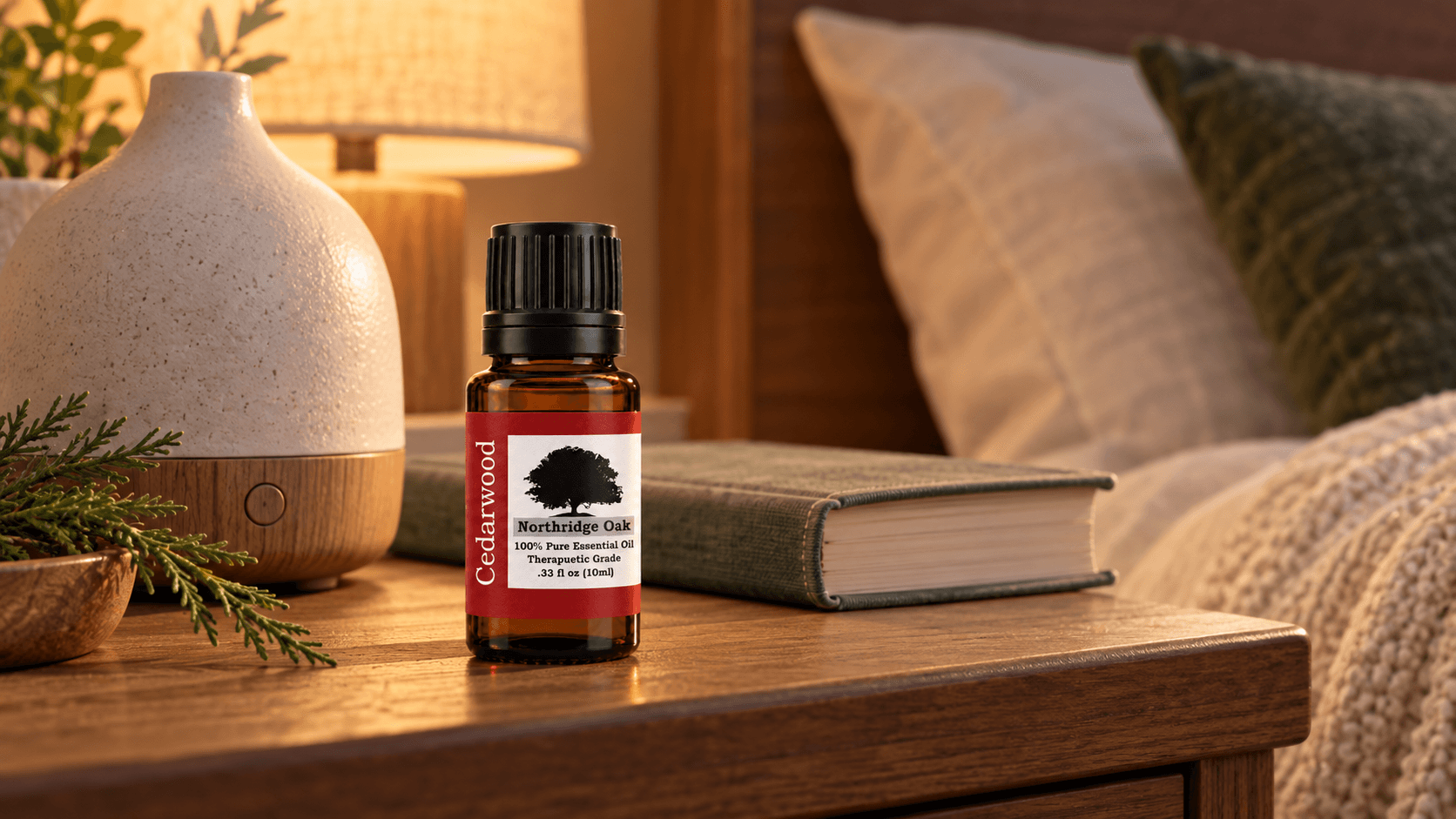
Cedarwood develops slowly. Bright top notes fade first, while the steady wood base remains. That progression suits an evening routine because the aroma becomes softer rather than louder as time passes.
A repeated scent can also become a meaningful ritual cue. Turning on the diffuser while dimming lights, putting away screens or reading tells the room—and your routine—that the active part of the day is ending.
What the Cedrol Study Found
A 2003 study investigated inhaled cedrol in rats and people and reported marked sedative effects along with changes connected to autonomic activity. Read the cedrol study.
Cedrol is associated strongly with some cedarwood-type oils, particularly juniper-derived cedarwoods. Northridge Oak Cedarwood is Atlas Cedarwood, Cedrus atlantica, so the study is best understood as encouraging research into a cedarwood-associated aromatic constituent rather than a clinical trial of this exact bottle.
The practical reason to try Atlas Cedarwood remains compelling: its lasting, unsweet wood aroma can make an evening space feel settled and create a ritual you enjoy repeating.
Six Cedarwood Bedtime Diffuser Blends
- Woodland Rest: 2 Cedarwood, 3 Lavender, 1 Frankincense.
- Quiet Roots: 2 Cedarwood, 1 Vetiver, 3 Bergamot.
- Soft Cabin: 2 Cedarwood, 2 Marjoram, 2 Lavender.
- Evening Resin: 2 Cedarwood, 2 Frankincense, 1 Myrrh.
- Gentle Forest: 2 Cedarwood, 2 Balsam Fir, 2 Lavender.
- Still Air: 3 Cedarwood, 2 Bergamot, 1 Clary Sage.
Build a Cedarwood Wind-Down Routine
- Choose one blend and keep it consistent for several evenings.
- Begin diffusion during the early part of the routine, following the diffuser instructions.
- Lower the lights and choose a quiet activity.
- Diffuse for a short, ventilated session rather than continuously through the night.
- Write down whether the blend felt too deep, too bright or balanced, then adjust one drop the next evening.
Alternatives to Bedroom Diffusion
Place one drop on a scent strip and set it at a comfortable distance during reading or journaling. A passive aroma stone can also hold a small amount of Cedarwood; position it with comfortable space from bedding, finished furniture and electronics.
For topical evening use, prepare a properly diluted body oil. Cedarwood and Lavender create a simple aroma, while Frankincense adds resinous depth. Patch test the completed formula before broader use.
Best Oils to Pair With Cedarwood at Night
Lavender brings floral softness. Frankincense feels spacious and resinous. Marjoram adds warm herbs. Vetiver creates deeper earthiness, so one drop is usually enough. Bergamot keeps the blend from feeling heavy, and Balsam Fir creates the comfort of an evergreen cabin.
Add one drop of Bergamot, Blood Orange or Lavender. When it feels too bright, add a drop of Cedarwood or Frankincense. When it feels too sweet, Cedarwood or Vetiver can restore balance.
Northridge Oak Cedarwood Essential Oil is 100% pure, undiluted Cedrus atlantica from Morocco. It is bottled in small batches and third-party GC/MS tested, with no fillers or synthetic fragrance. Its dry wood, subtle smoke and soft balsamic finish make it a versatile choice for diffusion, grooming and carefully diluted topical recipes.
Try Northridge Oak Cedarwood Essential Oil
Choose one simple blend and repeat it at the same point in your evening for seven nights. Two drops Cedarwood with two drops Lavender is an easy place to begin. Use a short, ventilated diffuser session while lowering the lights or reading, then turn the diffuser off according to its directions.
Each morning, note whether you enjoyed the aroma, whether the strength felt right and which part of the routine you want to repeat. This is not a sleep test; it is a practical way to discover whether a consistent sensory cue makes your wind-down feel more pleasant and familiar.
Add Bergamot for a lighter opening, Frankincense for balsamic depth or Vetiver for a very earthy drydown. In a small bedroom, begin with fewer drops. Cedarwood develops slowly, so pause before adding more.
If you prefer not to diffuse, place one drop of Atlas Cedarwood on a paper scent strip and set it in a safe place away from bedding, children and pets. The dry wood aroma offers a simple, low-equipment way to make an evening ritual feel intentional.
Choose one blend and use it at the same point in your evening for a week. The goal is to create a pleasant, repeatable association. At the end of the week, decide whether you want more wood, more softness or more brightness. This turns Cedarwood from a random scent into a deliberate part of the room.
Follow the diffuser manufacturer’s guidance, use intermittent sessions with ventilation and give everyone a scent-free exit. Keep diffusers stable and away from bedding, children and animal enclosures. Individualized guidance is valuable for young children, pregnancy, pets, respiratory sensitivity and significant health considerations.
Choose one blend and pair it with the same small sequence each evening: lower the lights, begin a short diffuser session, and shift into a quiet activity. The repeated combination helps Cedarwood become a familiar signal that the busy part of the day is ending.
Use Lavender for a soft floral direction, Frankincense for resinous warmth, or Marjoram for a gentle herbal character. Keep the first formula simple so you can tell which pairing feels most inviting.
After seven evenings, keep the parts you genuinely enjoyed—the aroma, the timing and the surrounding routine. A pleasant ritual earns its place because it is easy to anticipate and satisfying to repeat.
A Simple Way to Experience Cedarwood
You do not need a complicated project to decide whether this oil is for you. Begin with the aroma itself. Place one drop on a paper scent strip or cotton pad, set it several inches away and notice the first impression. Return after 15 minutes, then again after an hour. Cedarwood often reveals more character as the sharpest opening settles, and this slower test makes it easier to notice the dry, woody and quietly balsamic details that disappear when you smell directly from the bottle.
Pick one blend and use it at the same point in your evening for several nights: perhaps while reading, preparing tomorrow’s clothes or dimming the lights. Keep the session brief and the aroma gentle. Repetition is what turns a pleasant smell into a familiar cue that the busy part of the day is over.
If that sounds like the kind of ritual you would enjoy, Northridge Oak Cedarwood Essential Oil is 100% pure and undiluted, bottled in small batches and third-party GC/MS tested. It gives you a clearly identified single oil and a dependable place to begin.
Continue Learning About Cedarwood Essential Oil
Make this article part of a complete Cedarwood routine:
- Cedarwood Essential Oil Diffuser Blends: 20 Woodsy Recipes
- Cedarwood Essential Oil Benefits, Uses & Safety Guide
- What Blends Well With Cedarwood Essential Oil?
- What Does Cedarwood Essential Oil Smell Like?
- Cedarwood Essential Oil for Hair and Scalp: Study & Recipes
These statements have not been evaluated by the Food and Drug Administration. Northridge Oak products are not intended to diagnose, treat, cure or prevent disease.
A bedtime aroma becomes more effective as a ritual when the surrounding cues stay consistent. Dim the lights, begin the diffuser before getting into bed and pair the aroma with a calm activity such as reading or gentle stretching. Keep the recipe unchanged for several evenings so the woodsy scent becomes familiar. Cedarwood’s steady aroma works especially well in this role because it supports the atmosphere without requiring a complicated blend or a large number of drops.