Table of Contents
- Citrus Oils: Make Geranium Feel Bright and Joyful
- Floral Oils: Build a Fuller Bouquet
- Herbal Oils: Reveal Geranium’s Green Side
- Wood Oils: Give Geranium a Beautiful Foundation
- Resins and Earthy Oils: Add Warmth and Dimension
- Three Simple Blending Formulas
- Pairings by Mood and Setting
- How to Adjust a Blend That Is Almost Right
- Start With the Pairing You Already Love
- Continue Exploring Geranium Essential Oil
- Frequently Asked Questions
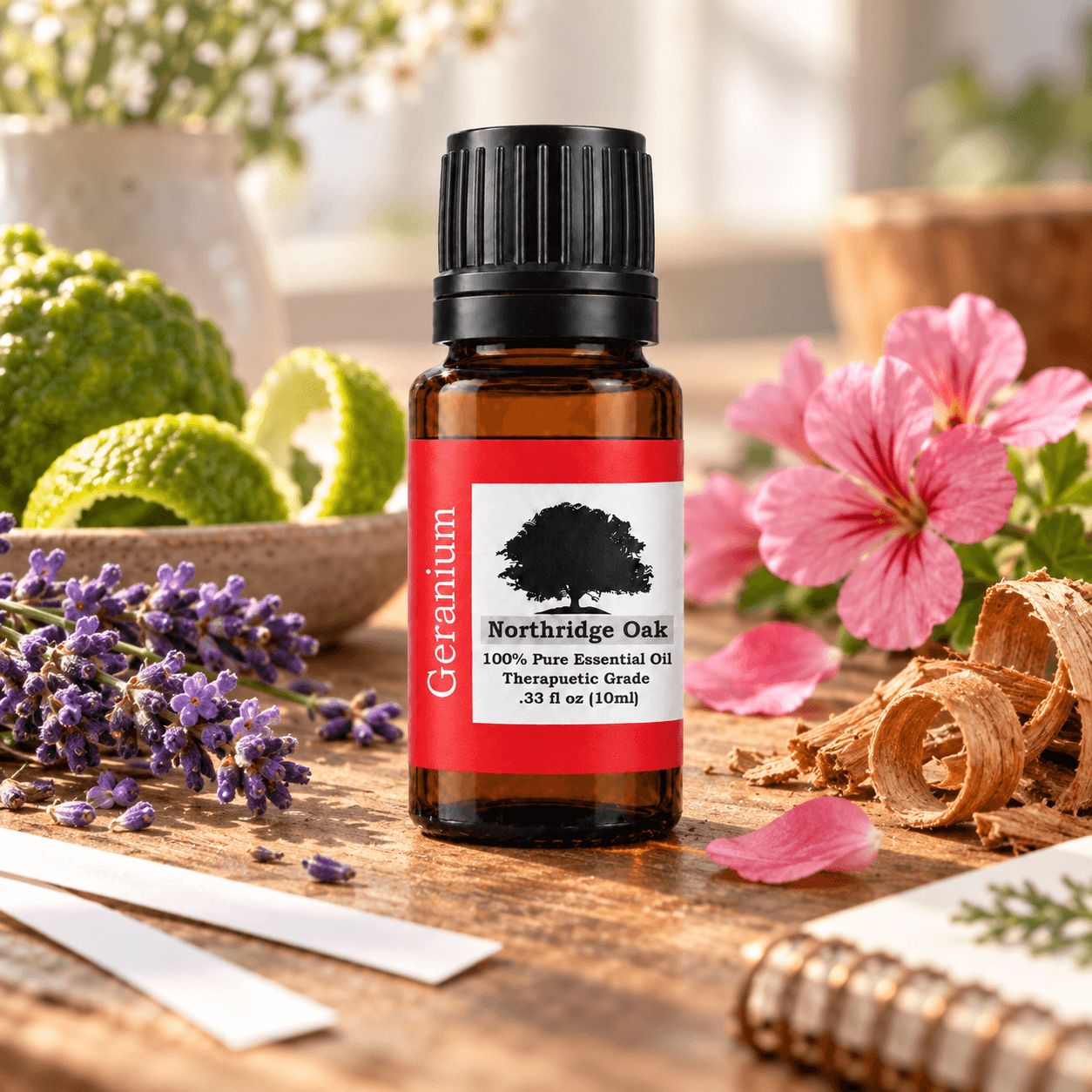
Geranium Essential Oil is the friend who helps everyone at the table get along. Its rosy center understands florals, its green edges speak naturally to herbs, and its gentle sweetness welcomes citrus, woods and resins. That range makes geranium one of the most useful oils for blending—and one of the most enjoyable for learning how aromas fit together.
The best companion depends on the feeling you want. Choose citrus for brightness, lavender for softness, rosemary for a garden-fresh lift or cedarwood for quiet depth. Below, you will find both the “why” behind each pairing and simple formulas you can try right away.
Citrus Oils: Make Geranium Feel Bright and Joyful
Sweet orange, bergamot, lemon and grapefruit lighten geranium’s floral heart. Citrus tends to arrive first in a blend, creating an immediate impression of freshness before geranium unfolds.
Sweet orange makes geranium friendlier and rounder. Try 3 drops sweet orange, 3 drops geranium and 1 drop cedarwood in the diffuser. The orange opens with warmth, geranium supplies a garden-like center and cedarwood gives the aroma staying power.
Bergamot is especially elegant because it already carries both citrus and floral nuances. Combine 3 drops bergamot, 3 drops geranium and 2 drops lavender for a refined blend that works from late morning into evening.
Lemon emphasizes the crisp green side of geranium. Three drops geranium, 3 drops lemon and 2 drops rosemary create a lively botanical atmosphere for kitchens, studios and productive afternoons.
Grapefruit adds a sparkling, slightly tart quality. Pair 3 drops grapefruit with 3 drops geranium and 1 drop patchouli for a cheerful opening with an earthy finish.
Floral Oils: Build a Fuller Bouquet
Lavender, clary sage, palmarosa and ylang ylang can turn geranium into a layered bouquet. The art is allowing one flower to lead while the others add shape.
Lavender is the most approachable partner. It softens geranium’s green edge without erasing it. A 1:1 ratio is balanced and calm; add a small amount of frankincense when you want a smooth, resinous base.
Clary sage contributes an herbal floral softness. Try 3 drops geranium, 2 drops clary sage and 3 drops bergamot. The combination feels spacious, graceful and especially suited to an evening transition.
Palmarosa brings another rosy-grassy note, creating a more generous floral heart. Because the two share related facets, bergamot or lemon is useful for contrast.
Ylang ylang is lush and powerful. One or two drops are often enough beside three drops geranium and several drops of orange. That restraint lets the blend feel beautiful rather than dense.
Herbal Oils: Reveal Geranium’s Green Side
Rosemary, basil and eucalyptus make geranium feel like a living plant in a sunlit garden. These pairings are wonderful when a pure floral blend would feel too sweet.
Rosemary adds clarity and an evergreen-herbal lift. Use 3 drops geranium, 2 drops rosemary and 3 drops lemon for a crisp daytime blend. Basil contributes a bright culinary-green accent; start with only one drop. Eucalyptus radiata creates an open, leafy impression when balanced by geranium and cedarwood.
The reason these formulas work is contrast. Geranium gives the herbs a softer middle, while the herbs make its flower feel freshly cut from the stem.
Wood Oils: Give Geranium a Beautiful Foundation
Cedarwood, sandalwood and other soft woods slow the blend down. They do not compete with geranium’s floral center; instead, they create the impression that the aroma has somewhere warm to settle.
Cedarwood is practical and versatile. Try equal parts geranium and cedarwood with a little bergamot for brightness. In a personal perfume, the same trio feels polished and natural. If you are learning perfume structure, our geranium natural perfume guide provides carefully diluted roll-on formulas.
Sandalwood is creamy and soft, so only a little may be needed. It turns geranium into a close, skin-like floral aroma that feels special in a body oil or personal inhaler.
Resins and Earthy Oils: Add Warmth and Dimension
Frankincense gives geranium a clean, contemplative depth. Patchouli makes it richer and more mysterious. Both are excellent in small amounts.
For an inviting room, combine 3 drops geranium, 2 drops frankincense, 2 drops sweet orange and 1 drop patchouli. Each oil has a role: orange welcomes, geranium blooms, frankincense smooths and patchouli anchors. If patchouli is new to you, begin with a toothpick trace or a single drop.
Three Simple Blending Formulas
A helpful starting structure is 3 parts bright + 2 parts heart + 1 part base. For example, use 3 drops bergamot, 2 drops geranium and 1 drop cedarwood. The citrus opens, geranium carries the central theme and cedarwood lengthens the finish.
For a more floral blend, try 2 parts geranium + 2 parts companion flower + 1 part base. Four drops total floral oils with one drop frankincense creates a smooth, petal-like atmosphere.
For a fresh green blend, use 3 parts geranium + 2 parts citrus + 1 part herb. This keeps the herb from becoming sharp while allowing the leafy quality to shine.
Pairings by Mood and Setting
For a bright kitchen, choose geranium, lemon and rosemary. For a welcoming living room, combine geranium, sweet orange and cedarwood. For an elegant bedroom aroma before sleep, try geranium, lavender and frankincense, then turn the diffuser off as you settle in. For a creative afternoon, geranium, grapefruit and a touch of patchouli feels colorful and interesting.
These are sensory descriptions, not medical promises. Aroma is personal, and its best use is often to make a chosen moment feel more intentional. Explore 20 geranium diffuser recipes when you want exact drop counts for more settings.
How to Adjust a Blend That Is Almost Right
If a formula feels too floral, add one drop of citrus or wood. If it feels too sharp, add geranium or lavender. If it disappears too quickly, a base note such as cedarwood, frankincense or patchouli can give it a longer finish. Make one change at a time, smell again and take notes.
For topical blends, calculate dilution by the total number of essential-oil drops, not by each oil separately. A beautiful combination still needs appropriate dilution. The geranium safety and dilution guide makes those numbers easy to use.
Start With the Pairing You Already Love
The easiest way to discover geranium is to pair it with an oil you know well. Lavender lovers can begin with a 1:1 floral blend. Citrus lovers may prefer orange and geranium. Those drawn to woods can let cedarwood lead while geranium supplies a subtle rosy lift. There is no need to master every pairing at once; one lovely blend is enough to make the bottle useful today.
Continue Exploring Geranium Essential Oil
Geranium is one of the most versatile oils to keep within reach. Continue through the Northridge Oak Geranium Learning Center to discover more research, practical recipes and approachable ways to bring this fresh botanical into your everyday routine.
- Start with the complete Geranium Essential Oil benefits, uses, blends and safety guide.
- Create a bright home atmosphere with 20 Geranium Essential Oil diffuser blends.
- Bring geranium into a gentle skin and face routine.
- Refresh your hair and scalp ritual with geranium.
- Create a comforting pause with geranium for mood and relaxation.
- Explore geranium in an aromatic menopause self-care routine.
- Take geranium outside for fresh-air living.
- Make a naturally rosy geranium perfume.
- Learn what Geranium Essential Oil smells like.
- Shop Northridge Oak Geranium Essential Oil.
These statements have not been evaluated by the Food and Drug Administration. Northridge Oak products are not intended to diagnose, treat, cure or prevent disease.