Table of Contents
- Why Lemon Essential Oil Is So Useful for Kitchen Cleaning
- Study: Lemon Essential Oil Was Active Against 11 Bacterial Strains
- Study: Lemon Essential Oil Slowed Listeria in a Food Model
- Study: Pure and Nanoemulsified Lemon Oil Inhibited Foodborne Pathogens
- The Master Lemon Kitchen Degreaser
- Eight Focused Lemon Kitchen-Cleaning Recipes
- Make the Blend Match the Kitchen
- Surface Guide and Smart Mixing
- A Brighter Way to Finish the Kitchen
- Lemon Essential Oil Learning Center
- Research and References
- Frequently Asked Questions
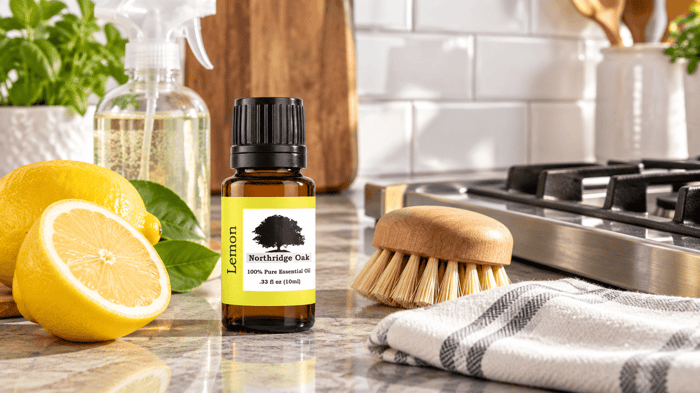
Lemon Essential Oil for kitchen cleaning is one of the most satisfying ways to tackle cooked-on splatter, greasy cabinet fronts, stovetop film and the stale aroma that can linger after a busy meal. The reason reaches beyond Lemon’s bright, clean scent: its peel oil is rich in limonene, a naturally occurring citrus solvent with an affinity for oily residue.
100% Pure Lemon Essential Oil – 10 mL

$7.50
Bright, Fresh and Useful Far Beyond the Diffuser Northridge Oak Lemon Essential Oil has the crisp, cheerful aroma of freshly cut lemon peel—but its value goes well beyond making a room smell good. A few carefully measured drops can brighten… read more
Paired with warm water, a small amount of dish soap and the right wiping method, Northridge Oak Lemon Essential Oil becomes the aromatic centerpiece of a practical kitchen-cleaning routine. The recipes below are precisely measured for the job at hand, and the research sections explain what scientists have observed when Lemon Essential Oil was tested against food-associated bacteria, fungi and oxidation.
Why Lemon Essential Oil Is So Useful for Kitchen Cleaning
Lemon Essential Oil is generally produced from the peel of Citrus limon. While exact chemistry varies by origin, harvest and extraction method, limonene is usually its dominant constituent. Other naturally occurring compounds can include beta-pinene, gamma-terpinene and small amounts of oxygenated terpenes.
Limonene is hydrophobic, meaning it has a natural affinity for oils rather than water. When a Lemon cleaning formula reaches greasy residue, limonene helps soften and dissolve the oily portion of the mess. Dish soap then surrounds the loosened grease so it can be carried into the cleaning water and wiped away. That combination explains why Lemon Essential Oil performs best in a complete formula instead of simply being dropped into water.
This makes Lemon especially useful for:
- Stovetop splatter and cooking-oil film
- Range-hood exteriors and backsplashes
- Greasy cabinet handles and appliance fronts
- Sink film and food-preparation cleanup
- Reusable containers with stubborn exterior residue
- Trash-bin washing and after-cooking freshness
Lemon Essential Oil is concentrated peel oil rather than lemon juice. It brings the oil-soluble citrus constituents to the recipe without adding pulp or sugar, and it does not supply the citric acid found in juice. That distinction matters when choosing a formula for stone, metal, wood and other kitchen surfaces.
Study: Lemon Essential Oil Was Active Against 11 Bacterial Strains
In a 2017 study, Ben Hsouna and colleagues analyzed Lemon Essential Oil by gas chromatography–mass spectrometry and tested it against a broad group of food-associated microorganisms. The researchers identified 21 constituents; limonene represented 39.74% of the oil and beta-pinene represented 25.44%.
For the antibacterial portion, the team tested seven Gram-positive and four Gram-negative strains, including Staphylococcus aureus, Listeria monocytogenes, Salmonella enterica, Escherichia coli and Pseudomonas aeruginosa. They placed 50 microliters of a 50 mg/mL Lemon Essential Oil preparation into wells in inoculated agar and ran each test in triplicate.
Lemon Essential Oil produced measurable inhibition against every bacterial strain tested. Inhibition zones ranged from 13 to 26 millimeters. Some of the strongest results were:
- 26 mm against Listeria monocytogenes
- 24 mm against Bacillus cereus
- 22 mm against Staphylococcus aureus
- 18 mm against Salmonella enterica
- 15 mm against Escherichia coli
The researchers also calculated minimum inhibitory concentrations. The value for L. monocytogenes was 0.039 mg/mL, while S. aureus was inhibited at 0.078 mg/mL. Across the complete bacterial panel, MIC values ranged from 0.039 to 2.5 mg/mL.
The same Lemon oil was evaluated against eight fungal strains. It produced 26 mm inhibition zones against both Aspergillus niger and Aspergillus flavus, with minimum fungicidal concentrations of 0.625 and 0.312 mg/mL respectively.
Read the complete Lemon Essential Oil antimicrobial study.
Study: Lemon Essential Oil Slowed Listeria in a Food Model
The 2017 research went a step beyond agar plates. The scientists inoculated minced beef with approximately one million colony-forming units of Listeria monocytogenes per gram, treated samples with Lemon Essential Oil and monitored them during ten days of refrigerated storage.
Lemon Essential Oil was tested at 0.06 and 0.312 mg per gram. Both concentrations produced a statistically significant effect on Listeria growth, and the treated samples kept bacterial numbers below the control through the end of the experiment. The researchers also measured pH and thiobarbituric acid reactive substances, a marker of lipid oxidation. Control meat produced higher values than Lemon-treated meat during storage, supporting the oil’s antioxidant activity in the food model.
This is valuable kitchen-focused research because it tested Lemon Essential Oil in a complex, fat-containing material rather than only in a simplified laboratory medium.
Study: Pure and Nanoemulsified Lemon Oil Inhibited Foodborne Pathogens
A 2019 study by Yazgan, Ozogul and Kuley compared pure Lemon Essential Oil, a 10% Lemon Essential Oil preparation and a Lemon Essential Oil nanoemulsion. GC-MS analysis found 52.85% d-limonene, 14.36% p-cymene and 13.69% beta-pinene.
The team tested the preparations against four foodborne pathogens—Staphylococcus aureus, Klebsiella pneumoniae, Enterococcus faecalis and Salmonella Paratyphi A—along with bacteria associated with fish spoilage. They used disc diffusion, minimum inhibitory concentration and minimum bactericidal concentration methods.
The nanoemulsion was more active against most of the foodborne pathogens than the undiluted oil, while the 10% preparation produced its largest inhibition result against Salmonella Paratyphi A. In the MIC testing, both the nanoemulsion and pure Lemon Essential Oil inhibited all four foodborne pathogens. The bactericidal testing also found notable activity against S. Paratyphi A.
The formulation result is particularly interesting for home cleaning: dispersion changes how effectively a citrus oil reaches a target. That is why the recipes in this guide first blend Lemon Essential Oil into dish soap before adding water.
View the Lemon Essential Oil foodborne-pathogen study.
The Master Lemon Kitchen Degreaser
Start here. This 16-ounce spray is balanced for everyday grease, fingerprints, cooking film and general kitchen cleanup.
Ingredients
- 14 fluid ounces distilled water
- 1 teaspoon unscented liquid dish soap
- 20 drops Lemon Essential Oil
- One 16-ounce glass or essential-oil-compatible spray bottle
Directions
- Add the dish soap to the bottle.
- Add the Lemon Essential Oil directly to the soap and swirl gently to combine.
- Pour in the distilled water, leaving room for the mixture to move.
- Close the bottle and turn it slowly several times. Label it with the recipe and preparation date.
- Shake before each use. Spray onto a cloth or compatible cooled surface, allow one to two minutes of contact time, wipe away the loosened film and finish with a clean damp cloth.
Use it on compatible sealed tile, laminate, appliance exteriors and many sealed counter materials. For food-contact areas, follow with a clean-water rinse and dry cloth.
Eight Focused Lemon Kitchen-Cleaning Recipes
1. Heavy Stovetop Grease Paste
Combine: 1/4 cup baking soda, 1 tablespoon dish soap and 6 drops Lemon Essential Oil. Add warm water one teaspoon at a time until the mixture forms a spreadable paste.
Apply a thin layer to a completely cooled compatible stovetop, wait five minutes and wipe with a damp non-scratching cloth. Repeat on thick deposits instead of scrubbing aggressively. Remove all residue and buff dry.
2. Lemon Sink Scrub
Combine: 2 tablespoons baking soda, 1 teaspoon dish soap and 3 drops Lemon Essential Oil.
Use the fresh mixture on a damp cloth or soft brush to work around the basin, drain flange and faucet base. Rinse thoroughly and dry for a polished finish. This small-batch version is ideal for stainless steel and other scratch-resistant sink materials approved for baking-soda cleaning.
3. Lemon Soft Scrub for a Full Kitchen Reset
Combine: 1 cup baking soda, 1/2 cup witch hazel and 10 drops Lemon Essential Oil.
Stir the Lemon Essential Oil into the witch hazel first, then gradually mix it into the baking soda. Use this generous batch during a full cleaning session on compatible sinks, sealed tile and other durable surfaces. Apply with a soft cloth, rinse completely and discard any leftover mixture when the session is finished.
4. Vinegar-Based Lemon Grease-Cutting Spray
For an 8-ounce bottle, combine: 4 fluid ounces white vinegar, 3 fluid ounces distilled water, 1/2 teaspoon unscented liquid dish soap and 10 drops Lemon Essential Oil.
Mix the Lemon into the dish soap before adding the liquids. Shake gently and use on compatible glass, sealed ceramic tile and selected stainless-steel surfaces. The vinegar supplies acidity for mineral film while Lemon and dish soap address oily residue. Keep this recipe away from marble, granite, limestone and other acid-sensitive stone.
5. Range Hood and Backsplash Wipe
Combine: 2 cups warm water, 1 teaspoon dish soap and 8 drops Lemon Essential Oil.
Blend the oil into the soap, then stir the mixture into the water. Dip in a microfiber cloth and wring it nearly dry. Wipe the exterior hood, lower lip and backsplash, then follow with a clean damp cloth. Working from the least greasy area toward the heaviest buildup keeps the cloth useful longer.
6. Cabinet Front and Handle Wash
Combine: 2 cups warm water, 1 teaspoon dish soap and 6 drops Lemon Essential Oil.
Use a well-wrung cloth rather than spraying cabinets. Work one door at a time, paying attention to handles and the area immediately around them. Follow with a clean damp cloth and dry promptly. Test first on painted, stained or finished wood.
7. Microwave Steam-and-Wipe Method
Place 1 cup of water in a microwave-safe bowl and heat it until the interior becomes steamy. Leave the door closed for several minutes so the moisture can soften splatter. Carefully remove the bowl.
In a separate container, combine 1 cup warm water, 1/2 teaspoon dish soap and 3 drops Lemon Essential Oil. Wipe the softened interior with a cloth dampened in the mixture, follow with clean water and dry. This two-step method uses steam for cooked-on food and Lemon for the greasy film left behind.
8. Refrigerator and Appliance-Handle Spray
For an 8-ounce bottle, combine: 7 fluid ounces distilled water, 1/2 teaspoon dish soap and 8 drops Lemon Essential Oil.
Premix the Lemon into the soap, add the water and shake before use. Spray onto a cloth and wipe refrigerator handles, dishwasher fronts and other compatible appliance exteriors. Finish with a barely damp clean cloth, then dry in the direction of the finish.
Make the Blend Match the Kitchen
Lemon is an excellent lead note, but companion oils can give the routine a distinct personality. Every oil below links to the exact Northridge Oak product.
- Add Tea Tree Essential Oil for a sharper, green-clean aroma.
- Pair Lemon with Eucalyptus Essential Oil for a brisk finish.
- Use Peppermint Essential Oil as a cool accent rather than the dominant note.
- Combine Lemon with Rosemary Essential Oil for an herbaceous kitchen blend.
- Add Lavender Essential Oil to soften the citrus edge.
- Pair it with Blood Orange Essential Oil for a sweeter citrus profile.
For a 20-drop cleaning blend, try 12 drops Lemon, 5 drops Tea Tree and 3 drops Eucalyptus. For an after-cooking aromatic blend, try 4 drops Lemon, 1 drop Rosemary and 1 drop Peppermint in your diffuser after burners and open flames are off.
Surface Guide and Smart Mixing
A few disciplined habits make every recipe easier to repeat:
- Premix the oil: Stir Lemon Essential Oil into the dish soap before adding water. Shake water-based sprays before every use.
- Use distilled water: It reduces the mineral residue that tap water can leave on shiny surfaces.
- Clean cool appliances: Turn off stovetops and allow them to cool completely before applying a formula.
- Spray the cloth near controls: This keeps liquid away from electrical seams, vents and switches.
- Rinse food-contact surfaces: Follow the cleaning step with a clean-water wipe.
- Match the formula to the material: Reserve vinegar mixtures for acid-compatible surfaces and use the vinegar-free master spray on many other sealed materials.
- Test specialty finishes: Check painted cabinets, finished wood and coated appliance panels in a hidden area first.
- Make fresh, modest batches: Store labeled sprays away from heat and direct light, and replace a mixture if its aroma, color or appearance changes.
A Brighter Way to Finish the Kitchen
The strongest Lemon kitchen routine is also the simplest: loosen heavy residue with warmth, give limonene time to work on the oily portion, let dish soap carry that grease into the cleaning water and wipe the surface clean. The result is a kitchen that feels refreshed rather than perfumed over.
Begin with the master degreaser and the stovetop paste. Together they cover most daily splatter and heavier cooking film, while the focused recipes make it easy to handle sinks, cabinets, appliance fronts and the microwave with measured ingredients.
Northridge Oak Lemon Essential Oil is 100% pure, undiluted, produced in small batches and supported by third-party GC/MS testing. Its vivid fresh-peel aroma and limonene-rich chemistry make it a natural centerpiece for an intentional kitchen-cleaning collection.
Lemon Essential Oil Learning Center
Continue exploring Lemon Essential Oil:
- Lemon Essential Oil Benefits, Uses, Research, Recipes and Safety
- How to Use Lemon Essential Oil: 15 Practical Uses
- Lemon Essential Oil Safety: Dilution, Kids, Pregnancy and Storage
- Is Lemon Essential Oil Phototoxic?
- Lemon Essential Oil Diffuser Blends
- What Blends Well With Lemon Essential Oil?
- Lemon Essential Oil for Skin
- Lemon Essential Oil for Hair and Scalp
- Lemon Essential Oil for Nails and Cuticles
Research and References
- Ben Hsouna A, Ben Halima N, Smaoui S, Hamdi N. Citrus lemon essential oil: chemical composition, antioxidant and antimicrobial activities with its preservative effect against Listeria monocytogenes inoculated in minced beef meat. Lipids in Health and Disease. 2017;16:146. Read the full study.
- Yazgan H, Ozogul Y, Kuley E. Antimicrobial influence of nanoemulsified lemon essential oil and pure lemon essential oil on food-borne pathogens and fish spoilage bacteria. International Journal of Food Microbiology. 2019;306:108266. View the PubMed record.
- Dosoky NS, Setzer WN. Biological Activities and Safety of Citrus spp. Essential Oils. International Journal of Molecular Sciences. 2018;19(7):1966. Read the citrus-essential-oil review.
These statements have not been evaluated by the Food and Drug Administration. This product and the information in this article are not intended to diagnose, treat, cure or prevent any disease. This content is for educational purposes only and is not a substitute for professional medical advice.