Table of Contents
- Quick Answer
- What Lemon Essential Oil Contains
- Why Dilution Matters
- Phototoxicity: The Non-Negotiable Lemon Rule
- Patch Testing
- 6 Practical Recipes and Methods
- How to Evaluate Results
- Common Mistakes
- Storage and Formula Freshness
- When to Ask a Professional
- A 14-Day Routine Check
- Try Lemon Thoughtfully
- Lemon Essential Oil Learning Center
- Research and References
- Frequently Asked Questions
Lemon Essential Oil for nails can add a bright, clean peel aroma to a carefully designed nails and cuticles routine, but concentrated citrus oil belongs in a measured formula—not directly on the body. Start with Northridge Oak Lemon Essential Oil, a carrier or compatible base, a low total dilution, and a clear plan for sunlight exposure.
100% Pure Lemon Essential Oil – 10 mL

$7.50
Bright, Fresh and Useful Far Beyond the Diffuser Northridge Oak Lemon Essential Oil has the crisp, cheerful aroma of freshly cut lemon peel—but its value goes well beyond making a room smell good. A few carefully measured drops can brighten… read more
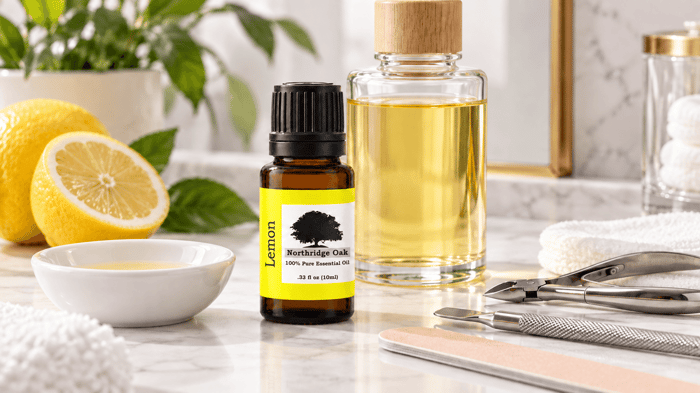
A nail-care formula can make grooming feel fresh and polished, but Lemon oil does not diagnose or cure nail fungus. Intact skin, clean tools, conservative dilution, and consistent moisturizing are the foundation.
Quick Answer
For a simple adult cuticle oil, add three drops Lemon and three drops Lavender to one ounce of carrier oil. Use a tiny amount at night, patch test, and keep treated hands away from UV exposure for at least 12 hours.
What Lemon Essential Oil Contains
Lemon peel oil is normally rich in limonene, with smaller amounts of beta-pinene, gamma-terpinene, citral-related molecules, and other volatile constituents. The exact profile changes with variety, origin, harvest, extraction, and storage. These concentrated aromatic molecules behave differently from lemon juice, which contains water and citric acid.
Why Dilution Matters
A carrier spreads a very small essential-oil amount over a larger area and reduces concentrated contact. Approximately three drops in one ounce of carrier is about 0.5%; six drops is about 1%, using a common estimate of 600 drops per ounce. Drop sizes vary, so weighed formulas are more precise. For nails and cuticles, begin at the lower end and use less when the area is sensitive or exposure is frequent.
Phototoxicity: The Non-Negotiable Lemon Rule
Expressed or cold-pressed Lemon oil can contain furocoumarins that react with ultraviolet light on skin. For any leave-on application, keep treated skin away from direct sun, tanning beds, and strong UV exposure for at least 12 hours, unless supplier documentation establishes a different safe condition. Steam-distilled Lemon is generally non-phototoxic, but verify the bottle rather than guessing.
Patch Testing
Prepare the complete diluted formula, place a small amount on a limited area of intact skin, and wait while monitoring for redness, itching, swelling, or burning. A patch test cannot predict every delayed reaction or phototoxic response, but it is more useful than testing undiluted essential oil, which should not be applied.
6 Practical Recipes and Methods
1. Simple cuticle oil
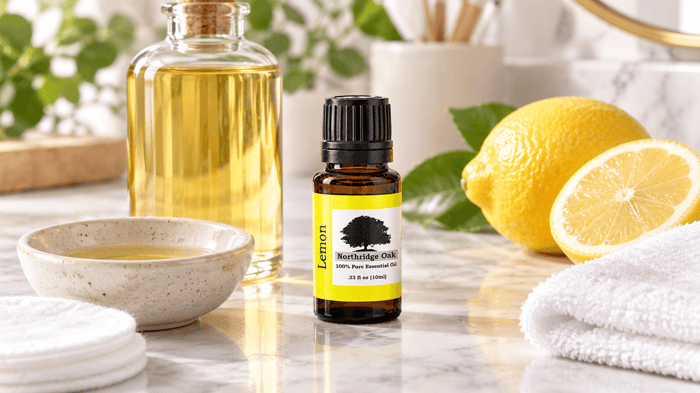
Add 3 drops Lemon and 3 drops Lavender to 1 ounce carrier. Apply one small drop across several cuticles and massage at night.
2. Grounded nail oil
Add 3 drops Lemon and 3 drops Frankincense to 1 ounce carrier for a bright-resinous aroma.
3. Fresh grooming blend
Add 2 drops Lemon, 2 drops Tea Tree, and 2 drops Lavender to 1 ounce carrier. This is cosmetic care, not a fungus treatment.
4. Single-use hand soak
Blend 1 drop Lemon into 1 teaspoon carrier oil, then disperse into a basin of warm water. Soak briefly, dry thoroughly, and moisturize.
5. Nail-buffing finish
After gentle buffing, use one drop of the finished diluted cuticle oil—not neat Lemon—across all nails and surrounding intact skin.
6. Travel cuticle roller
Add 1 drop Lemon and 1 drop Lavender to a 10 mL roller and fill with carrier oil. Label, cap, and keep out of heat.
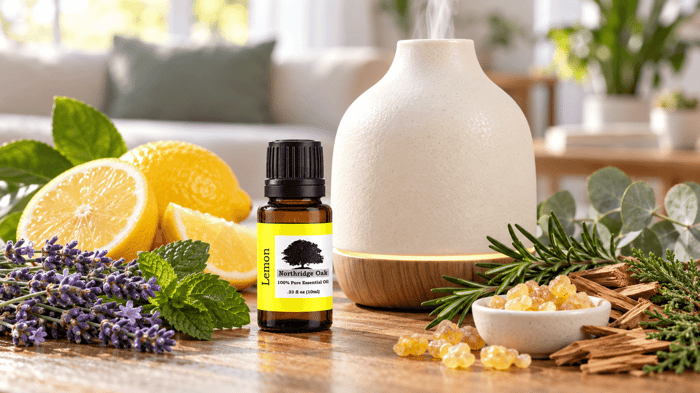
Depending on the goal, Lemon can be paired with Lavender, Tea Tree, Frankincense, Rosemary, Geranium, or Cedarwood Essential Oil. Use only oils appropriate for the application and link every named ingredient to its exact product.
How to Evaluate Results
Change one variable at a time and keep a brief record of ingredients, dilution, frequency, and response. Record splitting, peeling, dryness, tenderness, discoloration, thickening, and changes around the cuticle. Cosmetic improvements in softness are different from changes that suggest infection or nail disease. Aroma and cosmetic feel can be judged quickly, but comfort and compatibility require repeated observation. Stop if burning, persistent redness, swelling, blistering, or worsening symptoms appear.
Common Mistakes
- Applying Lemon Essential Oil undiluted
- Using fresh lemon juice as a substitute
- Ignoring UV exposure after leave-on use
- Adding drops directly to bathwater, where they float undiluted
- Using oxidized oil with a stale or harsh odor
- Changing several ingredients at once
- Treating a cosmetic routine as a diagnosis or cure
Storage and Formula Freshness
Keep the Lemon bottle cool, dark, upright, and tightly capped. Oxygen and heat accelerate oxidation, and oxidized limonene-rich oil can be more irritating. Make small water-free batches with clean tools. Any water-containing home formula needs an appropriate preservation system; without validated preservation, prepare only a very small fresh amount and discard promptly.
When to Ask a Professional
Pain, swelling, pus, a dark streak, nail separation, spreading discoloration, diabetes-related foot concerns, or a persistent thickened nail should be assessed by a qualified clinician. Seek prompt help for severe swelling, blistering, eye exposure, breathing difficulty, or accidental swallowing. Do not keep applying more product to an irritated area.
A 14-Day Routine Check
Photograph the starting appearance in consistent light, use one simple diluted formula at the same frequency, and keep every other product stable. Record comfort after each use and stop at the first sign of irritation. At day seven and day fourteen, compare the notes rather than relying on memory. This disciplined approach cannot prove medical efficacy, but it can tell you whether the aroma, texture, and routine suit you without confusing the result with several simultaneous changes.
Try Lemon Thoughtfully
A tiny evening cuticle massage is enough to enjoy the peel-bright aroma without overusing concentrated oil. Choose Northridge Oak Lemon Essential Oil when you want a pure, undiluted, small-batch peel oil with third-party GC/MS testing.
Lemon Essential Oil Learning Center
- Lemon Essential Oil Benefits, Uses, Research, Recipes & Safety
- How to Use Lemon Essential Oil: 15 Practical Uses
- Is Lemon Essential Oil Safe for Dogs?
- Relieving Headaches With Lemon Essential Oils
Research and References
Laboratory research summarized in a 2018 review reports antimicrobial, antioxidant, and other biological activity for citrus oils and isolated constituents. Results depend on concentration, organism, formulation, and method, and laboratory findings do not establish that a home mixture treats a skin, scalp, hair, or nail condition. The most important human-safety issue for expressed Lemon oil is phototoxicity after leave-on skin exposure followed by ultraviolet light.
- Dosoky NS, Setzer WN. Biological Activities and Safety of Citrus spp. Essential Oils. International Journal of Molecular Sciences. 2018. Read the review.
- Naganuma M, et al. A study of the phototoxicity of lemon oil. Archives of Dermatological Research. 1985. View PubMed record.
These statements have not been evaluated by the Food and Drug Administration. This product and the information in this article are not intended to diagnose, treat, cure, or prevent any disease. This content is for educational purposes only and is not a substitute for professional medical advice.