Table of Contents
- Quick Answer: Lemon Oil Comes From the Peel
- Step 1: Growing and Harvesting Lemons
- Step 2: Mechanical Expression or Cold Pressing
- How Steam-Distilled Lemon Oil Is Made
- Cold-Pressed vs Steam-Distilled Lemon Oil
- What GC/MS Testing Can—and Cannot—Tell You
- How to Evaluate a Bottle of Lemon Essential Oil
- Practical Ways to Use Expressed Lemon Oil
- Core Safety Practices
- Try the Bright Character of Real Lemon Peel
- Lemon Essential Oil Learning Center
- References
- Frequently Asked Questions
How Lemon Essential Oil is made has a direct effect on its aroma, composition, and topical-safety considerations. Most Lemon Essential Oil is mechanically expressed—often called cold pressed—from the brightly colored outer peel. Steam-distilled Lemon oil is also available, but it smells different and contains far fewer of the heavier furocoumarins associated with phototoxicity.
100% Pure Lemon Essential Oil – 10 mL

$7.50
Bright, Fresh and Useful Far Beyond the Diffuser Northridge Oak Lemon Essential Oil has the crisp, cheerful aroma of freshly cut lemon peel—but its value goes well beyond making a room smell good. A few carefully measured drops can brighten… read more
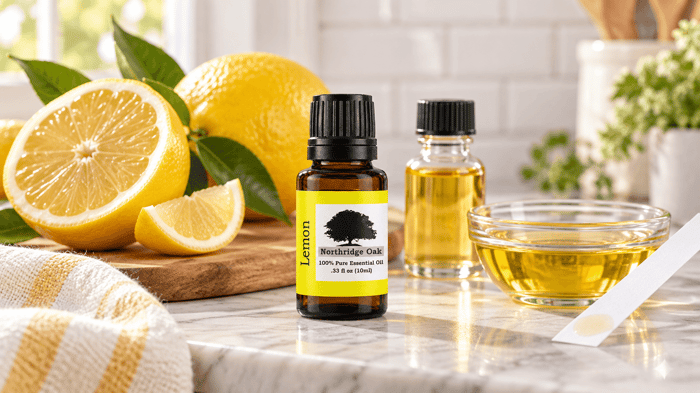
Northridge Oak Lemon Essential Oil brings the unmistakably clean, lively character of real lemon peel to diffusers, household recipes, and properly diluted topical blends. Understanding the journey from fruit to bottle makes it easier to use this concentrated botanical thoughtfully.
Quick Answer: Lemon Oil Comes From the Peel
The essential oil is stored in microscopic sacs within the flavedo, the yellow outer layer of the rind. When those sacs are broken, they release an aromatic liquid rich in limonene along with smaller amounts of beta-pinene, gamma-terpinene, citral components, and other naturally occurring constituents. Lemon juice comes primarily from the fruit’s interior; Lemon Essential Oil comes primarily from the peel. They are not interchangeable.
Step 1: Growing and Harvesting Lemons
Oil quality begins in the grove. Citrus variety, climate, soil, ripeness, disease pressure, and time between harvest and processing can all influence yield and aroma. Producers typically handle fruit promptly because the peel is most useful when it is fresh and intact. The same lemon can contribute juice, peel oil, and other co-products, which makes citrus processing unusually efficient.
Historically, citrus peel was valued in perfumery, household preparations, and culinary traditions long before modern analytical chemistry could describe limonene. Mechanical expression developed naturally from the observation that squeezing or rasping the peel releases a vivid aromatic mist.
Step 2: Mechanical Expression or Cold Pressing
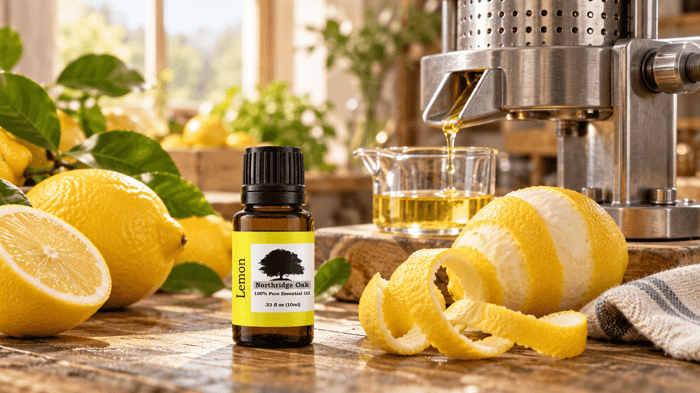
In modern expression, equipment punctures or rasps the peel’s oil sacs while water helps carry the released oil away. Centrifuges then separate the lightweight aromatic oil from juice, water, and peel solids. “Cold pressed” does not necessarily mean no heat is ever present anywhere in processing; it means the oil is obtained primarily through mechanical expression instead of being vaporized and condensed like a distilled oil.
Expressed Lemon oil tends to smell full, juicy, and recognizably peel-like. It also retains heavier nonvolatile constituents, including certain furocoumarins. That distinction is why a cold-pressed bottle deserves clear sunlight precautions when used on skin.
How Steam-Distilled Lemon Oil Is Made
Steam distillation moves volatile aromatic molecules with steam. The vapor is cooled, condensed, and separated into essential oil and aromatic water. Heavier furocoumarins do not readily travel with the steam, so distilled Lemon oil is generally considered non-phototoxic. Its aroma may seem lighter, sharper, or less true to freshly zested peel.
Neither method is automatically “better.” Expression preserves the classic peel profile many people want for diffusion and home care. Distillation can be useful when a formulator wants a different composition or reduced phototoxic concern. The label and supplier documentation should tell you which material you are purchasing.
Cold-Pressed vs Steam-Distilled Lemon Oil
| Feature | Cold-pressed/expressed | Steam-distilled |
|---|---|---|
| Process | Mechanical release from peel | Volatile molecules carried by steam |
| Aroma | Full, juicy, fresh-peel character | Lighter and more distilled |
| Furocoumarins | May retain phototoxic constituents | Typically contains very little |
| Best-known uses | Diffusion, household recipes, carefully diluted blends | Formulation where a distilled profile is preferred |
What GC/MS Testing Can—and Cannot—Tell You
Gas chromatography–mass spectrometry separates volatile constituents and helps identify whether a Lemon oil’s profile is consistent with expectations. It can reveal unusual ratios, contamination, or possible adulteration. It does not replace careful sourcing, sensory evaluation, lot documentation, or responsible use. Northridge Oak emphasizes 100% pure, undiluted, small-batch oils, with third-party GC/MS testing as an important quality check.
When comparing citrus oils, explore the bright sweetness of Blood Orange Essential Oil, the tart lift of Grapefruit Essential Oil, and the floral-citrus nuance of Bergamot Essential Oil. Their extraction details and chemistry influence how each behaves in a blend.
How to Evaluate a Bottle of Lemon Essential Oil
- Look for the botanical identity, extraction method, and peel source where supplied.
- Choose a company that explains purity and testing instead of relying only on vague grade language.
- Expect an amber bottle that helps limit light exposure.
- Check for a fresh, lively peel aroma rather than a candy-like synthetic impression.
- Store it cool and tightly capped after opening.
Practical Ways to Use Expressed Lemon Oil
Use a few drops in a diffuser according to its instructions, add it to measured household recipes, or blend it into carrier oil at an appropriate dilution. Pair it with Lavender for softness, Peppermint for a brisk lift, or Frankincense for depth. For topical use, follow phototoxicity guidance rather than assuming every citrus oil behaves the same.
Core Safety Practices
Lemon Essential Oil is highly concentrated. Do not ingest it. For skin use, dilute it in a carrier oil, patch test first, avoid eyes and mucous membranes, and pay close attention to sunlight guidance for expressed citrus oil. Follow diffuser directions, use ventilation, and keep bottles away from children and pets. Anyone who is pregnant, nursing, taking medication, or managing a health condition should speak with a qualified healthcare professional before use.
Storage matters too. Close the cap promptly, keep the bottle upright in a cool dark place, and replace oil that has developed an unusually sharp, stale, or resinous odor. Oxygen, light, and heat gradually oxidize limonene-rich citrus oil, which can increase the chance of skin irritation.
Try the Bright Character of Real Lemon Peel
Once you know how Lemon Essential Oil is made, its personality makes sense: the aroma is the concentrated voice of the peel. Add Northridge Oak Lemon Essential Oil to your collection for bright diffusion, custom blends, and practical home recipes.
Lemon Essential Oil Learning Center
- Lemon Essential Oil Benefits, Uses, Research, Recipes & Safety
- How to Use Lemon Essential Oil: 15 Practical Uses
- Is Lemon Essential Oil Safe for Dogs?
- Relieving Headaches With Lemon Essential Oils
References
- Dosoky NS, Setzer WN. Biological Activities and Safety of Citrus spp. Essential Oils. International Journal of Molecular Sciences. 2018. Read the review.
- Naganuma M, et al. A study of the phototoxicity of lemon oil. Archives of Dermatological Research. 1985. View PubMed record.
These statements have not been evaluated by the Food and Drug Administration. This product and the information in this article are not intended to diagnose, treat, cure, or prevent any disease. This content is for educational purposes only and is not a substitute for professional medical advice.