Table of Contents
- At-a-Glance Comparison
- What Lemon Essential Oil Really Is
- What Lemon Extract Is
- What Lemon-Infused Oil Is
- What Lemon Fragrance Oil Is
- Which One Should You Choose?
- Three Simple Lemon Essential Oil Ideas
- Label Questions Worth Asking
- Core Safety Practices
- Choose the Concentrated Botanical
- Lemon Essential Oil Learning Center
- References
- Frequently Asked Questions
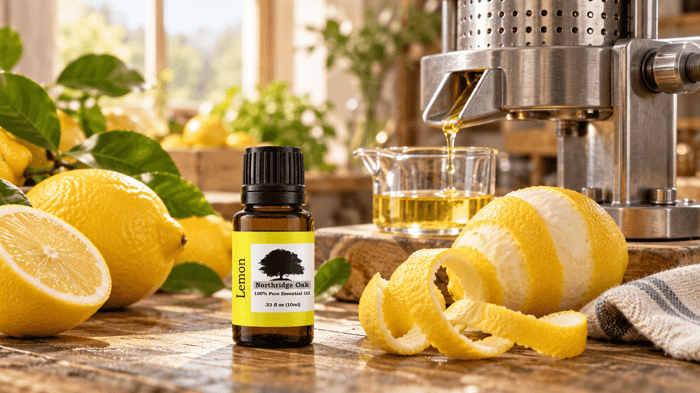
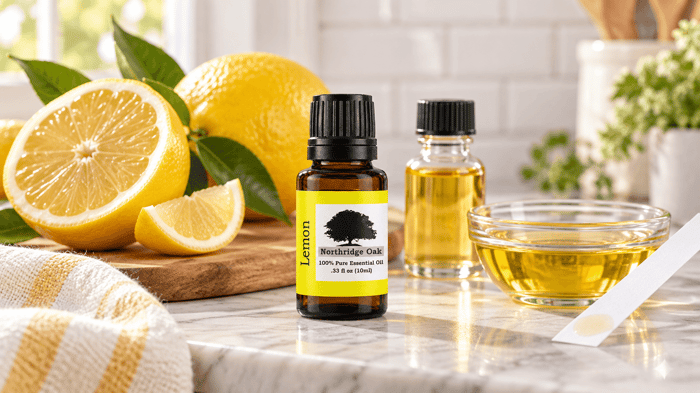
Lemon Essential Oil vs lemon extract is not a comparison between stronger and weaker versions of the same product. These materials are made differently, contain different compounds, and belong in different kinds of recipes. Lemon Essential Oil is concentrated peel oil; culinary extract is a food-flavoring preparation; infused oil is a carrier oil that has held lemon material; fragrance oil is a manufactured scent blend.
100% Pure Lemon Essential Oil – 10 mL

$7.50
Bright, Fresh and Useful Far Beyond the Diffuser Northridge Oak Lemon Essential Oil has the crisp, cheerful aroma of freshly cut lemon peel—but its value goes well beyond making a room smell good. A few carefully measured drops can brighten… read more
If your goal is diffusion, aromatherapy, or a carefully measured household or topical recipe, choose a clearly labeled pure Lemon Essential Oil. If your goal is flavoring food, use a culinary product designed for ingestion—not essential oil.
At-a-Glance Comparison
| Material | How it is made | Typical use | Use in diffuser? |
|---|---|---|---|
| Lemon Essential Oil | Expressed or distilled from peel | Diffusion, diluted topical use, household recipes | Yes, following directions |
| Lemon extract | Flavor compounds extracted into alcohol or another food-grade base | Culinary flavoring | No |
| Lemon-infused oil | Peel or botanical material steeped in carrier oil | Culinary or body-care use depending on formulation | No |
| Lemon fragrance oil | Manufactured aromatic formula | Products specifically designed for that fragrance | Only if its manufacturer explicitly allows it |
What Lemon Essential Oil Really Is
Lemon Essential Oil captures volatile aromatic constituents from the rind. Expressed oil is especially close to the smell of freshly zested peel. It is highly concentrated, not water soluble, and should be measured in drops rather than poured casually. It can scent a diffuser quickly and adds a bright top note to blends.
Because essential oil is not lemon juice, it does not provide the same water, citric acid, sugar, vitamin C, or culinary behavior. It also does not belong in food merely because the plant itself is edible. Northridge Oak’s use guidance excludes ingestion.
What Lemon Extract Is
Lemon extract is sold for baking and cooking. Manufacturers commonly capture flavor into an alcohol-and-water base or another approved food carrier. Its formula is designed for food use, but it is not designed for ultrasonic diffusers or for substituting into essential-oil dilution charts.
If a cake recipe calls for lemon extract, use culinary extract. If a diffuser recipe calls for Lemon Essential Oil, use essential oil. Matching the ingredient to its intended purpose produces better results and removes guesswork.
What Lemon-Infused Oil Is
An infusion is made by allowing lemon peel or another botanical material to sit in a carrier oil so oil-soluble compounds migrate into that base. The finished material is mostly carrier oil. Its aroma is usually softer, and its shelf life depends on the oil, preparation method, moisture control, and storage.
Infused oil may suit a body oil or culinary recipe when the maker designed it for that purpose, but it will not perform like a volatile essential oil in a diffuser. Introducing carrier oil into a water-based ultrasonic diffuser can damage the unit.
What Lemon Fragrance Oil Is
Fragrance oil is a scent formulation. It may contain synthetic aroma molecules, naturally derived materials, or both. A skillful fragrance can smell convincing, but the name “lemon” describes the scent impression rather than proving that the bottle contains expressed Citrus limon peel oil.
That distinction matters to Northridge Oak’s positioning: Lemon Essential Oil is chosen for customers seeking a pure botanical aromatic ingredient, not a generic lemon-scented substitute. Readers interested in citrus variety can also compare Blood Orange, Grapefruit, and Bergamot.
Which One Should You Choose?
- For a diffuser: use Lemon Essential Oil and follow the machine’s directions.
- For baking: use culinary lemon extract or zest.
- For a carrier-based body product: use a properly formulated infused oil or diluted essential oil.
- For soap or candles: use a material designed and tested for that specific formula.
- For natural household aroma: use measured Lemon Essential Oil in an appropriate recipe.
Three Simple Lemon Essential Oil Ideas
Bright diffuser: 4 drops Lemon + 2 drops Lavender Essential Oil. Crisp diffuser: 4 drops Lemon + 2 drops Peppermint Essential Oil. Grounded citrus: 3 drops Lemon + 2 drops Frankincense Essential Oil. Adjust totals to the diffuser instructions.
Label Questions Worth Asking
Look beyond the front name. Is the product meant for food, diffusion, cosmetics, candles, or soap? Does the ingredient statement identify a plant oil or a fragrance formula? Does the supplier explain extraction, purity, and testing? Is the package protective and the usage guidance specific? These questions prevent the common mistake of treating every lemon-scented liquid as interchangeable.
Core Safety Practices
Lemon Essential Oil is highly concentrated. Do not ingest it. For skin use, dilute it in a carrier oil, patch test first, avoid eyes and mucous membranes, and pay close attention to sunlight guidance for expressed citrus oil. Follow diffuser directions, use ventilation, and keep bottles away from children and pets. Anyone who is pregnant, nursing, taking medication, or managing a health condition should speak with a qualified healthcare professional before use.
Storage matters too. Close the cap promptly, keep the bottle upright in a cool dark place, and replace oil that has developed an unusually sharp, stale, or resinous odor. Oxygen, light, and heat gradually oxidize limonene-rich citrus oil, which can increase the chance of skin irritation.
Choose the Concentrated Botanical
When the recipe calls for the vivid aroma of lemon peel, Northridge Oak Lemon Essential Oil is the right starting point. Its concentrated character means a small measured amount can brighten a diffuser blend or household routine.
Lemon Essential Oil Learning Center
- Lemon Essential Oil Benefits, Uses, Research, Recipes & Safety
- How to Use Lemon Essential Oil: 15 Practical Uses
- Is Lemon Essential Oil Safe for Dogs?
- Relieving Headaches With Lemon Essential Oils
References
- Dosoky NS, Setzer WN. Biological Activities and Safety of Citrus spp. Essential Oils. International Journal of Molecular Sciences. 2018. Read the review.
- Tisserand Institute. Phototoxicity: Essential Oils, Sun and Safety. Read the safety explanation.
These statements have not been evaluated by the Food and Drug Administration. This product and the information in this article are not intended to diagnose, treat, cure, or prevent any disease. This content is for educational purposes only and is not a substitute for professional medical advice.