Table of Contents
- Five rosemary hair oil recipes at a glance
- Why make your own rosemary hair oil?
- What research says about rosemary hair oil
- Research behind the partner oils
- Rosemary’s traditional place in hair care
- Before you begin: the simple 1% dilution
- 1. Classic rosemary hair oil recipe
- 2. Rosemary and peppermint cooling scalp oil
- 3. Rosemary botanical conditioning oil
- 4. Fresh rosemary and tea tree scalp oil
- 5. Research-inspired rosemary scalp blend
- How to apply rosemary hair oil correctly
- How much finished oil should you apply?
- How often should you use a rosemary hair oil recipe?
- How to wash rosemary hair oil out
- How to make a 10 mL trial version
- How to store your homemade hair oil
- How to track your favorite recipe
- Choose pure oils for every recipe
- Use rosemary hair oils comfortably and safely
- What you have learned
- Continue learning about rosemary hair care
- Mix your first rosemary hair oil today
- References and further reading
- Frequently Asked Questions
A well-designed rosemary hair oil recipe should be simple to measure, pleasant to massage across the scalp and easy enough to use consistently. Rosemary has a long history in herbal hair rinses and grooming oils, and modern studies give natural hair-care enthusiasts an exciting reason to bring this enduring botanical into a weekly routine.
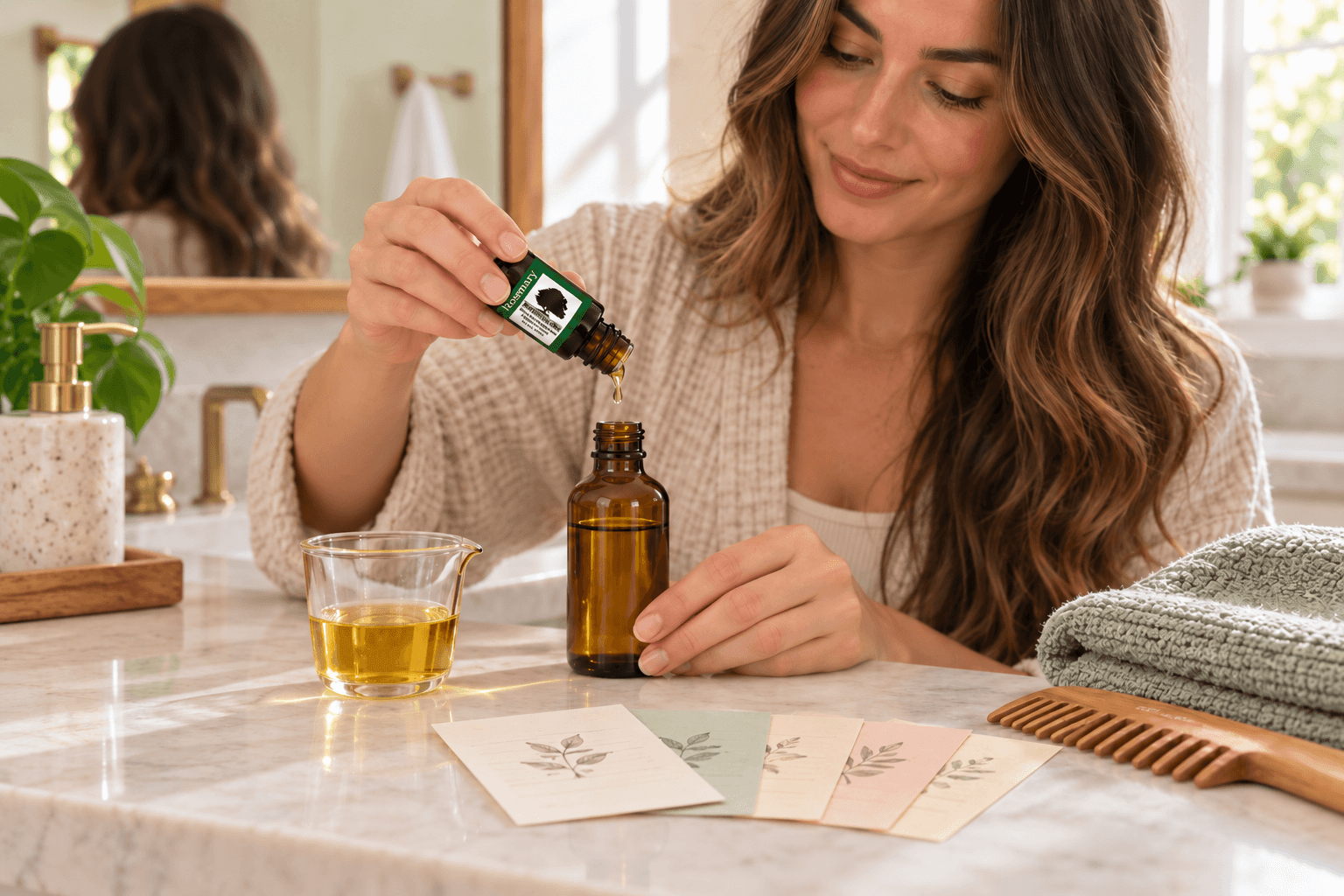
The five recipes below all begin with pure Northridge Oak Rosemary Essential Oil. From there, you can keep the formula beautifully simple or pair rosemary with peppermint, lavender, geranium, tea tree, thyme or cedarwood. Every one-ounce recipe uses six total essential-oil drops for a gentle concentration of approximately 1%.
100% Pure Rosemary Essential Oil – 10 mL
$7.50
100% Pure Rosemary Essential Oil Fresh, herbaceous and unmistakably invigorating, Northridge Oak Rosemary Essential Oil makes it easy to bring this time-honored botanical into your hair and scalp routine, diffuser blends, massage oils, skin-care recipes and naturally fresh home. This… read more

Five rosemary hair oil recipes at a glance
| Blend | Best fit | Carrier oil | Essential oils |
|---|---|---|---|
| 1. Classic Rosemary | Simple growth-focused scalp routine | Jojoba | 6 drops Rosemary |
| 2. Rosemary + Peppermint | Fresh, cooling scalp massage | Fractionated coconut | 4 Rosemary + 2 Peppermint |
| 3. Rosemary Botanical Conditioning | Dry-looking lengths and ends | Jojoba + argan | 3 Rosemary + 2 Lavender + 1 Geranium |
| 4. Rosemary + Tea Tree | Recurring flakes and oily-feeling roots | Jojoba | 4 Rosemary + 2 Tea Tree |
| 5. Research-Inspired Aromatic Blend | Complete multi-oil scalp ritual | Jojoba | 2 Rosemary + 1 Thyme + 1 Lavender + 2 Cedarwood |
If this is your first bottle, begin with the Classic Rosemary recipe. It is easy to evaluate because the essential-oil portion contains only rosemary. Once you know how the blend feels and shampoos out, choose a partner-oil recipe that matches your hair or scalp goals.
Why make your own rosemary hair oil?
Making a hair oil at home gives you control over every ingredient. You choose the carrier texture, total essential-oil concentration and aromatic character. You can also prepare a small fresh bottle without synthetic fragrance, unidentified parfum or ingredients that do not serve your routine.
A measured DIY blend offers several practical benefits:
- You know exactly how many drops of Rosemary Essential Oil are present.
- You can choose lightweight jojoba or fractionated coconut oil for the scalp.
- You can add argan oil when dry-looking lengths need more conditioning.
- You can tailor partner oils to cooling, fresh-scalp or evening routines.
- You can keep the formula consistent for meaningful progress tracking.
- You can make a new batch in minutes when the bottle runs low.
Consistency is especially important because rosemary’s strongest human hair study followed participants for six months. The recipe needs to be pleasant enough to become a habit rather than something you use only once or twice.
What research says about rosemary hair oil
A randomized comparative trial published in SKINmed in 2015 enrolled 100 participants with androgenetic alopecia. Fifty participants used a rosemary-oil lotion and fifty used 2% minoxidil. Researchers assessed hair count, standardized photographs, participant observations and scalp effects at baseline, three months and six months.
Neither group had a statistically significant hair-count increase at month three. At month six, however, both groups experienced significant increases in hair count compared with baseline. Researchers found no significant difference between the groups in the amount of hair-count change, while scalp itching was reported more frequently in the minoxidil group.
The study evaluated a prepared rosemary lotion rather than the homemade carrier-oil recipes in this guide, but its message is directly useful: rosemary deserves consistent, long-term use. A gentle blend, regular schedule and six-month photo plan give your home routine structure.
Read the original rosemary and minoxidil trial through PubMed and our detailed guide, Rosemary Oil for Hair Growth: What the Research Shows.
Research behind the partner oils
Peppermint for an invigorating scalp blend
A 2014 laboratory animal study compared a 3% peppermint oil preparation with saline, jojoba oil and 3% minoxidil over four weeks. The peppermint group showed strong hair-growth activity, including increased follicle number, follicle depth and dermal thickness. Researchers also observed increased alkaline phosphatase activity and IGF-1 expression, measurements associated with active follicle development in the study model.
This research helps explain why rosemary and peppermint have become such a popular pairing. Rosemary supplies the human clinical foundation, while peppermint contributes a refreshing cooling sensation and its own promising laboratory findings. Read the open-access peppermint hair-growth study.
Tea tree for a fresh scalp routine
Tea tree brings direct human dandruff research to the fourth recipe. A randomized study involving 126 people with mild to moderate dandruff compared a 5% tea tree shampoo with placebo over four weeks. The tea tree group experienced a 41% improvement in dandruff severity, compared with 11% in the placebo group. Itchiness and greasiness also improved significantly.
The study evaluated a professionally formulated shampoo, not the homemade carrier-oil blend below. Its results nevertheless make tea tree one of rosemary’s most interesting partners when recurring flakes and oily-feeling roots are the focus. Read the tea tree shampoo trial.
Lavender, thyme and cedarwood in a human scalp-massage study
A 1998 randomized, double-blind trial studied 86 people with alopecia areata. The active group massaged rosemary, thyme, lavender and cedarwood essential oils diluted in jojoba and grapeseed oils into the scalp daily. The control group used the carrier oils without essential oils.
After seven months, 19 of 43 participants in the essential-oil group showed improvement, compared with 6 of 41 in the carrier-only group. The essential-oil formula was significantly more effective than carrier oils alone.
That research inspired recipe five. The household blend below does not attempt to duplicate the study formulation, but it brings the same four aromatic oils together in a gentle, easy-to-measure recipe. Read the original aromatherapy scalp-massage trial.
Rosemary’s traditional place in hair care
Long before rosemary entered modern hair-growth research, its fragrant leaves were used throughout Mediterranean and European grooming traditions. Rosemary was steeped in water for hair rinses, infused into oils for massage and added to aromatic bathing preparations.
The herb became associated with remembrance, vitality and renewal. Its clean, green aroma made it a natural choice when people wanted hair and roots to feel refreshed. These traditional preparations were not identical to today’s steam-distilled essential oil, but they show that rosemary’s connection with hair care has deep roots.
Modern essential oil makes that traditional ritual precise. Instead of guessing how much rosemary entered an infusion, you can count exact drops, select a carrier oil and recreate the same formula week after week.
Before you begin: the simple 1% dilution
For these recipes, one fluid ounce equals approximately 30 mL or two tablespoons. Six total essential-oil drops in one fluid ounce of carrier create a household dilution of about 1%, although drop size naturally varies.
Keep the total at six drops when substituting partner oils. For example, if you increase peppermint from one drop to two, reduce another essential oil by one drop rather than increasing the overall total.
You will need:
- A clean, completely dry one-ounce amber glass bottle
- A small funnel or glass measuring cup
- Your chosen carrier oil or carrier-oil combination
- Rosemary Essential Oil and any partner oils
- A label and permanent marker
1. Classic rosemary hair oil recipe
This is the best starting blend for a simple, rosemary-centered scalp routine.
- 1 fluid ounce jojoba oil
- 6 drops Rosemary Essential Oil
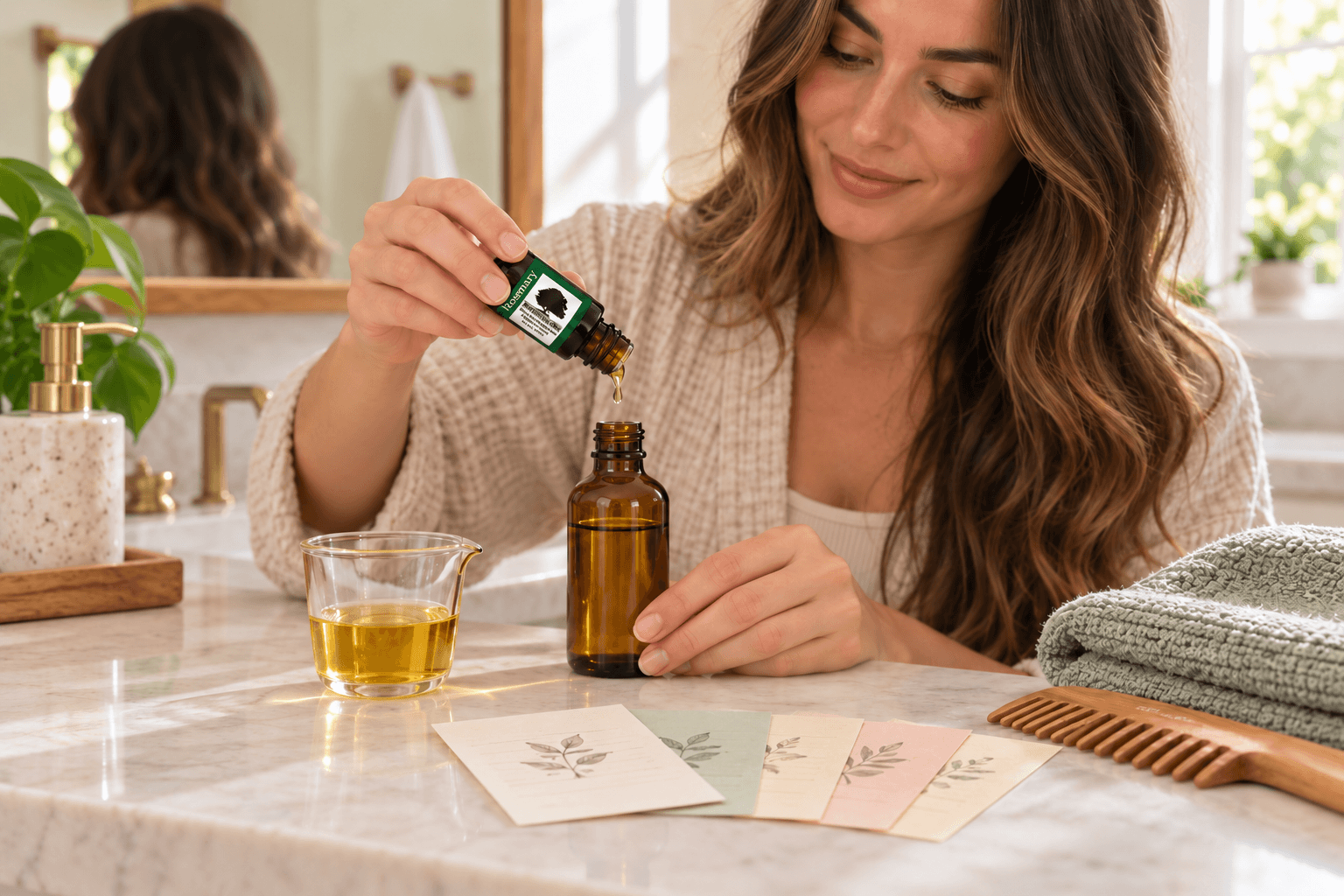
- Measure the jojoba oil into a clean, dry one-ounce amber bottle.
- Add 6 drops of Rosemary Essential Oil.
- Cap the bottle and gently roll it between your palms.
- Label the bottle “Classic Rosemary Hair Oil,” followed by the date.
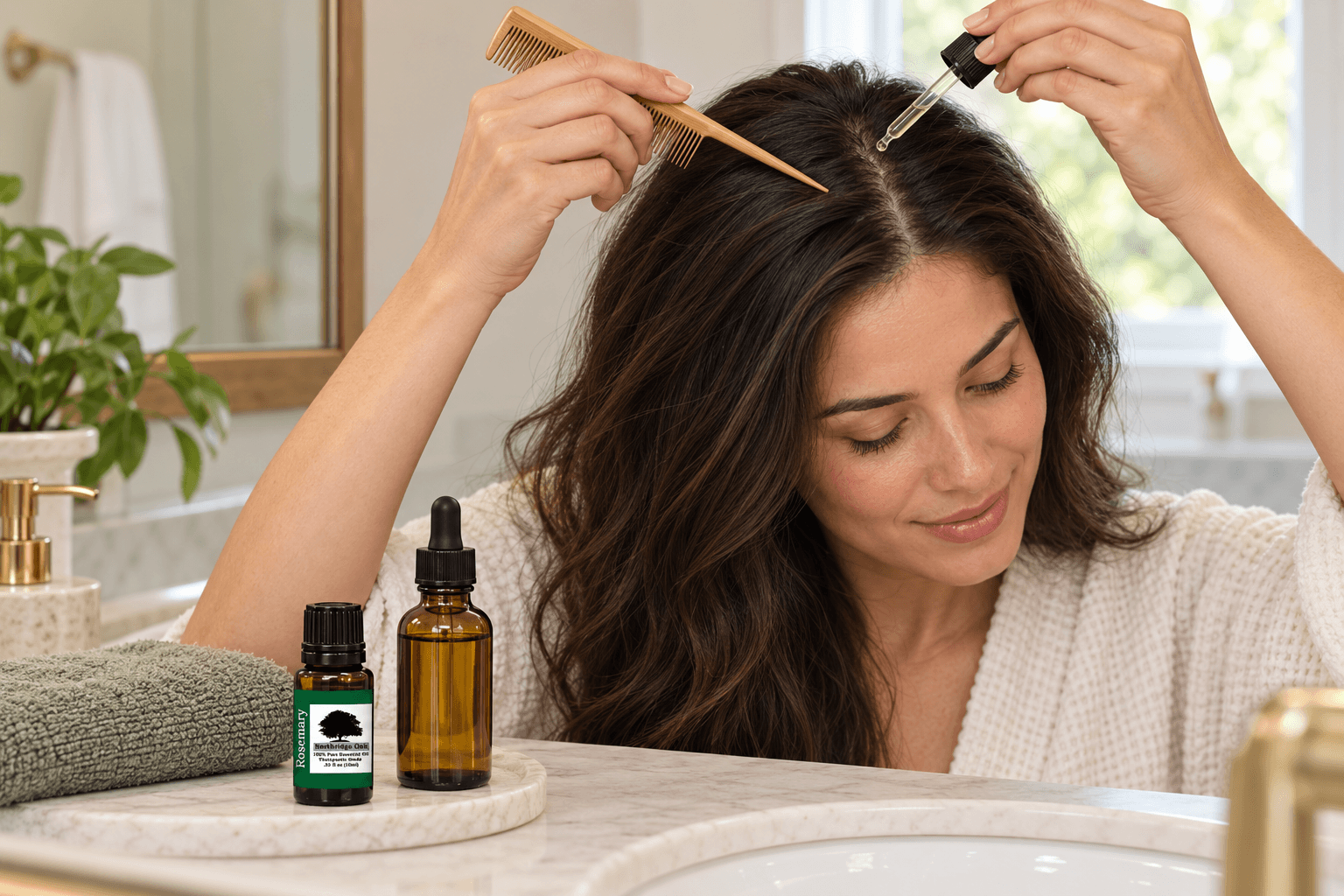
How to use it: Part dry hair across the hairline, temples and crown. Apply a small amount directly to the scalp, massage with fingertip pads for three to five minutes and leave the blend in place for 30–60 minutes. Shampoo thoroughly.
How often: Two or three times weekly for six months.
Why jojoba: Jojoba has a lightweight texture, spreads easily and gives the fingertips comfortable slip without requiring a heavy application.
2. Rosemary and peppermint cooling scalp oil
This invigorating recipe is ideal when you want scalp massage to feel fresh, lively and unmistakably aromatic.
- 1 fluid ounce fractionated coconut oil
- 4 drops Rosemary Essential Oil
- 2 drops Peppermint Essential Oil
How to use it: Apply a modest amount along several scalp parts and massage for three minutes. Keep the blend away from the forehead and eyes. Leave it on for approximately 30 minutes, then shampoo.
How often: Twice weekly.
Why fractionated coconut oil: It remains liquid, has a light texture and allows the cooling peppermint character to come through clearly.
Peppermint is powerful, so two drops are enough. For additional variations, visit Rosemary and Peppermint Oil for Hair: Benefits and Recipes.
3. Rosemary botanical conditioning oil
This formula cares for the scalp while giving dry-looking mid-lengths and ends a richer pre-shampoo treatment.
- 1 tablespoon jojoba oil
- 1 tablespoon argan oil
- 3 drops Rosemary Essential Oil
- 2 drops Lavender Essential Oil
- 1 drop Geranium Essential Oil
How to use it: Apply a small amount to the scalp and massage gently. Rub one or two additional drops of finished oil between your palms and smooth them over the mid-lengths and ends. Leave it on for 30 minutes before shampooing.
How often: Once or twice weekly.
Why this combination: Argan creates a richer feel for dry-looking lengths, lavender softens rosemary’s sharp herbal notes and geranium adds a fresh green-floral finish.
Fine hair needs only a very small amount along the ends. Coarse, curly or tightly textured hair may enjoy slightly more, but the hair should never need to be saturated.
4. Fresh rosemary and tea tree scalp oil
Choose this blend when recurring flakes, oily-feeling roots or scalp buildup make freshness the priority.
- 1 fluid ounce jojoba oil
- 4 drops Rosemary Essential Oil
- 2 drops Tea Tree Essential Oil
How to use it: Apply lightly to the scalp, concentrating on areas where flakes or buildup are most noticeable. Massage for three minutes, leave the blend in place for 15–20 minutes and shampoo thoroughly.
How often: Twice weekly for four weeks, then continue with the schedule that keeps the scalp feeling its best.
Why this combination: Rosemary provides its crisp herbal foundation, while tea tree contributes its familiar cleansing aroma and direct dandruff-shampoo research.
Explore the complete routine in Rosemary Oil for Dandruff, Dry Scalp and Itching and Tea Tree Oil for Dandruff and Scalp Care.
5. Research-inspired rosemary scalp blend
This beautifully layered blend brings together the four essential oils evaluated in the seven-month alopecia areata massage trial.
- 1 fluid ounce jojoba oil
- 2 drops Rosemary Essential Oil
- 1 drop Thyme Essential Oil
- 1 drop Lavender Essential Oil
- 2 drops Cedarwood Essential Oil
How to use it: Part the hair, apply sparingly across the scalp and massage gently for three to five minutes. Leave it in place for 20–30 minutes, then shampoo carefully.
How often: Begin once weekly. If the blend feels comfortable, move to twice weekly.
Why this combination: Rosemary brings a bright herbaceous quality, thyme adds intensity, lavender creates softness and cedarwood provides a warm grounding base. Because thyme is especially potent, keep it at one drop and do not increase the formula’s total concentration.
How to apply rosemary hair oil correctly
- Begin with dry, gently detangled hair.
- Create several clean parts rather than pouring oil over the entire head.
- Place a small amount of finished oil along each part.
- Use fingertip pads—not fingernails—to massage for three to five minutes.
- Focus on the hairline, temples, center part and crown when thinning is the goal.
- Smooth a very small amount over the ends only when the recipe is intended for lengths.
- Leave the treatment in place for the suggested time.
- Shampoo at the roots and rinse thoroughly.
A light, even application works better than saturating the hair. It keeps the massage comfortable, prevents unnecessary waste and makes the oil much easier to shampoo away.
How much finished oil should you apply?
There is no single amount for every head of hair. Begin with approximately one teaspoon or less of finished oil for the entire scalp. Fine hair or a focused hairline treatment may need much less. Thick or tightly curled hair may require more to reach the scalp between sections.
Add the oil gradually. Once the fingertips move easily and the scalp has a light coating, the application is complete. The purpose is scalp contact—not soaking every strand.
How often should you use a rosemary hair oil recipe?
For the Classic Rosemary blend, two or three applications weekly create a practical long-term rhythm. The cooling peppermint and fresh tea tree recipes work well twice weekly. The richer conditioning formula may be used once or twice weekly, depending on hair texture.
A sample schedule might be:
- Monday: Classic Rosemary or Rosemary + Peppermint scalp oil
- Thursday: Rosemary + Tea Tree or Research-Inspired blend
- Saturday: Botanical Conditioning oil for scalp and ends
You do not need to use three different recipes in the same week. Choose one formula and follow it consistently before deciding whether another better fits your goals.
How to wash rosemary hair oil out
- Before adding water, massage a small amount of shampoo directly over the oiled roots.
- Add a little warm water and continue massaging to create lather.
- Rinse thoroughly.
- Repeat once if the hair still feels coated.
- Apply conditioner primarily to the mid-lengths and ends.
Beginning with shampoo before fully soaking the hair can help it interact with the carrier oil. Using a modest amount of treatment in the first place makes removal easier.
How to make a 10 mL trial version
If you want to test a recipe before preparing a full ounce, reduce it to a 10 mL bottle:
- 10 mL carrier oil
- 2 total essential-oil drops
For Classic Rosemary, use 2 drops rosemary. For Rosemary + Peppermint, use 1 drop rosemary and 1 drop peppermint. For a gentler rosemary-forward trial, use only 1 rosemary drop in 10 mL carrier oil.
Label the small bottle clearly so it is not confused with an undiluted essential oil.
How to store your homemade hair oil
Use a clean, completely dry amber bottle and keep the cap closed between applications. Store the blend away from direct sunlight, bathroom steam and heat. Keep water out of the bottle, since these are oil-only formulas and contain no water.
Make one ounce at a time and note the preparation date. Follow the carrier oil’s stated shelf life and discard the blend if its aroma or appearance changes noticeably. Small batches are easy to use while fresh.
How to track your favorite recipe
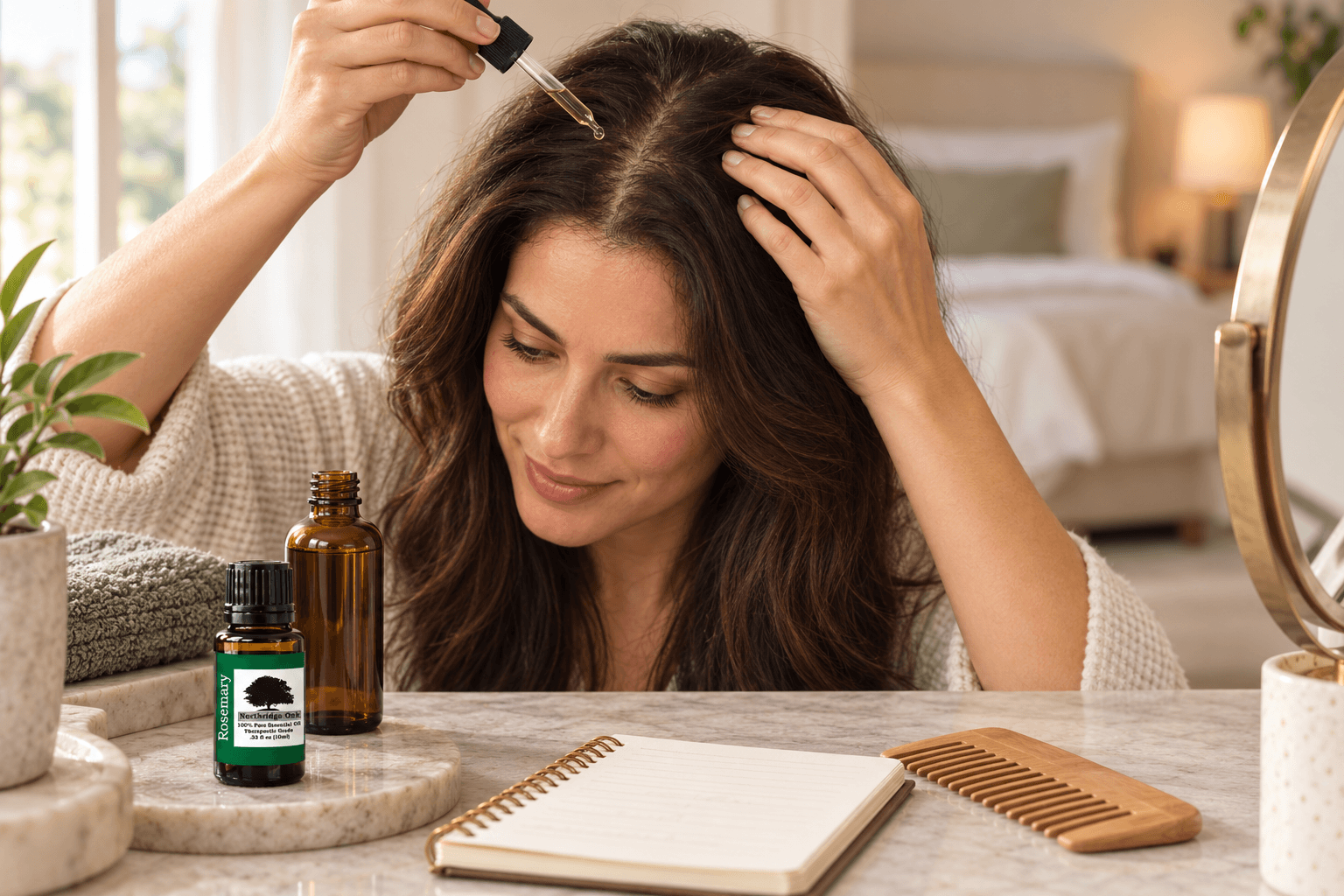
Write down the recipe, carrier oil, application amount, treatment time and wash-out experience. If hair density is the goal, take baseline photographs of the hairline, temples, center part and crown, then repeat them every four weeks.
Use clean, dry hair, the same part and the same lighting. The rosemary clinical trial recorded significant hair-count change at six months rather than three, so keep the formula and photo conditions consistent long enough to make a meaningful comparison.
Follow the complete timeline in How Long Does Rosemary Oil Take to Work for Hair Growth?
Choose pure oils for every recipe
A DIY hair oil contains only a few ingredients, which makes purity especially important. Northridge Oak Rosemary Essential Oil is 100% pure and undiluted, bottled in small batches and third-party GC/MS tested. It contains no fillers, synthetic fragrance or added carrier oil.
A typical 10 mL bottle contains approximately 200 drops, although natural drop size varies. At 6 rosemary drops per one-ounce Classic blend, one bottle can prepare roughly 33 batches. That makes a single bottle an excellent foundation for a long-term scalp routine.
Use rosemary hair oils comfortably and safely
Dilute every essential oil before broad scalp application and patch test the finished recipe. Keep blends away from the eyes, inner ears, broken skin and sensitive areas. Stop using a formula if persistent irritation develops.
Do not increase the total essential-oil amount simply because a recipe contains several oils. The six-drop total applies to the entire blend. Store essential oils out of reach of children and review the Complete Essential Oil Safety Guide before beginning a new topical routine.
What you have learned
- Every one-ounce recipe in this guide uses six total essential-oil drops for an approximately 1% blend.
- The Classic Rosemary recipe is the simplest choice for a consistent six-month scalp routine.
- The 100-participant rosemary study recorded significant hair-count improvement at six months.
- Peppermint contributes a cooling sensation and promising follicle findings from laboratory research.
- Tea tree brings direct human dandruff-shampoo research to a fresh-scalp blend.
- Rosemary, thyme, lavender and cedarwood were used together in a successful seven-month aromatherapy scalp-massage trial.
- Carrier-oil choice changes the texture, richness and washability of the finished recipe.
- A light scalp application is easier to massage and shampoo away than complete saturation.
- Monthly photographs make gradual hair changes easier to evaluate.
Continue learning about rosemary hair care
- Rosemary Oil for Hair Growth: What the Research Shows
- Rosemary Oil for Hair Loss and Thinning Hair
- How to Use Rosemary Essential Oil for Hair
- How Long Does Rosemary Oil Take to Work for Hair Growth?
- Rosemary and Peppermint Oil for Hair
- Rosemary Oil for Dandruff, Dry Scalp and Itching
- Rosemary Oil vs Rosemary Water for Hair
- Rosemary Essential Oil: Benefits, Uses, Blends and Safety
Mix your first rosemary hair oil today
A rosemary hair oil recipe does not need to be complicated to feel special. Choose the Classic Rosemary blend for a pure, focused routine or select one of the partner-oil recipes that matches your scalp, hair texture and favorite aroma.
Shop Northridge Oak Rosemary Essential Oil, prepare one fresh ounce and write the recipe on the label. Then choose your application days, take your baseline photographs and discover how easily this time-honored botanical can become part of caring for your hair.
References and further reading
- Panahi Y, Taghizadeh M, Marzony ET, Sahebkar A. Rosemary oil vs minoxidil 2% for the treatment of androgenetic alopecia: a randomized comparative trial. SKINmed. 2015;13(1):15–21.
- Oh JY, Park MA, Kim YC. Peppermint oil promotes hair growth without toxic signs. Toxicological Research. 2014;30(4):297–304.
- Satchell AC, Saurajen A, Bell C, Barnetson RS. Treatment of dandruff with 5% tea tree oil shampoo. Journal of the American Academy of Dermatology. 2002;47(6):852–855.
- Hay IC, Jamieson M, Ormerod AD. Randomized trial of aromatherapy: successful treatment for alopecia areata. Archives of Dermatology. 1998;134(11):1349–1352.
- de Macedo LM, et al. Rosemary: biological properties and therapeutic applications. 2020.
These statements have not been evaluated by the Food and Drug Administration. This content is for educational purposes and is not intended to diagnose, treat, cure or prevent any disease.
Frequently Asked Questions
What is the easiest rosemary hair oil recipe?
Add 6 drops of Rosemary Essential Oil to 1 fluid ounce of jojoba oil. Massage a small amount into the scalp for three to five minutes, leave it on for 30–60 minutes and shampoo thoroughly. This approximately 1% blend is the simplest starting recipe.
How often should I use rosemary hair oil?
Use the Classic Rosemary blend two or three times each week. Cooling peppermint and fresh tea tree blends generally fit well twice weekly, while a richer conditioning blend may be used once or twice weekly depending on hair texture.
Which carrier oil is best for rosemary hair oil?
Jojoba is a versatile lightweight choice for most scalp recipes. Fractionated coconut oil stays liquid and provides excellent massage slip. Argan oil feels richer and is especially useful when dry-looking mid-lengths and ends also need conditioning.
How many drops of rosemary oil go in one ounce of carrier oil?
Use 6 drops of Rosemary Essential Oil in 1 fluid ounce of carrier oil for an approximately 1% household dilution. If you add partner oils, keep the total at 6 drops—for example, 4 drops rosemary plus 2 drops peppermint.
Can I mix rosemary and peppermint oil for hair?
Yes. Combine 4 drops rosemary and 2 drops peppermint with 1 fluid ounce of fractionated coconut or jojoba oil. The blend creates a fresh, cooling scalp massage while keeping rosemary as the dominant essential oil.
Should rosemary hair oil be applied to wet or dry hair?
Dry, gently detangled hair makes it easier to create clean parts and apply the blend directly to the scalp. Use a light amount, massage with fingertip pads and shampoo after the recipe’s suggested treatment time.
How long should I use rosemary hair oil before comparing results?
Give a growth-focused rosemary routine six months. In the main human trial, hair-count change was not significant at three months but was significant at six months. Take matching photographs every four weeks to make gradual changes easier to see.