
Table of Contents
- What Does the Research Say About Lavender and Hair?
- What Lavender Can Bring to Your Scalp Routine
- Simple Lavender Pre-Shampoo Scalp Oil
- Lavender, Rosemary and Cedarwood Scalp Blend
- Three More Ways to Use Lavender for Hair
- Match the Carrier Oil to Your Hair
- When Hair Loss Deserves Professional Attention
- Why Choose Northridge Oak Lavender?
- Lavender Hair and Scalp Safety
- Continue Exploring Lavender
- FAQs
Lavender essential oil for hair is often added to scalp oils because it smells wonderful—but the research behind it is more interesting than the aroma alone. Lavender has been studied for hair growth in animals, and a human clinical trial using Lavender with several other essential oils produced meaningful improvement in people with patchy hair loss. The question is how to turn those findings into a simple routine that treats your scalp gently.
This guide shows you how to dilute Lavender correctly, build it into wash day and choose a method you will actually continue using.
Quick answer: Lavender is worth trying as part of a consistent scalp-care routine. Use 2 drops in 2 teaspoons of carrier oil for a gentle pre-shampoo massage, or add it to a properly diluted blend with Rosemary and Cedarwood.
What Does the Research Say About Lavender and Hair?
Lavender’s reputation in hair care is not based only on tradition. In a 2016 study, researchers applied 3% and 5% Lavender oil preparations to mice five days a week for four weeks. The Lavender groups showed increased hair follicles, greater follicle depth and thicker skin layers associated with hair growth. Because this was an animal study, it cannot tell us exactly what will happen on a human scalp, but it gives researchers a real biological reason to keep studying Lavender. Read the study through the National Library of Medicine.
Lavender was also included in a seven-month randomized, double-blind clinical trial involving 86 people with alopecia areata, a condition that causes patchy hair loss. Participants massaged either carrier oils alone or a blend of Lavender, Rosemary, Thyme and Cedarwood in jojoba and grapeseed oils into the scalp each day. Nineteen of 43 people using the essential-oil blend improved, compared with six of 41 using the carrier oils. The study supports the complete blend rather than Lavender by itself, but the results make a diluted botanical scalp routine genuinely worth exploring. Review the trial through the National Library of Medicine.
What Lavender Can Bring to Your Scalp Routine
A healthy-looking head of hair begins with a scalp that is treated kindly. Harsh scratching, very hot water, heavy product buildup and overly concentrated essential oils can leave the scalp feeling worse. Lavender offers a softer approach: a properly diluted oil can make scalp massage more enjoyable, encourage you to slow down and help turn routine hair care into a consistent ritual.
That consistency matters. Hair grows slowly, and no topical routine can create an overnight transformation. A weekly photograph taken in the same light is often more useful than checking the mirror every morning.
Simple Lavender Pre-Shampoo Scalp Oil
For one treatment, combine:
- 2 teaspoons jojoba or fractionated coconut oil
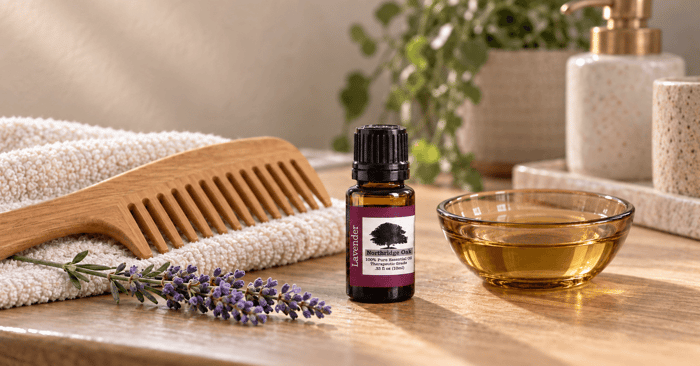
- 2 drops Northridge Oak Lavender Essential Oil
Part the hair in several places and apply a small amount to the scalp with clean fingertips. Massage gently for three to five minutes without using your nails. Leave it in place for 15 to 30 minutes, then shampoo thoroughly. Fine or naturally oily hair may need two light washes.
This is a modest dilution designed for routine scalp care. Patch-test the finished mixture first, especially if your scalp is reactive or you use medicated products.
Lavender, Rosemary and Cedarwood Scalp Blend
If you want a blend inspired by the oils used in the human alopecia trial, make a 30-milliliter bottle with:
- 3 drops Lavender Essential Oil
- 2 drops Rosemary Essential Oil
- 1 drop Cedarwood Essential Oil
- 30 milliliters jojoba or fractionated coconut oil
Massage a small amount into the scalp two or three times per week and wash it out after 30 minutes. This home blend is not identical to the research formula and should not be presented as a treatment for alopecia, but it is a practical way to bring the same group of oils into a gentle grooming routine.
Three More Ways to Use Lavender for Hair
Add It to a Single Shampoo Portion
Mix one drop Lavender into the amount of unscented shampoo you will use immediately. Combine it in your palm, wash and rinse thoroughly. Do not add essential oil directly to an entire bottle unless the formula was designed for that addition.
Scent the Ends With a Hair Oil
For dry-looking ends, add one drop Lavender to one tablespoon of a lightweight carrier oil. Use only a drop or two of the finished blend on the ends of damp hair. Avoid the roots if your hair becomes oily easily.
Make Wash Day Feel Calmer
Diffuse three drops Lavender for 15 to 30 minutes while you complete your routine. Research on Lavender inhalation has found encouraging effects on anxiety, giving the oil another role beyond the scalp itself. A systematic review found that Lavender inhalation significantly reduced anxiety scores across validated measures. Read it through the National Library of Medicine.
Match the Carrier Oil to Your Hair
- Jojoba oil: light, easy to spread and a good starting point for most scalp types.
- Fractionated coconut oil: lightweight, stable and easy to wash from many hair types.
- Argan oil: useful in tiny amounts on dry-looking ends.
- Grapeseed oil: light in texture but should be stored carefully because it can oxidize faster.
Begin with less product than you think you need. You can always add more, while an oversaturated scalp can require several washes.
When Hair Loss Deserves Professional Attention
Sudden shedding, smooth bald patches, scalp pain, sores, heavy scaling or hair loss after an illness or medication change deserves a conversation with a healthcare professional. Thyroid concerns, iron deficiency, hormonal shifts, autoimmune conditions and other causes need more than a cosmetic oil.
Lavender can still be part of a comforting routine, but getting the cause right helps you avoid losing months to guesswork.
Why Choose Northridge Oak Lavender?
Northridge Oak Lavender Essential Oil is 100% pure, undiluted Lavandula angustifolia, steam-distilled from Bulgarian flowering tops and third-party GC/MS tested for identity and purity. It contains no added carrier oil, filler or synthetic fragrance.
One 10-milliliter bottle can make dozens of scalp treatments while also serving your diffuser, bath, massage and bedtime routines. If you are ready to try lavender essential oil for hair, begin with a quality oil and a gentle dilution you can use consistently.
Lavender Hair and Scalp Safety
Never pour undiluted essential oil across the scalp. Patch-test every new blend, keep it away from the eyes and stop if burning, redness or persistent itching occurs. Do not apply it to broken, infected or severely inflamed skin. Keep oils away from children and pets, and do not ingest them.
For more guidance, read How to Use Lavender Essential Oil Safely and the Complete Essential Oil Safety Guide.
100% Pure Lavender Essential Oil – 10 mL

$11.67
100% Pure Lavender Essential Oil – Lavandula angustifolia Soft, floral and gently herbaceous, Northridge Oak Lavender Essential Oil is steam distilled from the flowering tops of Lavandula angustifolia grown in Bulgaria. This 100% pure, undiluted essential oil contains no fillers,… read more
Continue Exploring Lavender
- Discover more ideas in the Lavender Essential Oil Uses Guide.
- Learn gentle topical methods in Lavender Essential Oil for Skin.
- Shop Northridge Oak Lavender Essential Oil.
These statements have not been evaluated by the Food and Drug Administration. This content is educational and is not intended to diagnose, treat, cure or prevent any disease.
Frequently Asked Questions
Does Lavender essential oil help hair grow?
Animal research found hair-growth-related changes after topical Lavender preparations, and a human trial found improvement with a blend containing Lavender, Rosemary, Thyme and Cedarwood. These findings are encouraging, but Lavender has not been proven to regrow every type of human hair loss.
How do I dilute Lavender oil for my scalp?
For a gentle routine, mix 2 drops Lavender into 2 teaspoons of carrier oil. Patch-test first, massage a small amount into the scalp and shampoo it out after 15 to 30 minutes.
How often can I use Lavender scalp oil?
Begin once or twice a week. If your scalp remains comfortable and the oil washes out easily, you can use it up to three times weekly.
Can I leave Lavender oil in my hair overnight?
A short pre-shampoo treatment is usually easier on the scalp and bedding. Leaving any new blend on overnight increases contact time, so begin with 15 to 30 minutes and see how your scalp responds.
Can I add Lavender directly to shampoo?
Mix one drop into a single palmful of unscented shampoo and use it immediately. Adding oil to a full commercial bottle can disrupt the formula and make distribution uneven.
Which carrier oil works best with Lavender?
Jojoba and fractionated coconut oil are easy starting choices. Jojoba feels light on many scalps, while fractionated coconut oil spreads easily and has a long shelf life.
Can Lavender help a dry, itchy scalp?
A diluted oil massage may feel soothing when dryness is mild, but persistent itching, redness, heavy flaking or sores may have another cause and should be evaluated.
Can I combine Lavender and Rosemary for hair?
Yes. A diluted blend of Lavender, Rosemary and Cedarwood makes a pleasant scalp oil and reflects oils used together in published research. Keep the total essential-oil concentration modest.
How long until I notice a difference?
Hair changes take time because growth occurs slowly. Use the routine consistently and compare monthly photographs rather than expecting a visible change after a few applications.
When should I see a professional about hair loss?
Seek guidance for sudden shedding, bald patches, scalp pain, infection, scarring or hair loss that continues. A clinician can help identify causes that need medical or nutritional treatment.


