Table of Contents
- TRY FRANKINCENSE FOR YOURSELF—GET A FREE BOTTLE
- What Did the 2026 Frankincense Memory Study Test?
- What Did the Researchers Find?
- Does This Prove Frankincense Improves Memory?
- What Was in the Frankincense Oil Used in the Study?
- Why GC–MS Testing Matters
- Frankincense Essential Oil Is Not the Same as Boswellia Extract
- What About Frankincense for Concentration or Focus?
- How to Explore Frankincense Aromatically
- Using Frankincense Responsibly
- The Bottom Line
- Research Referenced
- FAQs
Can Frankincense Essential Oil help with memory or concentration? Early research offers a promising reason to keep studying the question—but the most accurate answer is not a simple yes or no.
TRY FRANKINCENSE FOR YOURSELF—GET A FREE BOTTLE
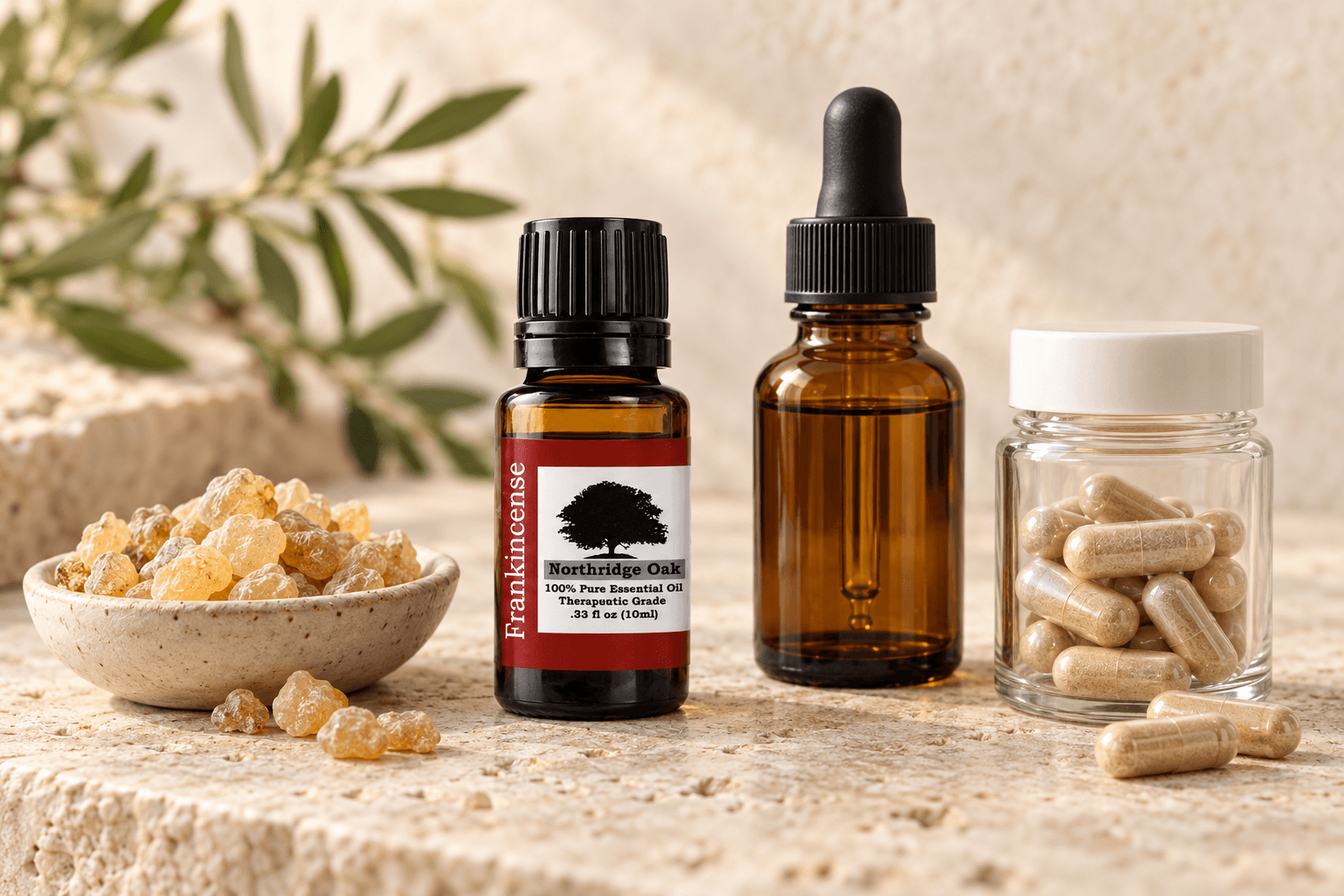
Ready to experience frankincense for yourself? Claim your FREE bottle of Northridge Oak Frankincense Essential Oil—just pay shipping. You’ll also get access to our Frankincense Oil Uses guide, packed with DIY recipes and diffuser blends.
A human study published in the January–March 2026 issue of Natural and Life Sciences Communications found that male university students who inhaled Frankincense Essential Oil performed better on short-term memory tests involving images, numbers and words. This is particularly noteworthy because the study evaluated inhalation of Frankincense Essential Oil rather than an oral Boswellia supplement or resin extract.
However, this was an initial study conducted in a specific group under controlled conditions. It did not prove that Frankincense prevents memory loss, treats cognitive impairment or improves concentration in every person.
Here is a closer look at what researchers tested, what they found and what the results may mean for someone who enjoys Frankincense as part of an aromatic routine.
Quick answer: One recent human study reported improved short-term memory test scores after 10 minutes of Frankincense Essential Oil inhalation. The result is encouraging, but additional research involving more diverse participants, different Frankincense oils and longer study periods is needed.
What Did the 2026 Frankincense Memory Study Test?
The study, titled “The Effect of Frankincense Essential Oil Inhalation on Short-term Memory in Male University Students,” involved 100 healthy male students between 18 and 26 years old at Mae Fah Luang University in Thailand.
Researchers divided the students into two groups of 50:
A test group exposed to the aroma of Frankincense Essential Oil
A control group placed in a similar room using deionized water instead of Frankincense
Before entering the treatment rooms, participants completed short-term memory exercises involving images, numbers and words. They also had their blood pressure and pulse measured.
The test room contained two beakers with cotton wool. Researchers added 10 drops of diluted Frankincense oil to each beaker and prepared the room approximately 10 minutes before participants entered. The students then rested in the room for 10 minutes before repeating the short-term memory exercises and physiological measurements.
This setup is different from simply holding an open bottle beneath the nose. It created a room-wide aromatic exposure under the researchers’ study conditions.
What Did the Researchers Find?
Following Frankincense Essential Oil inhalation, average scores increased on all three short-term memory exercises:
| Short-term memory test | Before inhalation | After inhalation | Average change |
|---|---|---|---|
| Images | 7.62 | 8.34 | +0.72 |
| Numbers | 6.10 | 7.00 | +0.90 |
| Words | 6.72 | 7.50 | +0.78 |
The researchers reported that the changes were statistically significant, with reported p values below 0.05 for the image, number and word exercises.
The control group did not show the same pattern. Its average image and number scores declined on the second round of testing.
The Frankincense group also experienced a statistically significant decrease in systolic blood pressure. Changes in diastolic blood pressure and pulse rate were not statistically significant. Participants exposed to the aroma described greater feelings of refreshment, relaxation and calm, although the reported between-group differences for those subjective ratings were not statistically significant.
The researchers concluded that inhaling the Frankincense Essential Oil used in the study could help improve short-term memory scores in the population they tested.
Does This Prove Frankincense Improves Memory?
Not yet. The study provides encouraging preliminary evidence, but one study should not be treated as final proof.
Several limitations matter when interpreting the result:
The participants were a narrow group
Every participant was a healthy male university student between 18 and 26 years old. The findings cannot automatically be generalized to women, children, older adults or people experiencing cognitive difficulties.
It tested an immediate response
The students repeated the memory exercises after a 10-minute aromatic exposure. The study did not determine whether any change lasted beyond the testing session or whether repeated use produces long-term effects.
Short-term memory is not the same as concentration
The researchers tested recall of images, numbers and words. They did not conduct a comprehensive evaluation of sustained attention, concentration, long-term memory, academic performance or everyday productivity.
Aroma blinding is difficult
Although participants were not told that Frankincense aroma would be present, people can usually detect whether a room has a noticeable scent. Expectations, aroma preference and familiarity may influence performance or subjective experience.
Frankincense oils are chemically variable
The chemical composition of Frankincense Essential Oil can differ with Boswellia species, geography, harvest conditions and distillation. Results obtained with one oil should not automatically be promised for every Frankincense oil.
For these reasons, the study is best viewed as promising early evidence that supports further research—not as proof that Frankincense Essential Oil treats memory problems.
What Was in the Frankincense Oil Used in the Study?
The researchers analyzed their Frankincense oil using gas chromatography–mass spectrometry, commonly called GC–MS.
Its major reported constituents included:
α-thujene: 57.18%
Sabinene: 7.58%
α-pinene: 7.17%
Anisole: 6.16%
p-cymene: 5.85%
δ-3-carene: 4.76%
α-limonene: 3.42%
The researchers discussed earlier laboratory and animal research involving several of these aromatic constituents. However, research on an isolated constituent or an animal model does not establish the same effect in people using a complete essential oil.
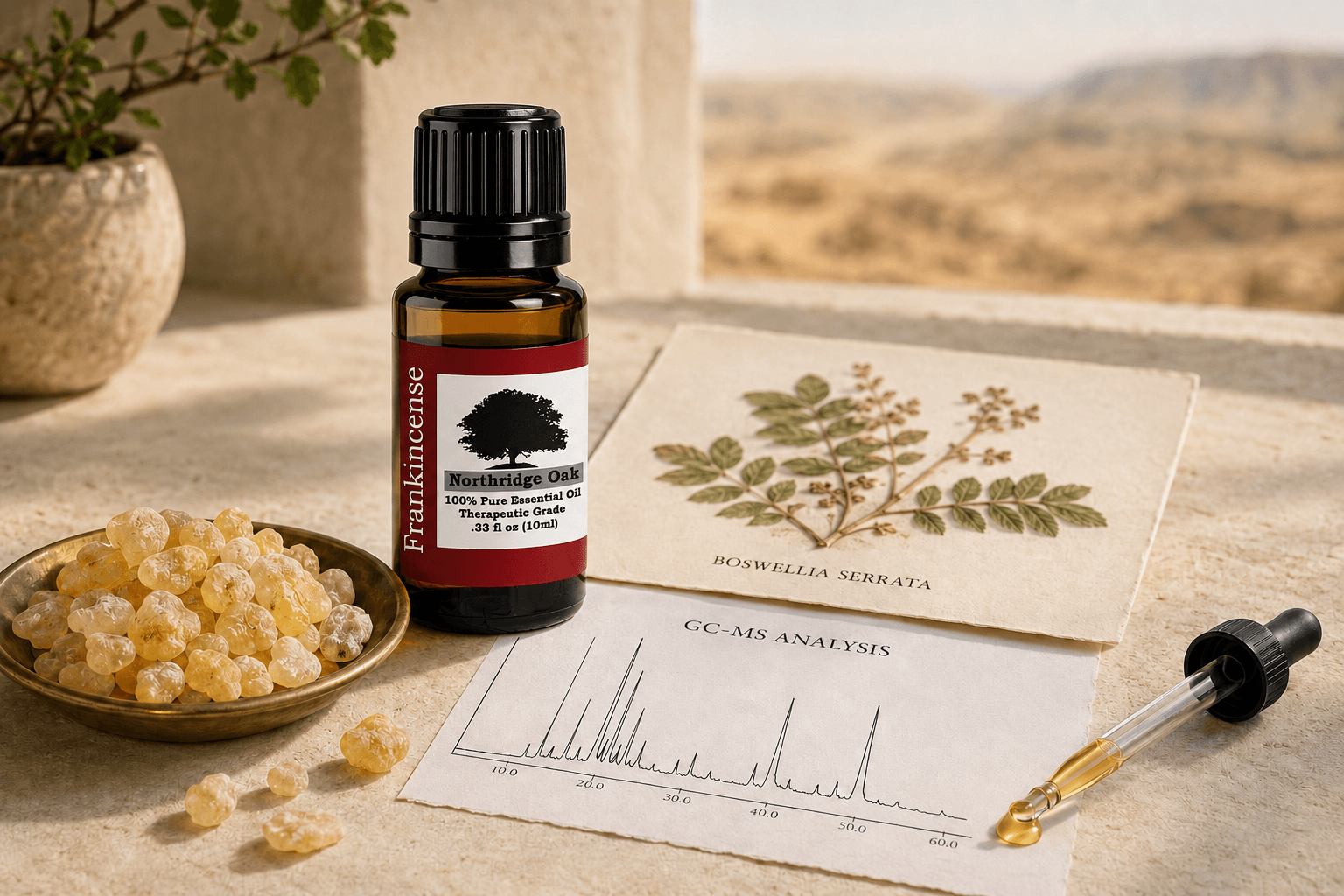
Northridge Oak Frankincense Essential Oil is steam distilled from the resin of Boswellia serrata and is third-party GC–MS tested. This testing documents the oil’s chemical profile and helps verify its identity, composition and purity.
That is an important quality distinction, but it does not mean Northridge Oak’s oil was the product tested in this particular university study. Because species, source, harvest and distillation can influence composition, the study should not be presented as a product-specific clinical trial of Northridge Oak Frankincense.
Why GC–MS Testing Matters
GC–MS stands for gas chromatography–mass spectrometry. The testing separates and identifies volatile aromatic compounds within an essential oil, producing a chemical profile that can be reviewed for identity, composition and possible signs of adulteration.
The researchers in the 2026 memory study used GC–MS to characterize the Frankincense oil used in their experiment. Northridge Oak likewise has its Boswellia serrata Frankincense Essential Oil independently GC–MS tested as part of our commitment to product purity and transparency.
GC–MS testing and clinical research serve different purposes:
GC–MS testing helps establish what chemical constituents are present in an essential oil.
A clinical study evaluates what happened under a specific research protocol in a particular group of participants.
Therefore, GC–MS testing supports confidence in the identity and composition of Northridge Oak Frankincense, while the human study provides promising—but still preliminary—evidence about aromatic Frankincense exposure and short-term memory.
Frankincense Essential Oil Is Not the Same as Boswellia Extract
This distinction is essential when reading Frankincense research.
Frankincense begins as resin from trees in the Boswellia genus, but the finished preparations are chemically different:
Frankincense Essential Oil contains volatile aromatic compounds collected through steam distillation.
Boswellia extracts and supplements are made from resin and may be standardized for boswellic acids.
Frankincense resin is the raw aromatic material harvested from the tree.
Boswellic acids are relatively large, nonvolatile compounds. They do not carry over in meaningful quantities during steam distillation, so research involving boswellic-acid supplements cannot be used as direct proof for Frankincense Essential Oil.
Some human studies have reported cognitive findings after participants consumed Frankincense resin or Boswellia preparations. For example, a 2019 study reported changes in motor-memory acquisition and retention after four weeks of Frankincense consumption in older men. Other clinical research has evaluated standardized Boswellia preparations in specific patient populations.
Those studies contribute to the broader scientific conversation about Boswellia, but they do not demonstrate that inhaling steam-distilled Frankincense Essential Oil produces the same effects.
You can learn more about the oil, its origin and the essential-oil-versus-extract distinction in our complete guide to Frankincense Essential Oil.
What About Frankincense for Concentration or Focus?
The 2026 study directly evaluated short-term memory—not concentration as a separate outcome.
Short-term memory, attention and concentration can interact during a task, but they are not interchangeable. Remembering a series of numbers after viewing them briefly requires attention, yet that does not mean the study proved that Frankincense improves sustained focus during work or study.
Some people enjoy Frankincense’s warm, resinous aroma while reading, journaling, meditating or studying. An enjoyable aromatic environment may become part of a personal focus routine, but the experience will vary by individual.
The responsible conclusion is:
Frankincense Essential Oil has emerging human research related to short-term memory, while direct evidence for improved concentration or sustained focus remains limited.
How to Explore Frankincense Aromatically
The research does not establish a standardized at-home protocol, and its room setup should not be treated as a universal dosage recommendation. If you would like to enjoy Frankincense during reading or study, keep the routine simple and follow the instructions provided with your diffuser.
Simple Frankincense study-time diffuser blend
3 drops Frankincense Essential Oil
2 drops Rosemary Essential Oil
1 drop Lemon Essential Oil
Add the oils to your diffuser according to its manufacturer’s directions. If your diffuser is small or you are sensitive to aromas, begin with fewer total drops.
This blend is intended to create a pleasant aromatic environment. It is not a treatment for memory loss, attention disorders or cognitive impairment.
Frankincense on its own
Frankincense can also be diffused by itself. Its warm, woody and resinous aroma works well for quiet activities without requiring another essential oil.
For more aromatic combinations, explore our Frankincense diffuser blends.
Ready to experience frankincense for yourself? Claim your FREE bottle of Northridge Oak Frankincense Essential Oil—just pay shipping.
Using Frankincense Responsibly
Follow the diffuser manufacturer’s instructions
Diffusers differ in capacity and output. Use the amount of water and essential oil recommended for your particular device rather than assuming one drop count fits every model.
Begin with a lighter aroma
More essential oil is not necessarily better. Start with fewer drops, especially in a small room, and allow fresh air into the space.
Stop if discomfort occurs
Discontinue diffusion if you experience headache, nausea, coughing, breathing discomfort, dizziness or irritation.
Use care around children and pets
Keep essential oils and diffusers out of children’s reach. When diffusing around pets, provide ventilation and make sure the animal can freely leave the room. Consult an appropriately qualified healthcare professional or veterinarian if you have questions about individual circumstances.
Do not ingest Frankincense Essential Oil
The human inhalation study discussed in this article does not support adding essential oil to food, beverages or supplements. Frankincense Essential Oil and Boswellia dietary preparations are not interchangeable.
The Bottom Line
The evidence surrounding Frankincense and memory is more interesting than it was only a few years ago.
A 2026 human study reported improved short-term memory scores for images, numbers and words after male university students inhaled Frankincense Essential Oil for 10 minutes. This represents meaningful early research specifically involving aromatic exposure to the essential oil.
At the same time, the study does not prove that Frankincense treats memory loss, prevents cognitive decline or improves concentration in everyone. Its participants were limited to young men, the exposure was brief, and Frankincense oils can differ chemically.
The fairest conclusion is that Frankincense Essential Oil shows promising preliminary evidence related to short-term memory, while larger and more diverse human studies are needed.
If you enjoy Frankincense’s warm, resinous aroma, you can thoughtfully incorporate it into a reading, studying, meditation or journaling routine—without turning an early research finding into a guaranteed result.
Ready to explore its aroma? Discover Northridge Oak Frankincense Essential Oil, steam distilled from the resin of Boswellia serrata and third-party GC–MS tested for purity and identity.
100% Pure Frankincense Essential Oil – 10 mL
$35.00
Warm, woody and resinous, Northridge Oak Frankincense Essential Oil is steam distilled from Boswellia serrata resin grown in India. This 100% pure, undiluted essential oil is third-party GC–MS tested for identity and purity, then bottled in the USA. Use Frankincense in diffusers, properly… read more

Research Referenced
Wuttisin N, Nakornsri P, Pimsan A. The Effect of Frankincense Essential Oil Inhalation on Short-term Memory in Male University Students. Natural and Life Sciences Communications. 2026;25(1).
Asadi E, Shahabi Kaseb MR, Zeidabadi R, Hamedinia MR. Effect of 4 weeks of frankincense consumption on explicit motor memory and serum BDNF in elderly men. Turkish Journal of Medical Sciences. 2019;49(4):1033–1040.
Meshkat S, et al. Boswellia serrata extract shows cognitive benefits in a double-blind, randomized, placebo-controlled pilot clinical trial in individuals who suffered traumatic brain injury. Brain Injury. 2022.
Essential oils are highly concentrated. Always follow appropriate usage and dilution guidance for each individual oil. Some oils require additional precautions, so familiarize yourself with an oil's safety information before use. Keep essential oils out of reach of children and pets.
These statements have not been evaluated by the Food and Drug Administration. This information is for educational purposes only and is not intended to diagnose, treat, cure, or prevent any disease.
Frequently Asked Questions
Does Frankincense Essential Oil improve memory?
One 2026 human study reported improved short-term memory test scores after male university students inhaled Frankincense Essential Oil for 10 minutes. The result is promising, but one study is not enough to guarantee that Frankincense improves memory for everyone.
Is Frankincense good for studying?
Some people enjoy diffusing Frankincense while studying because of its warm, grounding aroma. Emerging research has examined short-term memory after inhalation with amazing results.
How was Frankincense used in the memory study?
Researchers created an aromatic treatment room using diluted Frankincense oil placed on cotton wool in two beakers. Participants rested in the room for 10 minutes before repeating short-term memory tests. This controlled setup should not be interpreted as a universal at-home dosage.
Is Frankincense Essential Oil the same as a Boswellia supplement?
No. Frankincense Essential Oil contains volatile aromatic compounds produced through steam distillation. Boswellia extracts and supplements contain different resin compounds and may be standardized for boswellic acids. Research on one preparation should not automatically be applied to the other.