Table of Contents
- Why Lemon Smells Energizing
- The 56-Person Mood Study
- The 2023 Working-Memory Study
- Six Focused Diffuser Blends
- The 25-Minute Lemon Focus Ritual
- A Three-Day Personal Test
- Energy Is Not the Same as Stimulation
- How to Avoid Aroma Fatigue
- Desk Inhaler Option
- How to Choose a Strong Lemon Aroma
- Turn the Routine Into a Habit
- Safety and Sensitivity
- Create Your Own Bright Start
- Lemon Essential Oil Learning Center
- References
- Frequently Asked Questions
Lemon Essential Oil for energy, mood and focus is one of the clearest places where traditional aroma use and controlled human research meet. Northridge Oak Lemon Essential Oil cannot replace sleep, nutrition, treatment, or a well-designed work system, but its bright peel aroma can become a useful cue for beginning a task, resetting a room, and creating a more positive atmosphere.
100% Pure Lemon Essential Oil – 10 mL

$7.50
Bright, Fresh and Useful Far Beyond the Diffuser Northridge Oak Lemon Essential Oil has the crisp, cheerful aroma of freshly cut lemon peel—but its value goes well beyond making a room smell good. A few carefully measured drops can brighten… read more
Two controlled human studies are especially relevant: one found a reliable positive-mood effect in 56 adults, and another found better working-memory performance after two minutes of Lemon inhalation along with measurable brain-activation changes.
Why Lemon Smells Energizing
Lemon is a fast-moving top note rich in volatile compounds such as limonene. It reaches the nose quickly and is culturally associated with daylight, clean spaces, fresh food, and activity. Those learned associations may work alongside direct sensory and nervous-system responses. Aroma preference also matters; a scent someone dislikes is unlikely to support a pleasant routine.
The 56-Person Mood Study
Kiecolt-Glaser and colleagues used a within-person design in which 56 healthy adults experienced Lemon, Lavender, and water-control conditions during separate laboratory visits. Researchers measured mood through self-report and unobtrusive behavior while also collecting autonomic, endocrine, and immune data.
Lemon reliably enhanced positive mood compared with both Lavender and the control. The investigators did not find meaningful improvements in their tested immune or pain outcomes. That precision strengthens the useful conclusion: Lemon aroma changed positive mood under controlled conditions.
The 2023 Working-Memory Study
Ueda and colleagues compared brief inhalation of Lemon, sandalwood, ho wood, and a control. Participants completed a letter 2-back task before and after two-minute aroma exposure while researchers used multichannel near-infrared spectroscopy to examine brain activation.
Working-memory performance improved significantly after Lemon inhalation. The researchers also observed activation changes in prefrontal and related brain regions. The sample and acute design limit broad conclusions, but the study gives a concrete reason to test Lemon as a short pre-task cue.
Six Focused Diffuser Blends
| Blend | Drops | Use |
|---|---|---|
| Bright Start | 5 Lemon | Simple baseline |
| Clear Desk | 3 Lemon + 2 Rosemary + 1 Peppermint | Focused work |
| Positive Morning | 3 Lemon + 3 Blood Orange | Cheerful room |
| Calm Focus | 3 Lemon + 2 Lavender + 1 Peppermint | Balanced attention |
| Grounded Work | 3 Lemon + 2 Frankincense + 1 Rosemary | Long task |
| Fresh Air | 4 Lemon + 2 Eucalyptus | Room reset |
The 25-Minute Lemon Focus Ritual
- Open the room briefly for fresh air.
- Add three to five drops Lemon to a clean diffuser according to its directions.
- Write one concrete result for the next 25 minutes.
- Silence notifications and remove unrelated tabs.
- Begin the timer as the aroma starts.
- Turn the diffuser off at the break and assess both focus and comfort.
This routine gives the scent a specific job: marking the beginning of focused action. Repetition can make the aroma a recognizable transition cue.
A Three-Day Personal Test
On day one, complete a 25-minute work block without aroma. On day two, diffuse Lemon. On day three, try your preferred Lemon blend. Keep task type, time, caffeine, and room similar. Record start resistance, distractions, task completion, mood, and whether the aroma became annoying. This is not a clinical trial, but it is more informative than relying on one impression.
Energy Is Not the Same as Stimulation
Lemon does not add calories, reverse sleep deprivation, or correct a medical cause of fatigue. Its value is environmental: it can make a room feel vivid and help define a reset. If persistent fatigue is new, severe, or accompanied by other symptoms, seek qualified healthcare advice.
How to Avoid Aroma Fatigue
The nose adapts during continuous exposure. An aroma may seem to disappear even while it remains in the room. Use 15- to 30-minute sessions rather than continually adding drops. Ventilation and breaks preserve the experience and reduce the chance of headache or irritation.
Desk Inhaler Option
Add five drops Lemon, two Rosemary, and one Peppermint to a blank personal inhaler wick, or scale that proportion to the device directions. Cap between uses and inhale gently from a comfortable distance. Do not insert it into the nostril or share it.
How to Choose a Strong Lemon Aroma
Fresh Lemon oil should smell lively, clean, and recognizably peel-like rather than stale, harsh, or resinous. Choose an amber bottle, clear sourcing, and meaningful quality testing. Close the cap promptly and store the oil cool and dark because oxygen, heat, and light gradually change limonene-rich citrus oil. A well-kept bottle gives your personal test a more consistent aroma from one day to the next.
Turn the Routine Into a Habit
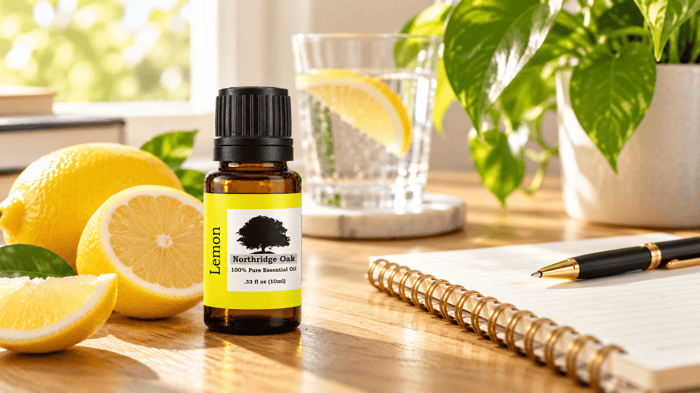
Place the diffuser, notebook, and Lemon oil together before the workday begins. Use the same blend only for focused blocks, and turn it off when the block ends. That boundary matters: it links the aroma to starting and completing a defined action rather than allowing it to become unnoticed background scent all day.
Safety and Sensitivity
Follow diffuser directions and ventilate. Use fewer drops around children, older adults, pets, and people with breathing sensitivity. Stop if coughing, wheezing, dizziness, nausea, or headache appears. Keep bottles inaccessible and do not ingest. Diffusion avoids leave-on skin phototoxicity, but any topical formula still requires dilution and UV precautions.
Create Your Own Bright Start
Begin with Lemon alone so you know its real character, then add one partner. Shop Northridge Oak Lemon Essential Oil and turn the aroma into a consistent cue for the work and routines that matter to you.
Lemon Essential Oil Learning Center
- Lemon Essential Oil Benefits, Uses, Research, Recipes & Safety
- How to Use Lemon Essential Oil: 15 Practical Uses
- Is Lemon Essential Oil Safe for Dogs?
- Relieving Headaches With Lemon Essential Oils
References
- Kiecolt-Glaser JK, et al. Olfactory influences on mood and autonomic, endocrine, and immune function. 2008. Read the full study.
- Ueda K, et al. Effects of inhaling essential oils on brain function associated with memory. 2023. Read the full study.
These statements have not been evaluated by the Food and Drug Administration. This product and the information in this article are not intended to diagnose, treat, cure, or prevent any disease. This content is for educational purposes only and is not a substitute for professional medical advice.